
 Afrika
 Asia
Asia Yuropa
 Amerika Borwa
 Australia le Oceania
 Antarctica
 Lewatle la Pacific
 Lewatle la Atlantic
 Lewatle la India
 Lewatle la Arctic
 Lewatle la Mediterranean
 Lewatle le Lefubedu
 Lewatle la Caribbean
 Lewatle la Coral
 Lewatle la China Borwa
 Lewatle la Philippine
 Lewatle la Andaman
 Lewatle la Leboya
 Lewatle la Timor le Arafura
 Kgwohlo ya Bengal
 Kgwohlo ya California
Mexican beaded lizard
 Ho loma
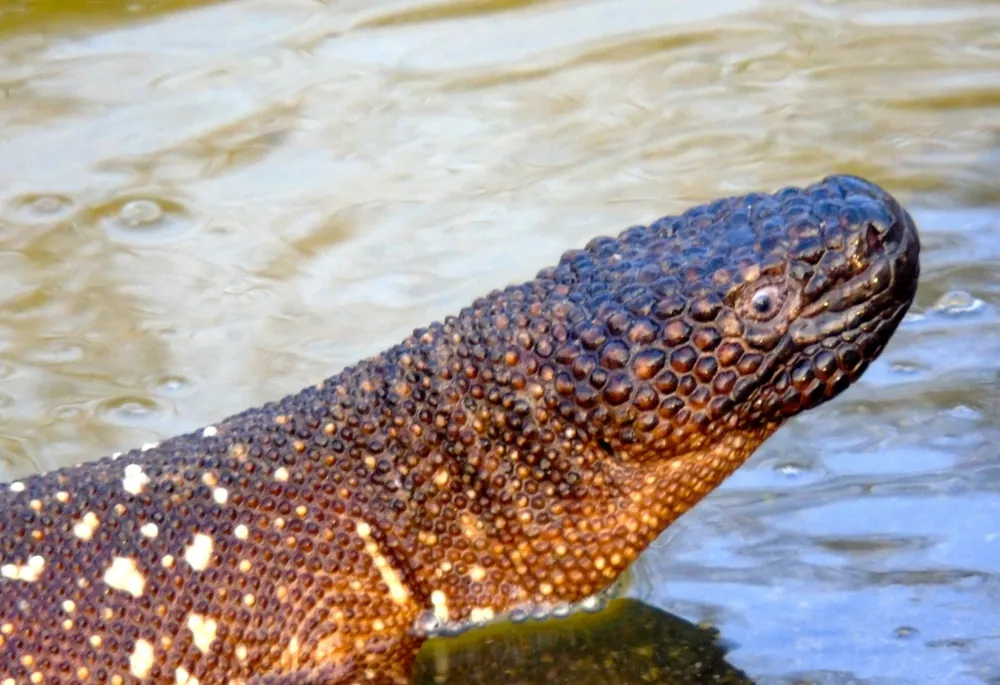
The Mexican beaded lizard is a venomous lizard found mainly in Mexico and southern Guatemala. It is one of only a few lizards known to have evolved a true venom delivery system. Its venom is also being studied for possible medicines.1



 Ho e tseba jwang
- Black with yellowish spots or bands.1
- Small, beadlike scales that do not overlap, which give it its name.1
- Stocky body with a broad head.1
- Short tail that stores fat, and does not regrow if broken.1
- Adults are 57 to 91 cm long.1
Hangata e ferekanngwa le: The Gila monster is its closest relative and looks similar. The Mexican beaded lizard is larger, and its colours are duller, black with yellowish bands.1
Matla a chefo
Chefo e tswa ka meno a yona a chefo (fangs) kapa ka meno a mang ha e loma.
Chefo ya yona (eo e e kenyang ka ho loma kapa ho hlaba) e etsang?
Its venom is a weak hemotoxin, meaning it attacks blood and tissue. It can cause respiratory failure, which is when breathing fails. In humans, bites cause severe pain that can spread well beyond the bite and last up to 24 hours, along with swelling, weakness, sweating and a rapid drop in blood pressure.1
E kotsi hakae ho batho?
Kotsi ho batho: E tebilengHo longwa ho hloka ngaka. Lefu le etsahala ka seoelo haholo.Human deaths from its bites are rare. Eight human bites were documented in the past century, and almost all happened when people prodded captive lizards with a finger or bare foot.1
 Haeba e loma
- Hlatswa leqeba, boloka motho a kgutsitse mme o fumane thuso ya bongaka.
Kamehla letsetsa nomoro ya tshohanyetso pele (112, 000, 911). Ena ke tataiso e akaretsang ya thuso ya pele, hase keletso ya bongaka. Metheo ya thuso ya pele
 Dula o bolokehile
- O se ke wa ama, wa tshwara kapa wa tena phoofolo ya naheng, leha e le e nyenyane, le leha e shebahala e robetse kapa e shwele.
- E fe sebaka. Ha o kopana le yona, dula o kgutsitse, kgutlela morao butle mme o e tlohele e tsamaye ka tsela ya yona.
- Haeba e nngwe e o loma: dula o kgutsitse, o se ke wa sisinyeha, letsetsa nomoro ya tshohanyetso (112, 000, 911) kapa o ye sepetlele kapele. Hopola hore e ne e shebahala jwang, foto e a thusa.
Ha e o batle. E sebedisa chefo ya yona ho tshwara dijo kapa ho itshireletsa, mme e kgetha ho ipata. Ho eketsehileng ka ho dula o bolokehile
Hokae lefatsheng?
E kgolo hakae?
E telele hakae?
E boima hakae?
 e telele jwaloka dikatse tsa lapeng tse 2 ho tloha nkong ho isa mohatleng
 e telele jwaloka dibanana tse 5 tse latellanange boima jwaloka katse ya lapeng
 e ka matha metara e 100 ka metsotswana e 140 (motho ya potlakang ka ho fetisisa o hloka 9,6)
Mexican beaded lizard e kgolo hakae ha e bapiswa le WENA?
Ke dipalo feela ka hara sebatli sa hao. Ha ho letho le bolokwang kapa le romelwang kae kapa kae.
E potlaka hakae?


Dintlha
It is one of only two venomous beaded lizard species, and the only lizards known to have evolved an overt venom delivery system, along with the rest of its genus.1
Some compounds in its venom are being studied for possible treatments of diabetes, Alzheimer's disease and HIV. One of them, exendin-3, is the basis of the drug exenatide.1
The beaded lizard is immune to the effects of its own venom.1
It is larger than the Gila monster, with an average adult weight of 800 g, and large specimens exceed 2,000 g.1
Beaded lizards have forked pink tongues that they use to smell, with the help of a Jacobson's organ.1
Young beaded lizards are rarely seen, as they are believed to spend much of their early lives underground.1
Ho senya ditshomo
Tshomo: The beaded lizard is more venomous than a rattlesnake, can cause lightning strikes with its tail, or can make a pregnant woman miscarry by looking at her.
Nnete: These beliefs are incorrect. Its venom is weak, and human deaths are rare.1
Bakeng sa ditsebi tsa chefo
- Lebitso la saense
- Heloderma horridum
- Sehlopha
- Mekgodutswane e nang le chefo
- Lelapa
- Helodermatidae2
- Tatelano
- Squamata
- Dikontinente
- Amerika Leboya
- Masea
- It lays clutches of 2 to 30 eggs in late summer or early fall, and the eggs hatch the following spring or summer.1
- Boemo ba yona naheng
- Threatened (Mexican law, category A). Listed on Appendix II of CITES.1
- Kotsi ho batho
- 3 / 5: E tebileng3
Moo dintlha di tswang teng
- Mexican beaded lizard (Wikipedia (CC BY-SA 4.0))
- Heloderma horridum (iNaturalist): mabitso le tlhophiso.
- Venom Wiki: boemo ba kotsi, boholo bo tlwaelehileng le kakanyo ya lebelo ke tsa rona. Bona kamoo re di balang ka teng: Kamoo re lekanyang kotsi ka teng.
Taba e nngwe le e nngwe leqepheng lena e na le nomoro e bontshang mohlodi wa yona. Haeba re entse phoso, re kopa tshwarelo, re barati ba diphoofolo, hase makasine wa saense. Re bolelle ho [email protected] mme re tla e lokisa.
 Phepheng e lapile! Venom Wiki ke projeke ya motho a le mong: ke mahala, ha e na dipapatso ebile ha e na di-tracker. Thuso e nyenyane ya tjhelete e e boloka e ntse e le inthaneteng.Fepa phepheng
Tse ding tsa sehlopha se le seng: Mekgodutswane e nang le chefo
 Gila monsterMekgodutswane e nang le chefoE hloka ngaka
 Chiapan beaded lizardMekgodutswane e nang le chefoE hloka ngaka
 Guatemalan beaded lizardMekgodutswane e nang le chefoE hloka ngaka
 Rio Fuerte beaded lizardMekgodutswane e nang le chefoE hloka ngaka
 Komodo dragonMekgodutswane e nang le chefoE ka bolaya
 Desert monitorMekgodutswane e nang le chefoE utlwisa bohloko feela
 Terciopelo
 Eastern coral snake
 Eastern diamondback rattlesnake
 Eyelash viper
 Timber rattlesnake
 Western diamondback rattlesnake