
 Afrika
 Asia
Asia Yuropa
 Amerika Borwa
 Australia le Oceania
 Antarctica
 Lewatle la Pacific
 Lewatle la Atlantic
 Lewatle la India
 Lewatle la Arctic
 Lewatle la Mediterranean
 Lewatle le Lefubedu
 Lewatle la Caribbean
 Lewatle la Coral
 Lewatle la China Borwa
 Lewatle la Philippine
 Lewatle la Andaman
 Lewatle la Leboya
 Lewatle la Timor le Arafura
 Kgwohlo ya Bengal
 Kgwohlo ya California
Mexican horned pitviper
 Ho loma
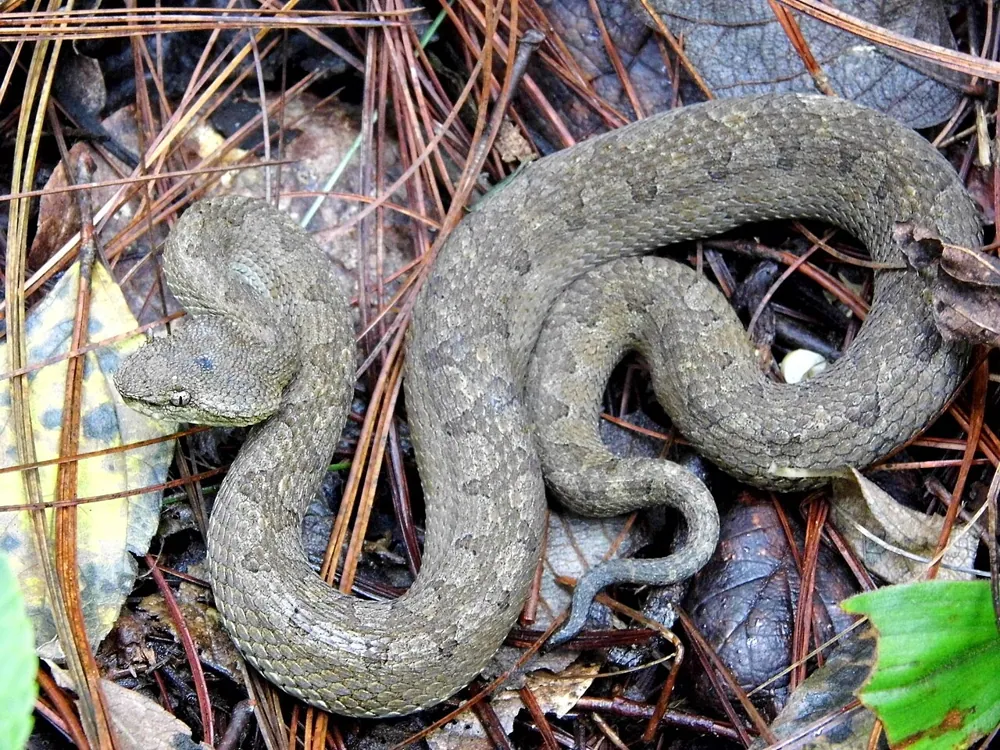
The Mexican horned pitviper is a venomous snake that lives in the mountains of central and southern Mexico. It has a pair of raised scales above its eyes that look like small horns, which is how it gets its name. It is listed as Vulnerable, which means it is at risk of dying out in the wild.1


 Ho e tseba jwang
- Adults grow to 55 to 70 centimetres long and are moderately stout.1
- A pair of elongated scales above the eyes forms 'horns' or 'spines'.1
- The body is silvery-grey with a row of black blotches that merge into a broad, wavy stripe down the back.1
- Black speckles appear on the sides of the body.1
- The top of the head is black.1
Matla a chefo
Chefo e tswa ka meno a yona a chefo (fangs) kapa ka meno a mang ha e loma.
E kotsi hakae ho batho?
Kotsi ho batho: E tebilengHo longwa ho hloka ngaka. Lefu le etsahala ka seoelo haholo. Haeba e loma
- Boloka motho a sa sisinyehe ebile a kgutsitse, boloka setho se lomilweng se lekana le bophahamo ba pelo, tlosa mesale le dintho tse tiileng, mme o mo ise sepetlele kapele.
Kamehla letsetsa nomoro ya tshohanyetso pele (112, 000, 911). Ena ke tataiso e akaretsang ya thuso ya pele, hase keletso ya bongaka. Metheo ya thuso ya pele
 Dula o bolokehile
- O se ke wa ama, wa tshwara kapa wa tena phoofolo ya naheng, leha e le e nyenyane, le leha e shebahala e robetse kapa e shwele.
- E fe sebaka. Ha o kopana le yona, dula o kgutsitse, kgutlela morao butle mme o e tlohele e tsamaye ka tsela ya yona.
- Haeba e nngwe e o loma: dula o kgutsitse, o se ke wa sisinyeha, letsetsa nomoro ya tshohanyetso (112, 000, 911) kapa o ye sepetlele kapele. Hopola hore e ne e shebahala jwang, foto e a thusa.
Ha e o batle. E sebedisa chefo ya yona ho tshwara dijo kapa ho itshireletsa, mme e kgetha ho ipata. Ho eketsehileng ka ho dula o bolokehile
Hokae lefatsheng?
E kgolo hakae?
E telele hakae?
 e telele jwaloka dibanana tse 4 tse latellanang
 e ka matha metara e 100 ka metsotswana e 110 (motho ya potlakang ka ho fetisisa o hloka 9,6)
Mexican horned pitviper e kgolo hakae ha e bapiswa le WENA?
Ke dipalo feela ka hara sebatli sa hao. Ha ho letho le bolokwang kapa le romelwang kae kapa kae.
E potlaka hakae?


Dintlha
It has raised scales above its eyes that look like horns.1
It is often found coiled in bushes and small trees, sometimes more than three metres off the ground.1
It is only active during the day, because night-time temperatures across its range are low.1
It gives birth to live young instead of laying eggs.1
Bakeng sa ditsebi tsa chefo
Moo dintlha di tswang teng
- Ophryacus undulatus (Wikipedia (CC BY-SA 4.0))
- Ophryacus undulatus (iNaturalist): mabitso le tlhophiso.
- Venom Wiki: boemo ba kotsi, boholo bo tlwaelehileng le kakanyo ya lebelo ke tsa rona. Bona kamoo re di balang ka teng: Kamoo re lekanyang kotsi ka teng.
Taba e nngwe le e nngwe leqepheng lena e na le nomoro e bontshang mohlodi wa yona. Haeba re entse phoso, re kopa tshwarelo, re barati ba diphoofolo, hase makasine wa saense. Re bolelle ho [email protected] mme re tla e lokisa.
 Phepheng e lapile! Venom Wiki ke projeke ya motho a le mong: ke mahala, ha e na dipapatso ebile ha e na di-tracker. Thuso e nyenyane ya tjhelete e e boloka e ntse e le inthaneteng.Fepa phepheng
 Terciopelo
 Eyelash viper
 Cottonmouth
 Eastern copperhead
 Cantil
 Central American bushmaster
 Eastern coral snake
 Eastern diamondback rattlesnake
 Timber rattlesnake
 Western diamondback rattlesnake
 Arizona bark scorpion
 Brown recluse