
 Afrika
 Asia
Asia Yuropa
 Amerika Borwa
 Australia le Oceania
 Antarctica
 Lewatle la Pacific
 Lewatle la Atlantic
 Lewatle la India
 Lewatle la Arctic
 Lewatle la Mediterranean
 Lewatle le Lefubedu
 Lewatle la Caribbean
 Lewatle la Coral
 Lewatle la China Borwa
 Lewatle la Philippine
 Lewatle la Andaman
 Lewatle la Leboya
 Lewatle la Timor le Arafura
 Kgwohlo ya Bengal
 Kgwohlo ya California
Panamanian golden frog
 Chefo letlalong la yona
The Panamanian golden frog is a bright yellow-gold toad that lives only in Panama. It sits on the mountain streams and cloud forests of the west-central part of the country. It is a national symbol, and it is also one of the most endangered amphibians in the world.1

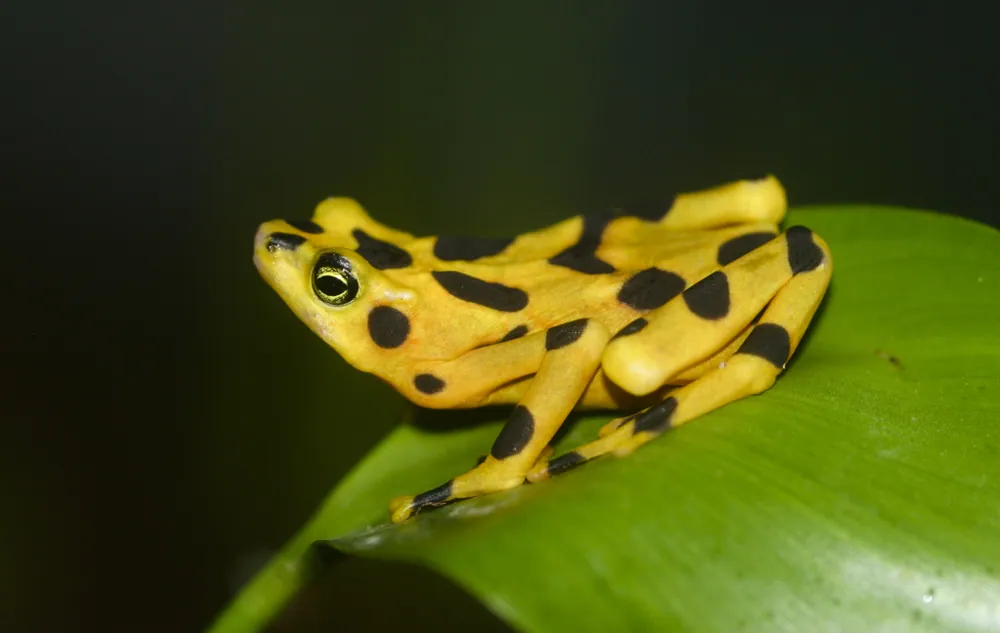
 Ho e tseba jwang
Matla a chefo
Letlalo la yona le a chefa. Ho kotsi ho e ama, ho e nyeka kapa ho e ja.
Chefo ya yona (e chefang ha o e ama kapa o e ja) e etsang?
It is poisonous rather than venomous, because its toxins work on contact with the skin and are not injected. The toxin is water-soluble and affects the nerve cells of anyone who touches it. Large doses can be fatal within 20 to 30 minutes, after convulsions that stop breathing and blood circulation.1
E kotsi hakae ho batho?
Kotsi ho batho: E tebilengHaeba motho a e ama kapa a e ja, eya ho ngaka. Lefu le etsahala ka seoelo haholo.Its toxin affects the nerve cells of anyone who comes into contact with it, and large doses can be fatal. Because it is critically endangered, the frog should be left alone in the wild.1
E etsang ha e tshohile?
When a predator approaches, it waves and lifts its foot to show its bright colours, which warn of its toxicity. If the predator keeps coming, the waving and calls increase in speed and volume.1
 Haeba motho a e amme kapa a e jele
- Haeba motho a amme e nngwe: hlatswa matsoho hantle mme o se ke wa ama mahlo kapa molomo. Haeba ngwana kapa phoofolo ya lapeng e e nyeditse kapa e e jele: letsetsa setsi sa chefo (poison centre) kapa nomoro ya tshohanyetso.
Kamehla letsetsa nomoro ya tshohanyetso pele (112, 000, 911). Ena ke tataiso e akaretsang ya thuso ya pele, hase keletso ya bongaka. Metheo ya thuso ya pele
 Dula o bolokehile
- O se ke wa ama, wa tshwara kapa wa tena phoofolo ya naheng, leha e le e nyenyane, le leha e shebahala e robetse kapa e shwele.
- E fe sebaka. Ha o kopana le yona, dula o kgutsitse, kgutlela morao butle mme o e tlohele e tsamaye ka tsela ya yona.
- Haeba o e amme kapa o e jele: o se ke wa hohla mahlo kapa molomo, hlatswa matsoho mme o fumane thuso ya bongaka.
Ha e o batle. Chefo ya yona e teng feela hore ho se be le letho le e jang. Ho eketsehileng ka ho dula o bolokehile
Hokae lefatsheng?
E kgolo hakae?
E telele hakae?
E boima hakae?

 e telele jwaloka diboloko tsa ho bapala tse 2 moleng
 e bobebe hoo o neng o ke ke wa e utlwa letsohong la hao
 e ka matha metara e 100 ka metsotswana e 90 (motho ya potlakang ka ho fetisisa o hloka 9,6)
Panamanian golden frog e kgolo hakae ha e bapiswa le WENA?
Ke dipalo feela ka hara sebatli sa hao. Ha ho letho le bolokwang kapa le romelwang kae kapa kae.
E potlaka hakae?


Dintlha
It is able to communicate by waving its feet, a bit like semaphore, as well as by sound.1
It is an 'earless' frog with no eardrums, yet it can still hear sounds and work out where they come from.1
Its toxins are powerful enough that some predators avoid it, though a few snakes can cope with its poison.1
Tadpoles have black and gold colouring, which helps protect them from the sun.1
It was filmed in the wild for the last time in 2006 for the BBC series Life in Cold Blood.1
Ho senya ditshomo
Tshomo: It is a frog.
Nnete: Despite its common name, it is a true toad, a member of the family Bufonidae.1
Bakeng sa ditsebi tsa chefo
- Lebitso la saense
- Atelopus zeteki
- Sehlopha
- Dihoho tse chefang, mampotsana le di-newt
- Lelapa
- Bufonidae2
- Tatelano
- Anura
- Dikontinente
- Amerika Leboya
- Masea
- Eggs are laid in shallow streams and hatch after 2 to 10 days. The tadpoles then take 6 to 7 months to grow.1
- Nako ya bophelo
- e ka bang dilemo tse 121
- Boemo ba yona naheng
- Critically Endangered (IUCN). It may have been extinct in the wild since 2007.1
- Kotsi ho batho
- 3 / 5: E tebileng3
Moo dintlha di tswang teng
- Panamanian golden frog (Wikipedia (CC BY-SA 4.0))
- Atelopus zeteki (iNaturalist): mabitso le tlhophiso.
- Venom Wiki: boemo ba kotsi, boholo bo tlwaelehileng le kakanyo ya lebelo ke tsa rona. Bona kamoo re di balang ka teng: Kamoo re lekanyang kotsi ka teng.
Taba e nngwe le e nngwe leqepheng lena e na le nomoro e bontshang mohlodi wa yona. Haeba re entse phoso, re kopa tshwarelo, re barati ba diphoofolo, hase makasine wa saense. Re bolelle ho [email protected] mme re tla e lokisa.
 Phepheng e lapile! Venom Wiki ke projeke ya motho a le mong: ke mahala, ha e na dipapatso ebile ha e na di-tracker. Thuso e nyenyane ya tjhelete e e boloka e ntse e le inthaneteng.Fepa phepheng
Tse ding tsa sehlopha se le seng: Dihoho tse chefang, mampotsana le di-newt
 Cane toadDihoho tse chefang, mampotsana le di-newtE hloka ngakaO se ke wa ama
 Strawberry poison-dart frogDihoho tse chefang, mampotsana le di-newtE utlwisa bohloko feelaO se ke wa ama
 California newtDihoho tse chefang, mampotsana le di-newtE ka bolayaO se ke wa ama
 Rough-skinned newtDihoho tse chefang, mampotsana le di-newtE ka bolayaO se ke wa ama
 Colorado River toadDihoho tse chefang, mampotsana le di-newtE hloka ngakaO se ke wa ama
 Eastern newtDihoho tse chefang, mampotsana le di-newtE utlwisa bohloko feelaO se ke wa ama
 Terciopelo
 Eastern coral snake
 Eastern diamondback rattlesnake
 Eyelash viper
 Timber rattlesnake
 Western diamondback rattlesnake