
 Afrika
 Asia
Asia Yuropa
 Amerika Borwa
 Australia le Oceania
 Antarctica
 Lewatle la Pacific
 Lewatle la Atlantic
 Lewatle la India
 Lewatle la Arctic
 Lewatle la Mediterranean
 Lewatle le Lefubedu
 Lewatle la Caribbean
 Lewatle la Coral
 Lewatle la China Borwa
 Lewatle la Philippine
 Lewatle la Andaman
 Lewatle la Leboya
 Lewatle la Timor le Arafura
 Kgwohlo ya Bengal
 Kgwohlo ya California
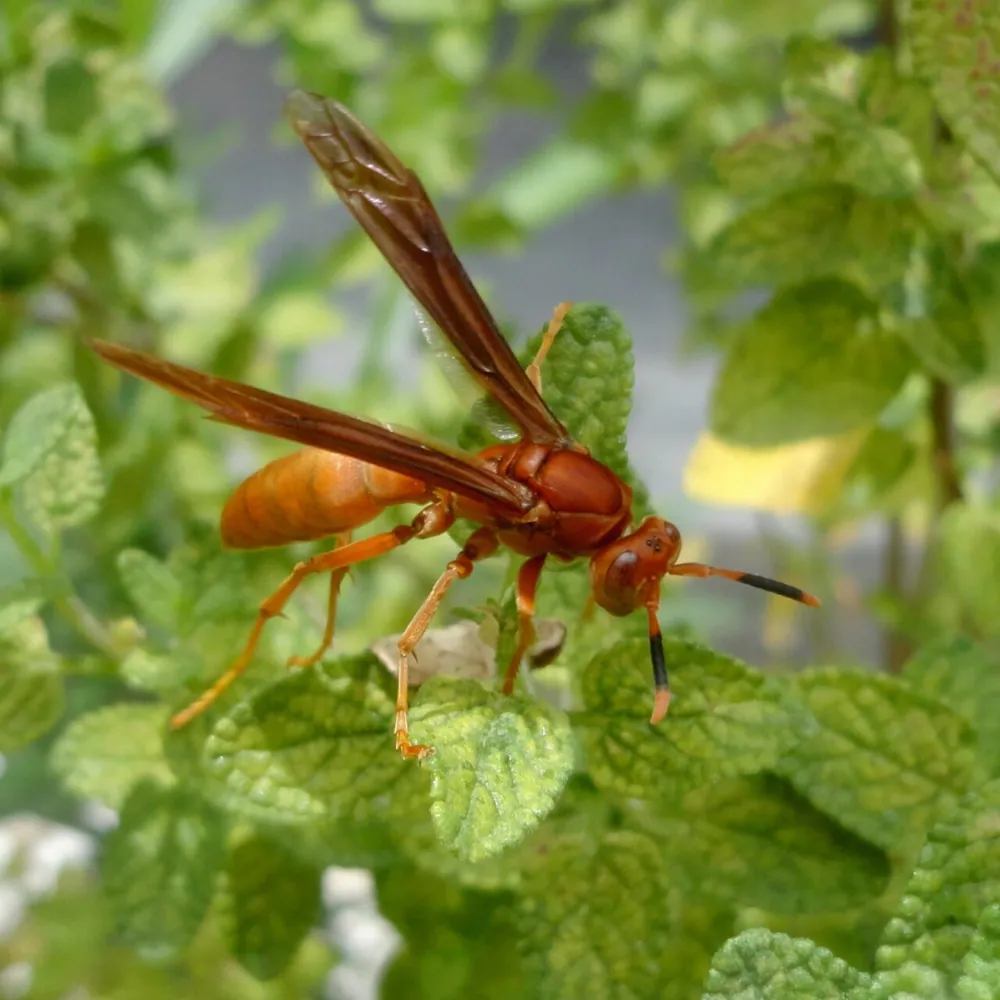
Red paper wasp
 Ho hlaba
The red paper wasp is a social wasp that builds papery nests from chewed plant fibres and saliva. It lives across much of the Neotropical region, from southern Arizona down to Argentina. Its colonies share work between many females, which makes it a useful example for scientists studying how social animals organise themselves.1


 Ho e tseba jwang
- Body is a uniform light to dark mahogany-brown, sometimes with a lighter head and thorax.1
- Some individuals have a yellow edge on the front of the first abdominal segment.1
- Wings are purplish black, with black or reddish-brown veins.1
- It is a large paper wasp, with wings 17.0 to 24.5 mm long.1
- Nests have open combs with hexagonal cells and no outer envelope.1
Matla a chefo
Chefo e tswa ka lemao le hlabang.
E kotsi hakae ho batho?
Kotsi ho batho: E bohlokoE ka utlwisa bohloko haholo, empa hoo e batlang e le kamehla ha e kotsi haholo. Haeba e hlaba
- Kgwaratla lemao la notshi o le ntshe mme o pholise sebaka seo.
- Haeba motho a hema ka thata, sefahleho kapa qoqotho di ruruha, kapa a ikutlwa a tla idibala, ke tshohanyetso ya aletjhi (allergy): letsetsa nomoro ya tshohanyetso mme o sebedise pene ya hae ya adrenaline (adrenaline auto-injector) haeba a na le yona.
Kamehla letsetsa nomoro ya tshohanyetso pele (112, 000, 911). Ena ke tataiso e akaretsang ya thuso ya pele, hase keletso ya bongaka. Metheo ya thuso ya pele
 Dula o bolokehile
- O se ke wa ama, wa tshwara kapa wa tena phoofolo ya naheng, leha e le e nyenyane, le leha e shebahala e robetse kapa e shwele.
- E fe sebaka. Ha o kopana le yona, dula o kgutsitse, kgutlela morao butle mme o e tlohele e tsamaye ka tsela ya yona.
- Haeba e nngwe e o hlaba: dula o kgutsitse, o se ke wa sisinyeha, letsetsa nomoro ya tshohanyetso (112, 000, 911) kapa o ye sepetlele kapele. Hopola hore e ne e shebahala jwang, foto e a thusa.
Ha e o batle. E sebedisa chefo ya yona ho tshwara dijo kapa ho itshireletsa, mme e kgetha ho ipata. Ho eketsehileng ka ho dula o bolokehile
Hokae lefatsheng?
E kgolo hakae?
E telele hakae?
 e telele jwaloka klipi ya pampiri
 e ka fofa ho tshela lebala lohle la bolo ya maoto ka metsotswana e 14
Red paper wasp e kgolo hakae ha e bapiswa le WENA?
Ke dipalo feela ka hara sebatli sa hao. Ha ho letho le bolokwang kapa le romelwang kae kapa kae.
E potlaka hakae?


Dintlha
A single queen dominates the other females, sometimes using physical attacks that can turn into fatal battles.1
Colonies build many combs, often around 38 in total, and move brood into new combs as old ones are abandoned. This is thought to protect the colony from moth infestations.1
Male wasps follow two mating tactics: some defend territories, while smaller males patrol from tree to tree and sneak matings when they can.1
Around 56% of females drift to nearby nests, which helps protect the colony against predators. An egg has a 40% chance of being eaten by a predator before it reaches adulthood.1
Colonies are founded or abandoned at any time of year, so their development is not tied to the seasons.1
Ho senya ditshomo
Tshomo: The species name canadensis shows that this wasp lives in Canada.
Nnete: Linnaeus was misinformed about where his specimen came from. In North America, this wasp only reaches as far north as southern Arizona.1
Bakeng sa ditsebi tsa chefo
Moo dintlha di tswang teng
- Polistes canadensis (Wikipedia (CC BY-SA 4.0))
- Polistes canadensis (iNaturalist): mabitso le tlhophiso.
- Venom Wiki: boemo ba kotsi, boholo bo tlwaelehileng le kakanyo ya lebelo ke tsa rona. Bona kamoo re di balang ka teng: Kamoo re lekanyang kotsi ka teng.
Taba e nngwe le e nngwe leqepheng lena e na le nomoro e bontshang mohlodi wa yona. Haeba re entse phoso, re kopa tshwarelo, re barati ba diphoofolo, hase makasine wa saense. Re bolelle ho [email protected] mme re tla e lokisa.
 Phepheng e lapile! Venom Wiki ke projeke ya motho a le mong: ke mahala, ha e na dipapatso ebile ha e na di-tracker. Thuso e nyenyane ya tjhelete e e boloka e ntse e le inthaneteng.Fepa phepheng
Tse ding tsa sehlopha se le seng: Dinotshi, di-wasp le di-hornet
 Tarantula hawkDinotshi, di-wasp le di-hornetE utlwisa bohloko feela
 Executioner waspDinotshi, di-wasp le di-hornetE hloka ngaka
 Warrior waspDinotshi, di-wasp le di-hornetE hloka ngaka
 Bald-faced hornetDinotshi, di-wasp le di-hornetE utlwisa bohloko feela
 Cow killer velvet antDinotshi, di-wasp le di-hornetE utlwisa bohloko feela
 Eastern cicada killerDinotshi, di-wasp le di-hornetHa e na kotsi
 Terciopelo
 Eastern coral snake
 Eastern diamondback rattlesnake
 Eyelash viper
 Timber rattlesnake
 Western diamondback rattlesnake