
 Afrika
 Asia
Asia Ulaya
Ulaya Amerika Kusini
 Australia na Oceania
 Antaktika
 Bahari ya Pasifiki
 Bahari ya Atlantiki
 Bahari ya Hindi
 Bahari ya Aktiki
 Bahari ya Mediterania
 Bahari ya Shamu
 Bahari ya Karibi
 Bahari ya Matumbawe
 Bahari ya Kusini ya China
 Bahari ya Ufilipino
 Bahari ya Andaman
 Bahari ya Kaskazini
 Bahari ya Timor na Arafura
 Ghuba ya Bengal
 Ghuba ya California
Brown-tail moth
 Manyoya yanayowasha
The brown-tail moth is a moth whose caterpillars are covered in tiny irritating hairs. It is native to Europe, neighbouring parts of Asia and the north coast of Africa. Its hairs can cause a very itchy rash, so it matters to anyone who works or plays near trees it feeds on.1

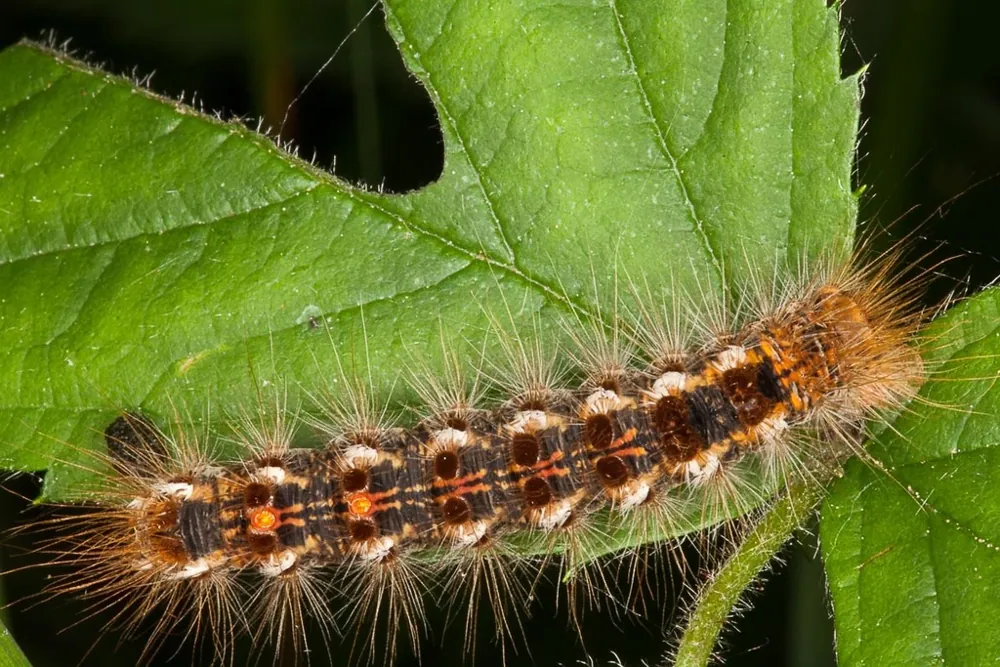
 Jinsi ya kumtambua
- Adults have pure white upper wings and a hairy white body with a tuft of brown hair at the tip of the tail end.1
- Adults have a wingspan of 36 to 42 millimetres.1
- Caterpillars are very hairy, brown with white markings, and have two prominent red spots toward the tail end.1
- In late autumn and winter, silken tents hang on branch tips, which are a sign that the caterpillars are present.1
Mara nyingi huchanganywa na: Euproctis similis, also native to Europe, is similar as an adult but the female has a yellow tail tuft. Hyphantria cunea, native to North America, is similar too, but it lacks the coloured tail tuft.1
Nguvu ya sumu
Manyoya madogo au vinywele hukatika ndani ya ngozi na kuwasha.
Sumu yake hufanya nini?
The hairs are not venom injected by a bite or sting. They are toxic and irritating to skin. Barbed hairs lodge in the skin and cause physical irritation, and chemicals in the hairs also irritate it. If inhaled, the hairs can cause breathing difficulties similar to asthma. The toxins stay active for up to three years after the hairs are shed.1
Ana hatari gani kwa watu?
Hatari kwa watu: InaumaInaweza kuuma sana, lakini karibu kamwe si jambo zito.Contact with the hairs causes a very itchy rash that can last for weeks. Doctors reported rashes worse than poison ivy rash in the early 1900s. Breathing difficulties can occur if the hairs are inhaled.1
Hufanya nini akiogopa?
Its hairs protect the caterpillars from predators, and the caterpillars use some hairs in their cocoons.1
 Ukigusa manyoya yake
- Kwa manyoya ya kiwavi yanayowasha: yaondoe kwa utepe unaonata, kisha osha ngozi. Usisugue.
- Kwa kuumwa: osha na upoze. Tafuta msaada wa kitabibu mtu akijisikia vibaya au akivuja damu kwa urahisi.
Daima piga namba ya dharura kwanza (112, 000, 911). Huu ni mwongozo wa jumla wa huduma ya kwanza, si ushauri wa kitabibu. Misingi ya huduma ya kwanza
 Kaa salama
- Kamwe usimguse, kumkamata wala kumchokoza mnyama wa porini, hata akiwa mdogo, na hata akionekana amelala au amekufa.
- Mpe nafasi. Ukikutana naye, tulia, rudi nyuma polepole na umwache aende zake.
- Ukigusa manyoya yake: tulia, usitikisike, piga namba yako ya dharura (112, 000, 911) au nenda hospitali haraka. Kumbuka alivyoonekana, picha husaidia.
Hakuwindi wewe. Hutumia sumu yake kukamata chakula au kujilinda, na hupendelea zaidi kujificha. Zaidi kuhusu kukaa salama
Ana ukubwa gani?
Ana urefu gani?
 mfupi kuliko kidole chako kidogo
 polepole kuliko konokono wa bustanini
Brown-tail moth ana ukubwa gani ukilinganisha na WEWE?
Ni hesabu tu kwenye kivinjari chako. Hakuna kinachohifadhiwa wala kutumwa popote.
Ana kasi gani?

Ukweli
The hairs of the caterpillars can cause a rash even when no one touches a caterpillar, because shed hairs can blow in the wind.1
Brown-tail moths were described in outbreaks in Paris, London and Berlin as far back as the 1500s, when they stripped trees of leaves.1
The species spends about nine months of its year as caterpillars, which is unusually long for a moth.1
Caterpillars spend the winter together in silken tents built at branch tips, rather than spreading out.1
A parasitic fly introduced to North America in 1906 to control spongy moths also strongly affected brown-tail moths.1
Kuvunja dhana potofu
Dhana potofu: You can only get the rash by touching the caterpillars.
Ukweli: Hairs are shed and can become windblown, and they can be carried indoors on clothing and shoes, so a rash can occur without direct contact with the caterpillars.1
Ukweli unatoka wapi
- Brown-tail moth (Wikipedia (CC BY-SA 4.0))
- Euproctis chrysorrhoea (iNaturalist): majina na uainishaji.
- Venom Wiki: kiwango cha hatari, ukubwa wa kawaida na makadirio ya kasi ni yetu wenyewe. Ona jinsi tunavyovipata: Jinsi tunavyopima hatari.
Kila ukweli kwenye ukurasa huu una namba inayoonyesha chanzo chake. Kama tumekosea kitu, samahani, sisi ni wapenzi wa wanyama, si jarida la kisayansi. Tuambie kupitia [email protected] nasi tutarekebisha.
 Nge ana njaa! Venom Wiki ni mradi wa mtu mmoja: bure, bila matangazo na bila vifuatiliaji. Mchango mdogo husaidia kuiweka hewani.Mlishe nge
Zaidi kutoka kundi hilohilo: Viwavi na wadudu
 Oak processionary
 Pine processionary
 Common bombardier beetle
 Asian giant water bug
 Blue-striped nettle grub
 Masked hunter
Pia anaishi: Ulaya
 Common European adderNyoka aina ya fira na kifutuAnahitaji daktari
 Spanish flyWanyama wengine wenye sumu ya kugusa au kulaAnahitaji daktariUsiguse
 Common waspNyuki, nyigu na mavuInauma tu
 European hornetNyuki, nyigu na mavuInauma tu
 Fire salamanderVyura wa sumu, chura na mijusi-majiInauma tuUsiguse
 Western honey beeNyuki, nyigu na mavuInauma tu