
 Aprika
 Asya
Asya Europa
 Timog Amerika
 Australia at Oceania
 Antarctica
 Karagatang Pasipiko
 Karagatang Atlantiko
 Karagatang Indiyano
 Karagatang Artiko
 Dagat Mediteraneo
 Dagat Pula
 Dagat Caribe
 Dagat Coral
 Dagat Timog Tsina
 Dagat Pilipinas
 Dagat Andaman
 Dagat Hilaga
 Dagat Timor at Arafura
 Look ng Bengal
 Golpo ng California
Cow killer velvet ant
 Mga tusok
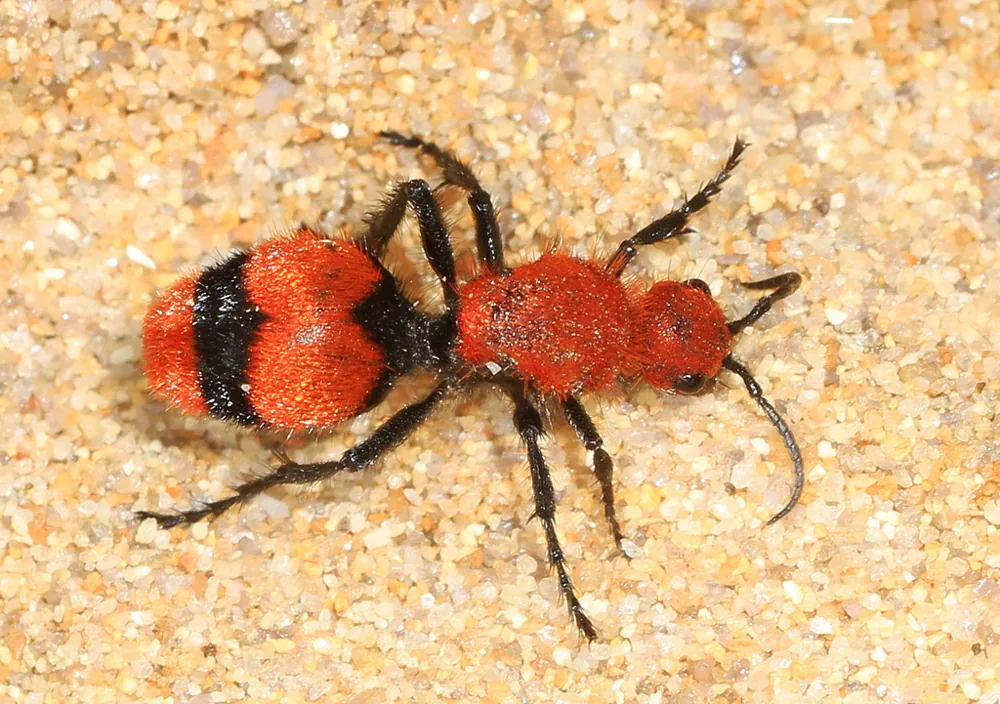
The cow killer velvet ant is a wasp that looks like a black and red ant. It lives in the eastern United States, from Connecticut and Kansas in the north to Florida and Texas in the south. It is known for a sting so painful that it earned the nickname cow killer.1

 Paano ito makikilala
- Black overall, with bright red on the upper side of the head, thorax and abdomen.1
- Females have no wings. Males have dark, translucent wings and no stinger.1
- Adults reach about 1.9 cm long, the largest velvet ant in the eastern United States.1
- Quick-moving, and often takes a defensive posture when threatened.1
- Adults are mostly seen in the summer months.1
Madalas mapagkamalang: It is often mistaken for an ant because of its appearance and its common name. It is actually a wasp, and only the males have wings.1
Lakas ng kamandag
Lumalabas ang kamandag sa pamamagitan ng pantusok.
Ano ang epekto ng kamandag nito?
Its sting is among the most painful of any insect, ranked 3 out of 4 on the Schmidt sting pain index. The venom contains a peptide called Do6a, which triggers a pain response in fruit fly larvae in laboratory studies.1
Gaano ito kapanganib sa tao?
Panganib sa tao: MasakitTalagang masakit, pero halos hindi kailanman malala.The sting is extremely painful, ranked 3 out of 4 on the Schmidt sting pain index. This is the reason for the nickname cow killer.1
Ano ang ginagawa nito kapag natatakot?
It has a thickened exoskeleton, runs fast and evasively, shows warning colours, makes a squeaking sound by rubbing its abdominal segments together, releases a chemical secretion and uses its venom.1
 Kung tumusok ito
- Kayurin palabas ang naiwang pantusok ng bubuyog at palamigin ang lugar.
- Kung nahihirapang huminga ang tao, namamaga ang mukha o lalamunan, o parang hihimatayin, ito ay emergency sa allergy: tawagan ang numero pang-emergency at gamitin ang adrenaline pen niya kung mayroon siya.
Laging tawagan muna ang numero pang-emergency (112, 000, 911). Ito ay pangkalahatang gabay sa pangunang lunas, hindi payong medikal. Mga batayan ng pangunang lunas
 Mag-ingat
- Huwag kailanman hawakan, hulihin o asarin ang ligaw na hayop, kahit maliit, at kahit mukha itong tulog o patay.
- Bigyan ito ng espasyo. Kung makasalubong ka ng isa, manatiling kalmado, dahan-dahang umatras at hayaan itong umalis.
- Kung tusukin ka ng isa: manatiling kalmado, huwag gumalaw, tawagan ang numero pang-emergency (112, 000, 911) o pumunta agad sa ospital. Tandaan ang itsura nito, makakatulong ang litrato.
Hindi ka nito hinahabol. Ginagamit nito ang kamandag para manghuli ng pagkain o ipagtanggol ang sarili, at mas gusto pa nitong magtago. Higit pa tungkol sa pag-iingat
Gaano ito kalaki?
Gaano ito kahaba?
 mas maikli kaysa sa hinliliit mo
Gaano kalaki si Cow killer velvet ant kumpara sa IYO?
Math lang sa browser mo. Walang sine-save o ipinapadala kahit saan.
Gaano ito kabilis?


Mga fact
Both sexes squeak to warn predators. Velvet ants rub their abdominal segments together, while crickets rub their legs against their abdomen.1
North American velvet ant species form one of the most intricate mimicry rings in the natural world, split into eight separate rings of mimicry.1
Males find females by smelling pheromones and by following their squeaking sounds. They carry the female in their jaws to a shaded, safe spot to mate.1
Females are wingless, a feature shared by all females in the family Mutillidae.1
Females are believed to mate only once in their lifetime.1
Myth buster
Mito: It is an ant because it looks like one and has the name ant.
Totoo: It is a parasitoid wasp. It is only commonly mistaken for an ant.1
Para sa mga eksperto sa kamandag
- Pangalang siyentipiko
- Dasymutilla occidentalis
- Grupo
- Mga bubuyog, putakti at hornet
- Pamilya
- Mutillidae2
- Ayos
- Hymenoptera
- Mga kontinente
- Hilagang Amerika
- Mga sanggol
- A female lays a single egg onto a host larva, such as one of the eastern cicada killer or horse guard wasp, and the grub that hatches eats the host larva.1
- Panganib sa tao
- 2 / 5: Masakit3
Saan galing ang mga fact
- Dasymutilla occidentalis (Wikipedia (CC BY-SA 4.0))
- Dasymutilla occidentalis (iNaturalist): mga pangalan at klasipikasyon.
- Venom Wiki: sarili naming tantiya ang antas ng panganib, karaniwang laki at hula sa bilis. Tingnan kung paano namin ito kinukuwenta: Paano namin sinusukat ang panganib.
Bawat fact sa pahinang ito ay may numerong tumuturo sa pinagmulan nito. Kung may mali kami, pasensya na, mahilig lang kami sa hayop, hindi kami science journal. Sabihin sa amin sa [email protected] at aayusin namin.
 Gutom ang alakdan! Ang Venom Wiki ay proyekto ng iisang tao: libre, walang ads at walang trackers. Nakatutulong ang maliit na tip para manatili itong online.Pakainin ang alakdan
Higit pa mula sa parehong grupo: Mga bubuyog, putakti at hornet
 Tarantula hawkMga bubuyog, putakti at hornetMasakit lang
 Executioner waspMga bubuyog, putakti at hornetKailangan ng doktor
 Warrior waspMga bubuyog, putakti at hornetKailangan ng doktor
 Bald-faced hornetMga bubuyog, putakti at hornetMasakit lang
 Eastern cicada killerMga bubuyog, putakti at hornetHindi nakapipinsala
 Aerial yellowjacketMga bubuyog, putakti at hornetMasakit lang
 Terciopelo
 Eastern coral snake
 Eastern diamondback rattlesnake
 Eyelash viper
 Timber rattlesnake
 Western diamondback rattlesnake