
 Aprika
 Asya
Asya Europa
 Timog Amerika
 Australia at Oceania
 Antarctica
 Karagatang Pasipiko
 Karagatang Atlantiko
 Karagatang Indiyano
 Karagatang Artiko
 Dagat Mediteraneo
 Dagat Pula
 Dagat Caribe
 Dagat Coral
 Dagat Timog Tsina
 Dagat Pilipinas
 Dagat Andaman
 Dagat Hilaga
 Dagat Timor at Arafura
 Look ng Bengal
 Golpo ng California
Spotted jelly
 Nanunusok na galamay
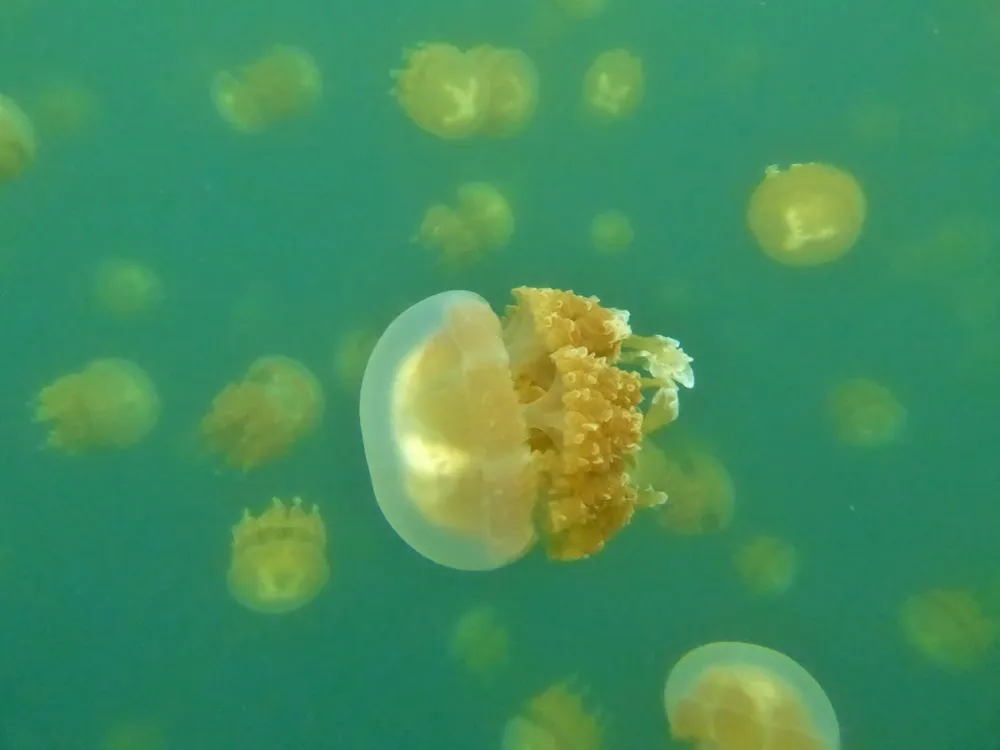
The spotted jelly is a jellyfish with spots on the top of its bell, the rounded body. It lives in the warm Indo-Pacific oceans, and in some saltwater lakes in Palau and Indonesia. Its lake populations are famous because they have lost most of their sting.1


 Paano ito makikilala
- Distinctive spots on the top of the bell1
- Colour ranges from greenish blue to olive green, from the algae living in its tissues1
- Eight rhopalia (sensory organs) along the edge of the bell1
- Eight frilled oral arms, each ending in a club-like appendage1
- Numerous small mouths along the bottom of the oral arms, unlike many other jellies1
Lakas ng kamandag
Libu-libong maliliit na selulang pantusok ang pumuputok kapag may humawak sa kanila.
Ano ang epekto ng kamandag nito?
The venom is protein-based and is delivered by stinging cells called nematocytes (cnidocytes) on the upper surfaces of the oral arms. In jellyfish living in marine lakes, conditions in the lake are thought to break down this venom, so those populations do not sting humans.1
Gaano ito kapanganib sa tao?
Panganib sa tao: BanayadParang kagat ng bubuyog o mas mahina. Halos hindi nakapipinsala sa tao.Jellyfish in the open ocean have stinging cells on their oral arms. Populations in marine lakes, such as Jellyfish Lake in Palau, do not sting humans.1
 Kung tumusok ito
- Umahon sa tubig at tanggalin ang anumang galamay (gamit ang guwantes o tela).
- Para sa tropikal na box jellyfish: buhusan ng suka ang mga tusok nang hindi bababa sa 30 segundo, tumawag ng tulong at maging handang mag-CPR. Para sa bluebottle at karamihan sa iba: banlawan ng tubig-dagat, pagkatapos ay mainit na tubig para sa sakit.
Laging tawagan muna ang numero pang-emergency (112, 000, 911). Ito ay pangkalahatang gabay sa pangunang lunas, hindi payong medikal. Mga batayan ng pangunang lunas
 Mag-ingat
- Huwag kailanman hawakan, hulihin o asarin ang ligaw na hayop, kahit maliit, at kahit mukha itong tulog o patay.
- Bigyan ito ng espasyo. Kung makasalubong ka ng isa, manatiling kalmado, dahan-dahang umatras at hayaan itong umalis.
- Kung tusukin ka ng isa: manatiling kalmado, huwag gumalaw, tawagan ang numero pang-emergency (112, 000, 911) o pumunta agad sa ospital. Tandaan ang itsura nito, makakatulong ang litrato.
Hindi ka nito hinahabol. Ginagamit nito ang kamandag para manghuli ng pagkain o ipagtanggol ang sarili, at mas gusto pa nitong magtago. Higit pa tungkol sa pag-iingat
Saan sa mundo?
Gaano ito kalaki?
Gaano ito kahaba?
 kasinghaba ng 9 laruang building brick na magkakasunod
Gaano kalaki si Spotted jelly kumpara sa IYO?
Math lang sa browser mo. Walang sine-save o ipinapadala kahit saan.
Gaano ito kabilis?


Mga fact
Lake populations of spotted jellies have lost most of their ability to sting, probably after being cut off in marine lakes long ago.1
Each day, spotted jellies rise to the surface and follow the sun from east to west, so their algae can photosynthesise.1
Lake jellyfish are over three times wider than ocean ones, yet their tentacles are about the same length.1
Unlike many jellies, spotted jellies have several small mouths along their oral arms.1
A sea anemone called Entacmaea medusivora preys on spotted jellies, catching them in its tentacles.1
At night they stay lower in the water column.1
Myth buster
Mito: All spotted jellies sting people.
Totoo: Ocean populations have stinging cells, but the jellyfish in marine lakes such as Jellyfish Lake in Palau do not sting humans.1
Saan galing ang mga fact
- Spotted jelly (Wikipedia (CC BY-SA 4.0))
- Mastigias papua (iNaturalist): mga pangalan at klasipikasyon.
- Venom Wiki: sarili naming tantiya ang antas ng panganib, karaniwang laki at hula sa bilis. Tingnan kung paano namin ito kinukuwenta: Paano namin sinusukat ang panganib.
Bawat fact sa pahinang ito ay may numerong tumuturo sa pinagmulan nito. Kung may mali kami, pasensya na, mahilig lang kami sa hayop, hindi kami science journal. Sabihin sa amin sa [email protected] at aayusin namin.
 Gutom ang alakdan! Ang Venom Wiki ay proyekto ng iisang tao: libre, walang ads at walang trackers. Nakatutulong ang maliit na tip para manatili itong online.Pakainin ang alakdan
Higit pa mula sa parehong grupo: Mga dikya at nanunusok sa dagat
 Australian box jellyfishMga dikya at nanunusok sa dagatNakamamatayHuwag hawakan
 Irukandji jellyfishMga dikya at nanunusok sa dagatPuwedeng pumatayHuwag hawakan
 Portuguese man o' warMga dikya at nanunusok sa dagatKailangan ng doktorHuwag hawakan
 Lion's mane jellyfishMga dikya at nanunusok sa dagatMasakit langHuwag hawakan
 Moon jellyfishMga dikya at nanunusok sa dagatHindi nakapipinsala
 Common kingslayerMga dikya at nanunusok sa dagatPuwedeng pumatayHuwag hawakan
Nakatira rin sa: Karagatang Pasipiko
 Geography cone snailMga cone snail at pugitaNakamamatay
 Malaking blue-ringed octopusMga cone snail at pugitaNakamamatay
 Butete ng HaponIba pang nakalalasong hayopNakamamatay
 Katimugang blue-ringed octopusMga cone snail at pugitaNakamamatay
 Hawksbill sea turtleIba pang nakalalasong hayopPuwedeng pumatay
 Reef stonefishMga makamandag na isdaPuwedeng pumatayHuwag hawakan