
 Aforika
 Asia
Asia Yuropa
 Amerika Borwa
 Australia le Oceania
 Antarctica
 Lewatle la Pacific
 Lewatle la Atlantic
 Lewatle la India
 Lewatle la Arctic
 Lewatle la Mediterranean
 Lewatle le Lehibidu
 Lewatle la Caribbean
 Lewatle la Coral
 Lewatle la China Borwa
 Lewatle la Philippines
 Lewatle la Andaman
 Lewatle la Bokone
 Lewatle la Timor le la Arafura
 Kou ya Bengal
 Gulf ya California
Anchieta's cobra
 Go loma
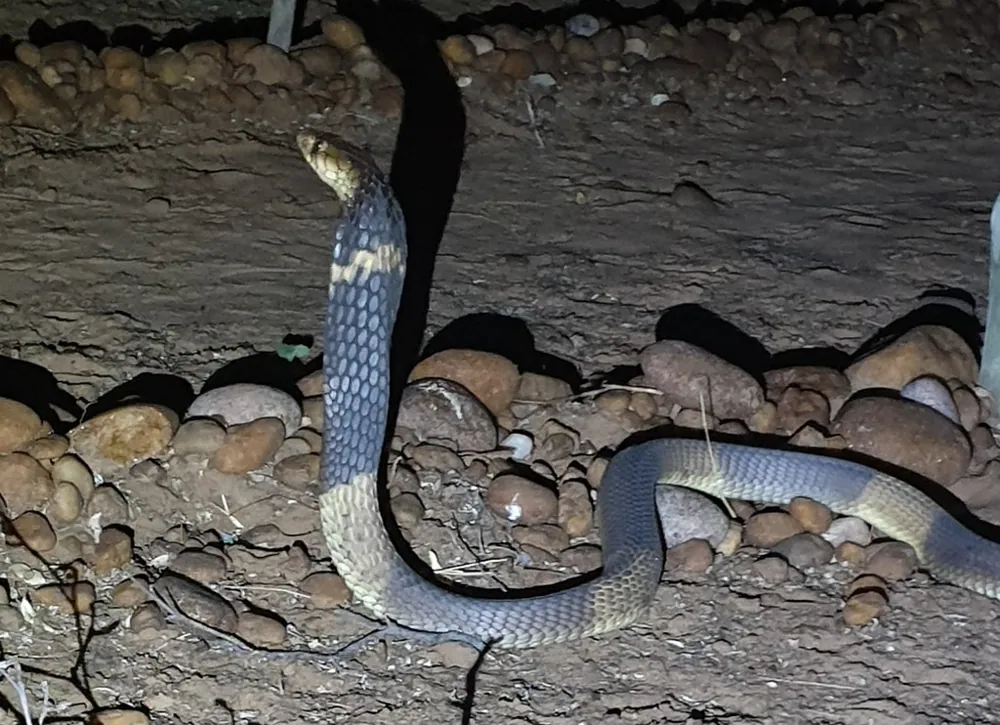
Anchieta's cobra is a venomous snake that lives in parts of southwestern Africa. It is a ground-dwelling cobra that spreads a broad hood when threatened. It is active at night and often comes close to human homes and farmyards.1



 Tsela ya go e lemoga
- Young snakes are yellowish to light brown, with a black band circling the neck.1
- As it grows, it becomes a darker brown and the neck band fades away.1
- The throat band, which covers the front belly scales, is blue-black.1
- When threatened, it spreads a large, impressive hood about 10 to 12 cm wide.1
- In the southernmost parts of its range, some snakes are black with yellow bands across the body and tail.1
Gantsi e tlhakanngwa le: The snouted cobra is very similar in shape, size and habits. The Anchieta's cobra is more inclined to stand its ground when confronted by a threat.1
Maatla a botlhole
Botlhole bo tswa ka meno a yone fa e loma.
Botlhole jo e bo tsenyang bo dira eng?
Its venom is mainly a potent neurotoxin, which attacks the nerves. It may also contain cardiotoxic components, which harm the heart. Because it has moderately large size and relatively large fangs, it can inject a large volume of venom in a single bite.1
E kotsi go le kae go batho?
Kotsi go batho: E kotsi thataE ka bolaya motho yo o sa alafiweng.Bites are rare, but they have been known to cause human deaths.1
E dira eng fa e tshogile?
When provoked it lifts its front body off the ground, spreads its hood and takes a defensive posture, but it will flee if it gets the chance, and it sometimes feigns death.1
 Fa e loma
- Dira gore motho a nne a sa tshikinyege a ritibetse, tlosa direng le dilo tse di tiileng, mme o mo ise bookelong ka bonako: antivenom ke yone kalafi.
Ka gale leletsa nomoro ya gago ya tshoganyetso pele (112, 000, 911). Se ke kaelo e e akaretsang ya thuso ya ntlha, ga se kgakololo ya bongaka. Motheo wa thuso ya ntlha
 Nna o babalesegile
- O se ka wa ama, wa tshwara kgotsa wa tshwenya phologolo ya naga, le fa e le e nnye, le fa e lebega e robetse kgotsa e sule.
- E fe sebaka. Fa o kopana le yone, ritibala, boela morago ka bonya mme o e tlogele e tsamaye ka tsela ya yone.
- Fa e nngwe e go loma: ritibala, o se ka wa tshikinyega, leletsa nomoro ya gago ya tshoganyetso (112, 000, 911) kgotsa o ye bookelong ka bonako. Gopola gore e ne e lebega jang, setshwantsho se a thusa.
Ga e go batle. E dirisa botlhole jwa yone go tshwara dijo kgotsa go itshireletsa, mme e rata go iphitlha go feta. Go le gontsi ka go nna o babalesegile
Kae mo lefatsheng?
E kgolo go le kae?
E telele go le kae?
 boleele jo bo lekanang le dikatse tsa ntlo di le 5 go tloga kwa nkong go ya mogatleng
 boleele jo bo lekanang le dipanana di le 13 di latelana
 e ka taboga dimetara di le 100 ka metsotswana e le 46 (motho yo o bonako go gaisa o tlhoka 9,6)
Anchieta's cobra e kgolo go le kae fa e bapisiwa le WENA?
Ke dipalo fela mo sefetleng sa gago (browser). Ga go sepe se se bolokwang kgotsa se se romelwang gope.
E bonako go le kae?


Dintlha
The longest recorded male was 2.31 metres long and was caught in Windhoek, Namibia.1
It is hunted by birds of prey such as secretary birds and snake eagles, and by honey badgers and white-throated monitors.1
Males and females grow to similar sizes, although males usually have larger heads and longer tails.1
A banded form has been noted in roughly 13% of males and up to 22% of females.1
Ya baitseanape ba botlhole
Kwa dintlha di tswang teng
- Anchieta's cobra (Wikipedia (CC BY-SA 4.0))
- Naja anchietae (iNaturalist): maina le thulaganyo ya mefuta.
- Venom Wiki: seelo sa kotsi, bogolo jo bo tlwaelegileng le kakanyo ya lebelo ke tsa rona. Bona kafa re di balang ka teng: Kafa re lekanyang kotsi ka teng.
Ntlha nngwe le nngwe mo tsebeng e e na le nomoro e e supang motswedi wa yone. Fa re dirile phoso, maitshwarelo, re barati ba diphologolo, e seng kgatiso ya saense. Re bolelele kwa [email protected] mme re tla e baakanya.
 Phepheng e tshwerwe ke tlala! Venom Wiki ke porojeke ya motho a le mongwe: ke mahala, ga e na dipapatso le ditraka. Mpho e nnye e thusa go e tshegetsa mo inthaneteng.Fepa phepheng
Tse dingwe tsa setlhopha se se tshwanang: Dikobra, dimamba le dikrait
 Black mambaDikobra, dimamba le dikraitE a bolaya
 Egyptian cobraDikobra, dimamba le dikraitE a bolaya
 Cape cobraDikobra, dimamba le dikraitE a bolaya
 Eastern green mambaDikobra, dimamba le dikraitE a bolaya
 Jameson's mambaDikobra, dimamba le dikraitE a bolaya
 Western green mambaDikobra, dimamba le dikraitE a bolaya
 Deathstalker
 Puff adder
 Boomslang
 Fat-tailed scorpion
 Gaboon viper
 Western honey bee