
 Aforika
 Asia
Asia Yuropa
 Amerika Borwa
 Australia le Oceania
 Antarctica
 Lewatle la Pacific
 Lewatle la Atlantic
 Lewatle la India
 Lewatle la Arctic
 Lewatle la Mediterranean
 Lewatle le Lehibidu
 Lewatle la Caribbean
 Lewatle la Coral
 Lewatle la China Borwa
 Lewatle la Philippines
 Lewatle la Andaman
 Lewatle la Bokone
 Lewatle la Timor le la Arafura
 Kou ya Bengal
 Gulf ya California
Arizona black rattlesnake
 Go loma
The Arizona black rattlesnake is a venomous pit viper, a type of snake that senses heat with pits between its eyes and nostrils. It lives in the southwestern United States, mostly in the mountains of Arizona. It is special because scientists have observed it showing complex social behaviour, and its mothers care for their babies.1



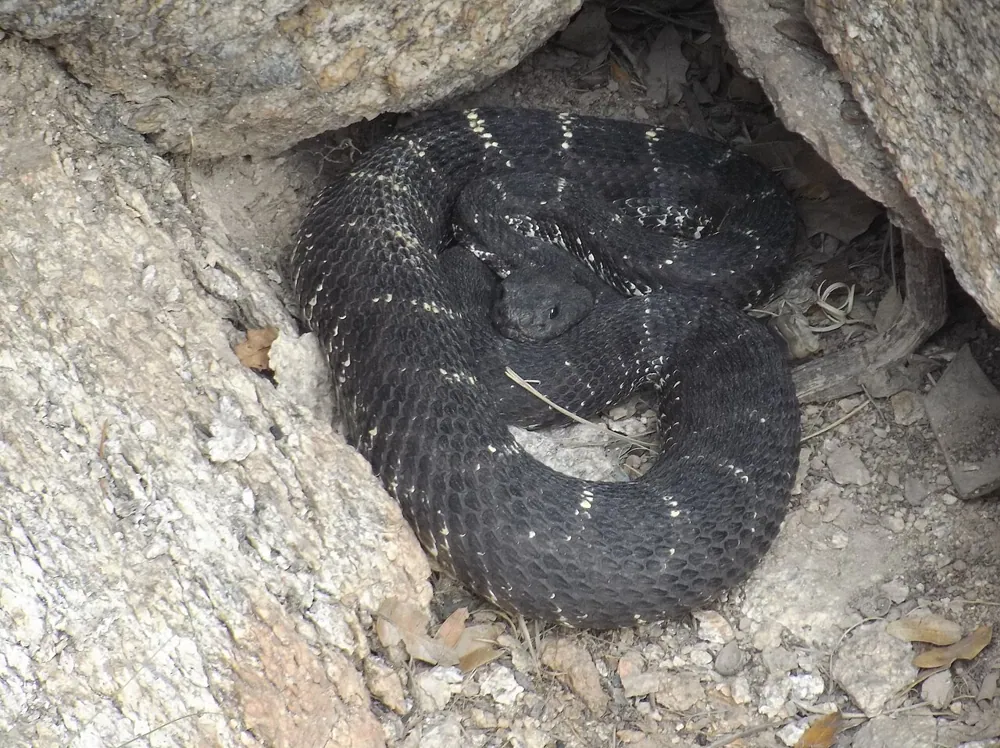
 Tsela ya go e lemoga
- Ground colour is dark grey, brownish black, reddish brown or blackish.1
- Dark blotches run along the back, becoming crossbands just before the tail.1
- Some individuals are a uniform dark colour with no clear pattern.1
- Some have dark blotches bordered with white, cream or yellow, or a pale body with a lot of yellow.1
- A stripe runs from the eye, clearer in lighter-coloured specimens. Adults are less patterned than juveniles.1
Gantsi e tlhakanngwa le: It is often incorrectly called a timber rattlesnake.1
Maatla a botlhole
Botlhole bo tswa ka meno a yone fa e loma.
E kotsi go le kae go batho?
Kotsi go batho: E masisiGo lomiwa ke yone go tlhoka ngaka. Go swa go seoka thata. Fa e loma
- Dira gore motho a nne a sa tshikinyege a ritibetse, tshegetsa setho se se lomilweng mo boemong jwa pelo, tlosa direng le dilo tse di tiileng, mme o mo ise bookelong ka bonako.
Ka gale leletsa nomoro ya gago ya tshoganyetso pele (112, 000, 911). Se ke kaelo e e akaretsang ya thuso ya ntlha, ga se kgakololo ya bongaka. Motheo wa thuso ya ntlha
 Nna o babalesegile
- O se ka wa ama, wa tshwara kgotsa wa tshwenya phologolo ya naga, le fa e le e nnye, le fa e lebega e robetse kgotsa e sule.
- E fe sebaka. Fa o kopana le yone, ritibala, boela morago ka bonya mme o e tlogele e tsamaye ka tsela ya yone.
- Fa e nngwe e go loma: ritibala, o se ka wa tshikinyega, leletsa nomoro ya gago ya tshoganyetso (112, 000, 911) kgotsa o ye bookelong ka bonako. Gopola gore e ne e lebega jang, setshwantsho se a thusa.
Ga e go batle. E dirisa botlhole jwa yone go tshwara dijo kgotsa go itshireletsa, mme e rata go iphitlha go feta. Go le gontsi ka go nna o babalesegile
Kae mo lefatsheng?
E kgolo go le kae?
E telele go le kae?
 boleele jo bo lekanang le dikatse tsa ntlo di le 2,5 go tloga kwa nkong go ya mogatleng
 boleele jo bo lekanang le dipanana di le 7 di latelana
 e ka taboga dimetara di le 100 ka metsotswana e le 100 (motho yo o bonako go gaisa o tlhoka 9,6)
Arizona black rattlesnake e kgolo go le kae fa e bapisiwa le WENA?
Ke dipalo fela mo sefetleng sa gago (browser). Ga go sepe se se bolokwang kgotsa se se romelwang gope.
E bonako go le kae?


Dintlha
The Arizona black rattlesnake is the first snake species observed to show complex social behaviour.1
Adults can change colour quickly, a trick it shares with chameleons and some other lizards.1
Mothers sometimes show cooperative parenting behaviour while they stay with their young.1
Its quick colour change is likely caused by melanin moving inside skin cells, as in the closely related prairie rattlesnake.1
Like all temperate pit vipers, it gives birth to live young rather than laying eggs.1
Mosenyi wa ditlhamane
Tlhamane: It is a timber rattlesnake.
Nnete: This is a common mistake. It is a separate species, Crotalus cerberus, found in the southwestern United States.1
Kwa dintlha di tswang teng
- Crotalus cerberus (Wikipedia (CC BY-SA 4.0))
- Crotalus cerberus (iNaturalist): maina le thulaganyo ya mefuta.
- Venom Wiki: seelo sa kotsi, bogolo jo bo tlwaelegileng le kakanyo ya lebelo ke tsa rona. Bona kafa re di balang ka teng: Kafa re lekanyang kotsi ka teng.
Ntlha nngwe le nngwe mo tsebeng e e na le nomoro e e supang motswedi wa yone. Fa re dirile phoso, maitshwarelo, re barati ba diphologolo, e seng kgatiso ya saense. Re bolelele kwa [email protected] mme re tla e baakanya.
 Phepheng e tshwerwe ke tlala! Venom Wiki ke porojeke ya motho a le mongwe: ke mahala, ga e na dipapatso le ditraka. Mpho e nnye e thusa go e tshegetsa mo inthaneteng.Fepa phepheng
Tse dingwe tsa setlhopha se se tshwanang: Dinoga tsa rathele
 Eastern diamondback rattlesnakeDinoga tsa ratheleE ka bolaya
 Timber rattlesnakeDinoga tsa ratheleE ka bolaya
 Western diamondback rattlesnakeDinoga tsa ratheleE ka bolaya
 SidewinderDinoga tsa ratheleE tlhoka ngaka
 Mojave rattlesnakeDinoga tsa ratheleE ka bolaya
 Aruba rattlesnakeDinoga tsa ratheleE tlhoka ngaka
E tshela gape kwa: Amerika Bokone
 TerciopeloDivaepara tsa mesima (pit vipers)E a bolaya
 Eastern coral snakeDinoga tsa khoraleE ka bolaya
 Eyelash viperDivaepara tsa mesima (pit vipers)E ka bolaya
 Arizona bark scorpionDiphephengE tlhoka ngaka
 Brown recluseDigokgoE tlhoka ngaka
 Cane toadDigwagwa tsa botlhole, digwagwa tse dingwe le dinewtE tlhoka ngakaO se ka wa ama