
 Aforika
 Asia
Asia Yuropa
 Amerika Borwa
 Australia le Oceania
 Antarctica
 Lewatle la Pacific
 Lewatle la Atlantic
 Lewatle la India
 Lewatle la Arctic
 Lewatle la Mediterranean
 Lewatle le Lehibidu
 Lewatle la Caribbean
 Lewatle la Coral
 Lewatle la China Borwa
 Lewatle la Philippines
 Lewatle la Andaman
 Lewatle la Bokone
 Lewatle la Timor le la Arafura
 Kou ya Bengal
 Gulf ya California
Blotched palm pitviper
 Go loma
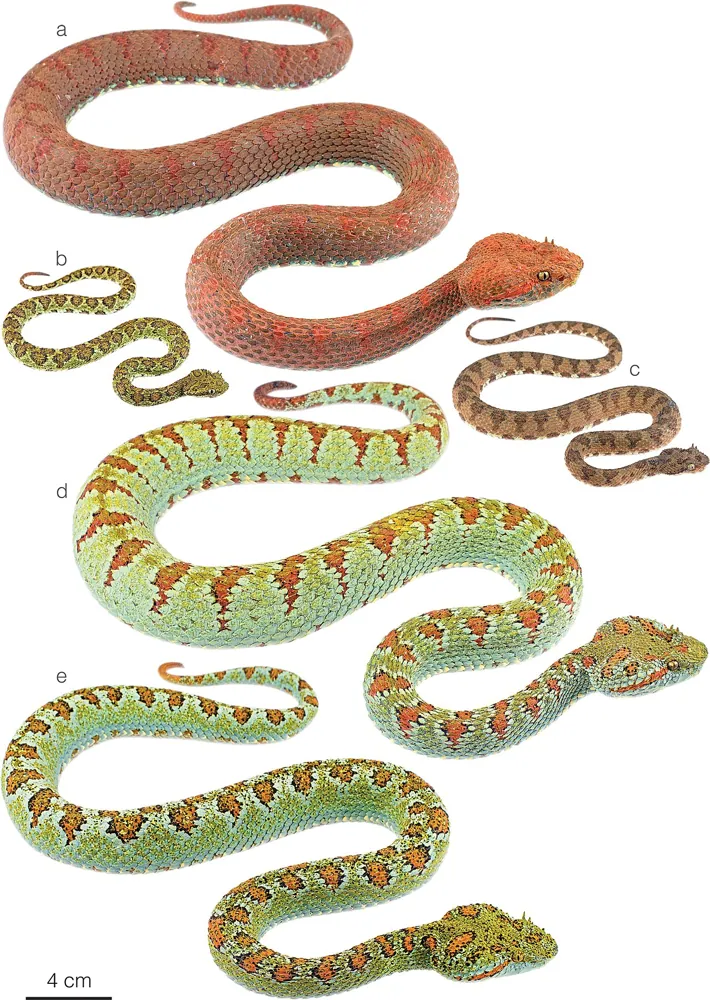
The blotched eyelash-pitviper is a venomous snake that lives in the mountain forests of southern Costa Rica and western Panama. It spends much of its time in trees and is active mainly at dusk or at night. Its bite can cause serious bleeding and muscle damage, so it is important to recognise it and keep well away.1


 Tsela ya go e lemoga
- Usually bright green or moss-green, though it can also be bluish-green, reddish-brown or reddish-maroon.1
- Irregular dark blotches run along the back, and these sometimes join to form crossbands.1
- The belly is light in colour.1
- The head has dark stripes and prominent scales above the eyes, which give it the name eyelash-pitviper.1
- Usually 50–60 cm long including the tail, and can reach 80 cm.1
Maatla a botlhole
Botlhole bo tswa ka meno a yone fa e loma.
Botlhole jo e bo tsenyang bo dira eng?
Its venom has a potent haemorrhagic action, which damages blood vessels and causes bleeding. It also has moderate myotoxicity, which destroys muscle tissue, and a very weak procoagulant effect, which can slightly speed up clotting.1
E kotsi go le kae go batho?
Kotsi go batho: E masisiGo lomiwa ke yone go tlhoka ngaka. Go swa go seoka thata. Dikgang tse di molemo: dingaka di na le molemo (antivenom) kgotsa kalafi ya se.1
 Fa e loma
- Dira gore motho a nne a sa tshikinyege a ritibetse, tshegetsa setho se se lomilweng mo boemong jwa pelo, tlosa direng le dilo tse di tiileng, mme o mo ise bookelong ka bonako.
Ka gale leletsa nomoro ya gago ya tshoganyetso pele (112, 000, 911). Se ke kaelo e e akaretsang ya thuso ya ntlha, ga se kgakololo ya bongaka. Motheo wa thuso ya ntlha
 Nna o babalesegile
- O se ka wa ama, wa tshwara kgotsa wa tshwenya phologolo ya naga, le fa e le e nnye, le fa e lebega e robetse kgotsa e sule.
- E fe sebaka. Fa o kopana le yone, ritibala, boela morago ka bonya mme o e tlogele e tsamaye ka tsela ya yone.
- Fa e nngwe e go loma: ritibala, o se ka wa tshikinyega, leletsa nomoro ya gago ya tshoganyetso (112, 000, 911) kgotsa o ye bookelong ka bonako. Gopola gore e ne e lebega jang, setshwantsho se a thusa.
Ga e go batle. E dirisa botlhole jwa yone go tshwara dijo kgotsa go itshireletsa, mme e rata go iphitlha go feta. Go le gontsi ka go nna o babalesegile
Kae mo lefatsheng?
E kgolo go le kae?
E telele go le kae?
 boleele jo bo lekanang le dikatse tsa ntlo di le 1,5 go tloga kwa nkong go ya mogatleng
 boleele jo bo lekanang le dipanana di le 4 di latelana
 e ka taboga dimetara di le 100 ka metsotswana e le 110 (motho yo o bonako go gaisa o tlhoka 9,6)
Blotched palm pitviper e kgolo go le kae fa e bapisiwa le WENA?
Ke dipalo fela mo sefetleng sa gago (browser). Ga go sepe se se bolokwang kgotsa se se romelwang gope.
E bonako go le kae?


Dintlha
Unlike most other Bothriechis species, it spends more time on the ground, and it may rest on the ground or at the base of trees and shrubs during the day.1
Its venom has an estimated LD50 of 6.04 mg/kg. LD50 is the dose that is expected to kill half of a test group, so a lower number means a more toxic venom.1
An antivenom made in horses, using venoms from Bothrops asper, Crotalus simus and another snake species, has been reported to neutralise its venom in tests.1
Females are longer and thicker than males, and this is the only difference between the sexes that has been noted.1
Kwa dintlha di tswang teng
- Bothriechis supraciliaris (Wikipedia (CC BY-SA 4.0))
- Bothriechis supraciliaris (iNaturalist): maina le thulaganyo ya mefuta.
- Venom Wiki: seelo sa kotsi, bogolo jo bo tlwaelegileng le kakanyo ya lebelo ke tsa rona. Bona kafa re di balang ka teng: Kafa re lekanyang kotsi ka teng.
Ntlha nngwe le nngwe mo tsebeng e e na le nomoro e e supang motswedi wa yone. Fa re dirile phoso, maitshwarelo, re barati ba diphologolo, e seng kgatiso ya saense. Re bolelele kwa [email protected] mme re tla e baakanya.
 Phepheng e tshwerwe ke tlala! Venom Wiki ke porojeke ya motho a le mongwe: ke mahala, ga e na dipapatso le ditraka. Mpho e nnye e thusa go e tshegetsa mo inthaneteng.Fepa phepheng
Tse dingwe tsa setlhopha se se tshwanang: Divaepara tsa mesima (pit vipers)
 TerciopeloDivaepara tsa mesima (pit vipers)E a bolaya
 Eyelash viperDivaepara tsa mesima (pit vipers)E ka bolaya
 CottonmouthDivaepara tsa mesima (pit vipers)E tlhoka ngaka
 Eastern copperheadDivaepara tsa mesima (pit vipers)E tlhoka ngaka
 CantilDivaepara tsa mesima (pit vipers)E ka bolaya
 Central American bushmasterDivaepara tsa mesima (pit vipers)E ka bolaya
 Eastern coral snake
 Eastern diamondback rattlesnake
 Timber rattlesnake
 Western diamondback rattlesnake
 Arizona bark scorpion
 Brown recluse