
 Aforika
 Asia
Asia Yuropa
 Amerika Borwa
 Australia le Oceania
 Antarctica
 Lewatle la Pacific
 Lewatle la Atlantic
 Lewatle la India
 Lewatle la Arctic
 Lewatle la Mediterranean
 Lewatle le Lehibidu
 Lewatle la Caribbean
 Lewatle la Coral
 Lewatle la China Borwa
 Lewatle la Philippines
 Lewatle la Andaman
 Lewatle la Bokone
 Lewatle la Timor le la Arafura
 Kou ya Bengal
 Gulf ya California
Caspian cobra
 Go loma
The Caspian cobra is a highly venomous snake that lives in Central Asia, Afghanistan, Iran and Pakistan. Many scientists consider it the most venomous cobra in the world. It is also a strong swimmer and a good climber.1



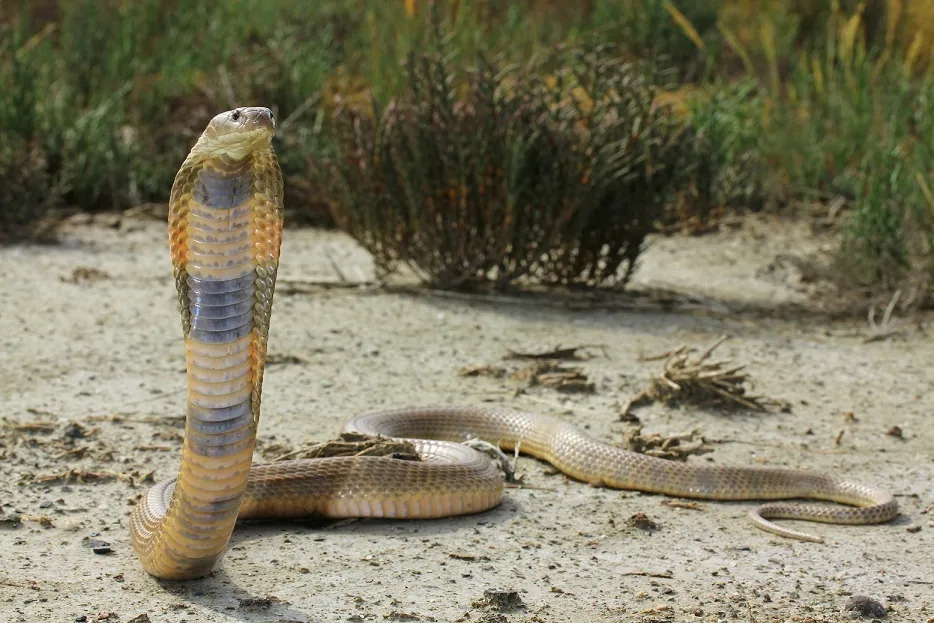
 Tsela ya go e lemoga
- Adults are light to chocolate brown or yellowish, with no hood marks and no spots on the throat.1
- Juveniles are pale and faded, with dark and light cross-bands of about equal width around the body.1
- The hood is long and tapers gradually, unlike the rounder hood of some other cobras.1
- It has several dark bands under the throat.1
- It is never fully black, although some individuals can be quite dark.1
Gantsi e tlhakanngwa le: The Caspian cobra is often confused with the Indian cobra, and the two live side by side in Pakistan and northern India. Indian cobras without a hood mark look similar. In the black form of the Indian cobra from Pakistan, almost the whole throat is black, while the Caspian cobra has several dark throat bands and is never fully black.1
Maatla a botlhole
Botlhole bo tswa ka meno a yone fa e loma.
Botlhole jo e bo tsenyang bo dira eng?
Its venom is mainly neurotoxic, meaning it attacks the nerves, and most of the venom is made of short neurotoxins. It also contains cytotoxins, which can kill cells, and enzymes called nucleases, which damage tissue at the bite. Severe pain and swelling appear quickly, and weakness, drowsiness and paralysis of the throat and limbs can appear within an hour. The venom can also affect the heart during the first few hours, and at least one heart attack after a bite has been recorded.1
E kotsi go le kae go batho?
Kotsi go batho: E a bolayaNngwe ya diphologolo tse di kotsi go gaisa mo lefatsheng.It is regarded as the most dangerous snake in Central Asia and has a high death rate. Between 1979 and 1987, 136 confirmed bites were attributed to it in the former Soviet Union. Of these, 8 people died after receiving antivenom, and 11 of the 15 who did not receive antivenom died. In Iran, it causes more deaths from snakebite than any other snake in the country. Without treatment, death can come in as little as 45 minutes or be delayed for up to 24 hours.1
 Dikgang tse di molemo: dingaka di na le molemo (antivenom) kgotsa kalafi ya se.1
E dira eng fa e tshogile?
It tends to avoid people, but when cornered or provoked it spreads its hood, hisses, sways from side to side and strikes repeatedly.1
 Fa e loma
- Medical treatment with antivenom is essential, because untreated bites are often fatal. Symptoms can worsen rapidly without treatment, so urgent medical care is needed.1
- Dira gore motho a nne a sa tshikinyege a ritibetse, tlosa direng le dilo tse di tiileng, mme o mo ise bookelong ka bonako: antivenom ke yone kalafi.
Ka gale leletsa nomoro ya gago ya tshoganyetso pele (112, 000, 911). Se ke kaelo e e akaretsang ya thuso ya ntlha, ga se kgakololo ya bongaka. Motheo wa thuso ya ntlha
 Nna o babalesegile
- O se ka wa ama, wa tshwara kgotsa wa tshwenya phologolo ya naga, le fa e le e nnye, le fa e lebega e robetse kgotsa e sule.
- E fe sebaka. Fa o kopana le yone, ritibala, boela morago ka bonya mme o e tlogele e tsamaye ka tsela ya yone.
- Fa e nngwe e go loma: ritibala, o se ka wa tshikinyega, leletsa nomoro ya gago ya tshoganyetso (112, 000, 911) kgotsa o ye bookelong ka bonako. Gopola gore e ne e lebega jang, setshwantsho se a thusa.
Ga e go batle. E dirisa botlhole jwa yone go tshwara dijo kgotsa go itshireletsa, mme e rata go iphitlha go feta. Go le gontsi ka go nna o babalesegile
Kae mo lefatsheng?
E kgolo go le kae?
E telele go le kae?
 boleele jo bo lekanang le dikatse tsa ntlo di le 3 go tloga kwa nkong go ya mogatleng
 boleele jo bo lekanang le dipanana di le 9 di latelana
 e ka taboga dimetara di le 100 ka metsotswana e le 48 (motho yo o bonako go gaisa o tlhoka 9,6)
Caspian cobra e kgolo go le kae fa e bapisiwa le WENA?
Ke dipalo fela mo sefetleng sa gago (browser). Ga go sepe se se bolokwang kgotsa se se romelwang gope.
E bonako go le kae?


Dintlha
Many toxinological studies suggest that the Caspian cobra is the most venomous cobra in the world.1
A ribonuclease called ribonuclease V1, purified from its venom, is used as a laboratory reagent in molecular biology because it can break down structured RNA.1
It cannot spit venom, but it is a good climber and an able swimmer.1
It is the westernmost species of Asiatic cobra, and it can be found at heights of up to about 3,000 m.1
For most of the twentieth century it was treated as a subspecies of the Indian cobra, until genetic analysis showed it was a separate species.1
Mosenyi wa ditlhamane
Tlhamane: Caspian cobras are always black, like some Indian cobras.
Nnete: The Caspian cobra is never fully black. Adults are light to chocolate brown or yellowish, and it has several dark bands under the throat.1
Kwa dintlha di tswang teng
- Caspian cobra (Wikipedia (CC BY-SA 4.0))
- Naja oxiana (iNaturalist): maina le thulaganyo ya mefuta.
- Venom Wiki: seelo sa kotsi, bogolo jo bo tlwaelegileng le kakanyo ya lebelo ke tsa rona. Bona kafa re di balang ka teng: Kafa re lekanyang kotsi ka teng.
Ntlha nngwe le nngwe mo tsebeng e e na le nomoro e e supang motswedi wa yone. Fa re dirile phoso, maitshwarelo, re barati ba diphologolo, e seng kgatiso ya saense. Re bolelele kwa [email protected] mme re tla e baakanya.
 Phepheng e tshwerwe ke tlala! Venom Wiki ke porojeke ya motho a le mongwe: ke mahala, ga e na dipapatso le ditraka. Mpho e nnye e thusa go e tshegetsa mo inthaneteng.Fepa phepheng
Tse dingwe tsa setlhopha se se tshwanang: Dikobra, dimamba le dikrait
 Indian cobraDikobra, dimamba le dikraitE a bolaya
 King cobraDikobra, dimamba le dikraitE a bolaya
 Common kraitDikobra, dimamba le dikraitE a bolaya
 Malayan kraitDikobra, dimamba le dikraitE a bolaya
 Many-banded kraitDikobra, dimamba le dikraitE a bolaya
 Monocled cobraDikobra, dimamba le dikraitE a bolaya
E tshela gape kwa: Asia
 DeathstalkerDiphephengE a bolaya
 Indian saw-scaled viperDivaepara le diboloboloE a bolaya
 Puff adderDivaepara le diboloboloE a bolaya
 Phika ya ga RussellDivaepara le diboloboloE a bolaya
 Asian giant hornetDinotshe, diwasepe le dihoneteE ka bolaya
 Komodo dragonDikgatitswane tse di tsenyang botlholeE ka bolaya