
 Aforika
 Asia
Asia Yuropa
 Amerika Borwa
 Australia le Oceania
 Antarctica
 Lewatle la Pacific
 Lewatle la Atlantic
 Lewatle la India
 Lewatle la Arctic
 Lewatle la Mediterranean
 Lewatle le Lehibidu
 Lewatle la Caribbean
 Lewatle la Coral
 Lewatle la China Borwa
 Lewatle la Philippines
 Lewatle la Andaman
 Lewatle la Bokone
 Lewatle la Timor le la Arafura
 Kou ya Bengal
 Gulf ya California
Common eastern bumble bee
 Go tlhaba
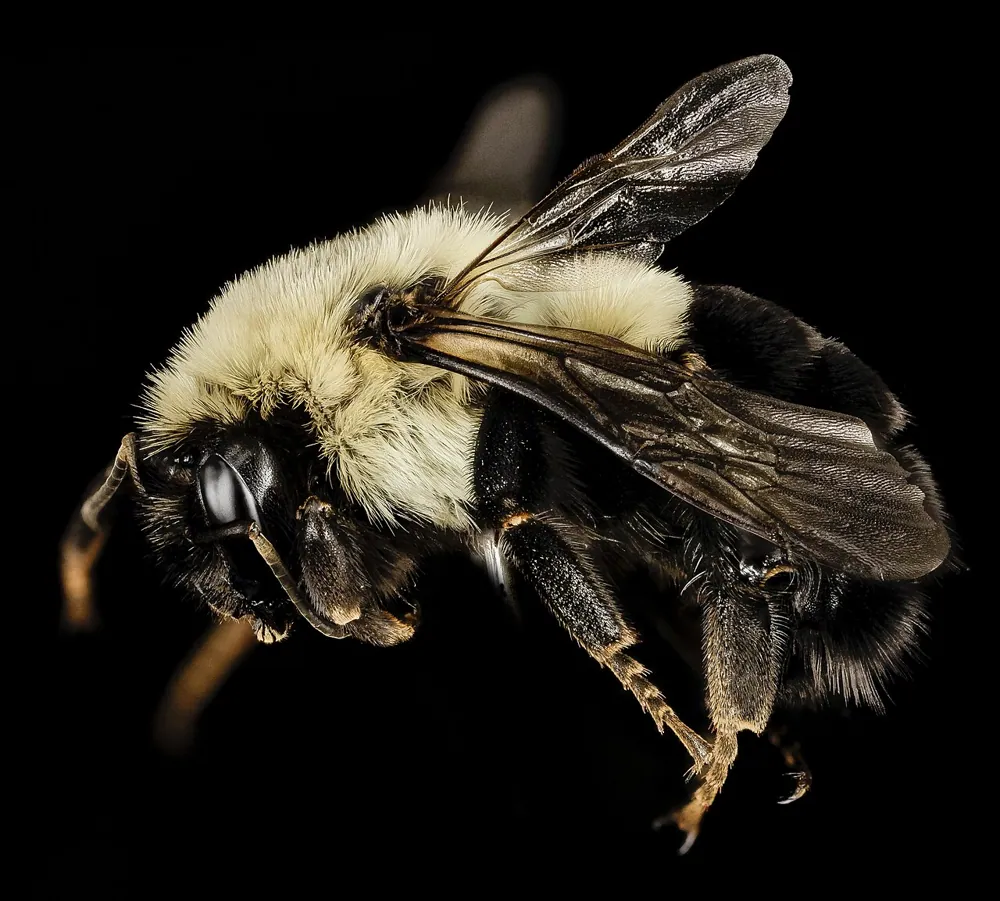
The common eastern bumblebee is a furry, black and yellow bee. It is the most commonly seen bumblebee across much of eastern North America, including towns, cities and fields. Its visits to flowers help pollinate many crops, so it matters to farmers and gardeners.1



 Tsela ya go e lemoga
- Queens and workers are black with a yellow thorax (the middle part of the body) and a yellow first abdominal segment (the first part of the rear body).1
- Males have a yellow face and head, and their coloring is slightly different from queens and workers.1
- They have short, even hair and a long, rectangular body.1
- Queens are the largest, at 17 to 23 mm long. Workers measure 8.5 to 16 mm and males 12 to 18 mm.1
Gantsi e tlhakanngwa le: They look similar to Bombus bimaculatus, B. perplexus, B. vagans, B. sandersoni and B. separatus.1
Maatla a botlhole
Botlhole bo tswa ka lemao le le tlhabang.
E kotsi go le kae go batho?
Kotsi go batho: Kotsi e nnyeJaaka go tlhabiwa ke notshe kgotsa go le kwa tlase. Ga e na kotsi go batho. Fa e tlhaba
- Ntsha lemao la notshe ka go le kgwaratla, mme o tsidifatse lefelo leo.
- Fa motho a hema ka bothata, sefatlhego kgotsa mometso o ruruga, kgotsa a ikutlwa a tla idibala, ke tshoganyetso ya aletshi: leletsa nomoro ya gago ya tshoganyetso mme o dirise pene ya gagwe ya adrenaline fa a na le yone.
Ka gale leletsa nomoro ya gago ya tshoganyetso pele (112, 000, 911). Se ke kaelo e e akaretsang ya thuso ya ntlha, ga se kgakololo ya bongaka. Motheo wa thuso ya ntlha
 Nna o babalesegile
- O se ka wa ama, wa tshwara kgotsa wa tshwenya phologolo ya naga, le fa e le e nnye, le fa e lebega e robetse kgotsa e sule.
- E fe sebaka. Fa o kopana le yone, ritibala, boela morago ka bonya mme o e tlogele e tsamaye ka tsela ya yone.
- Fa e nngwe e go tlhaba: ritibala, o se ka wa tshikinyega, leletsa nomoro ya gago ya tshoganyetso (112, 000, 911) kgotsa o ye bookelong ka bonako. Gopola gore e ne e lebega jang, setshwantsho se a thusa.
Ga e go batle. E dirisa botlhole jwa yone go tshwara dijo kgotsa go itshireletsa, mme e rata go iphitlha go feta. Go le gontsi ka go nna o babalesegile
Kae mo lefatsheng?
E kgolo go le kae?
E telele go le kae?
 e ka nna boleele jo bo lekanang le jwa kelipi ya pampiri
 e ka fofa go kgabaganya lebala lotlhe la kgwele ya dinao ka metsotswana e le 15
Common eastern bumble bee e kgolo go le kae fa e bapisiwa le WENA?
Ke dipalo fela mo sefetleng sa gago (browser). Ga go sepe se se bolokwang kgotsa se se romelwang gope.
E bonako go le kae?


.jpg)
Dintlha
Queen bees can stay underwater for up to a week without drowning, which may help them survive floods or wet winters.1
Foragers use traplining, visiting flowers in the same repeatable order. This saves time and energy.1
Foraging bees share information about good food sources with other bees in the nest.1
Inside the nest, smaller workers stay near the centre and feed the young, while bigger workers work as foragers and guards on the outside.1
Commercially raised colonies are used to pollinate tomatoes, blueberries, raspberries and pumpkins in greenhouses.1
Ya baitseanape ba botlhole
- Leina la saense
- Bombus impatiens
- Setlhopha
- Dinotshe, diwasepe le dihonete
- Lelapa
- Apidae2
- Lekoko
- Hymenoptera
- Dikontinente
- Amerika Bokone
- Masea
- A queen can lay about 2000 eggs in one season, but only about half of them survive to become adults. The eggs are laid in clumps throughout the nest.1
- Kotsi go batho
- 1 / 5: Kotsi e nnye3
Kwa dintlha di tswang teng
- Bombus impatiens (Wikipedia (CC BY-SA 4.0))
- Bombus impatiens (iNaturalist): maina le thulaganyo ya mefuta.
- Venom Wiki: seelo sa kotsi, bogolo jo bo tlwaelegileng le kakanyo ya lebelo ke tsa rona. Bona kafa re di balang ka teng: Kafa re lekanyang kotsi ka teng.
Ntlha nngwe le nngwe mo tsebeng e e na le nomoro e e supang motswedi wa yone. Fa re dirile phoso, maitshwarelo, re barati ba diphologolo, e seng kgatiso ya saense. Re bolelele kwa [email protected] mme re tla e baakanya.
 Phepheng e tshwerwe ke tlala! Venom Wiki ke porojeke ya motho a le mongwe: ke mahala, ga e na dipapatso le ditraka. Mpho e nnye e thusa go e tshegetsa mo inthaneteng.Fepa phepheng
Tse dingwe tsa setlhopha se se tshwanang: Dinotshe, diwasepe le dihonete
 Tarantula hawkDinotshe, diwasepe le dihoneteE utlwisa botlhoko fela
 Executioner waspDinotshe, diwasepe le dihoneteE tlhoka ngaka
 Warrior waspDinotshe, diwasepe le dihoneteE tlhoka ngaka
 Bald-faced hornetDinotshe, diwasepe le dihoneteE utlwisa botlhoko fela
 Cow killer velvet antDinotshe, diwasepe le dihoneteE utlwisa botlhoko fela
 Eastern cicada killerDinotshe, diwasepe le dihoneteGa e na kotsi
E tshela gape kwa: Amerika Bokone
 TerciopeloDivaepara tsa mesima (pit vipers)E a bolaya
 Eastern coral snakeDinoga tsa khoraleE ka bolaya
 Eastern diamondback rattlesnakeDinoga tsa ratheleE ka bolaya
 Eyelash viperDivaepara tsa mesima (pit vipers)E ka bolaya
 Timber rattlesnakeDinoga tsa ratheleE ka bolaya
 Western diamondback rattlesnakeDinoga tsa ratheleE ka bolaya