
 Aforika
 Asia
Asia Yuropa
 Amerika Borwa
 Australia le Oceania
 Antarctica
 Lewatle la Pacific
 Lewatle la Atlantic
 Lewatle la India
 Lewatle la Arctic
 Lewatle la Mediterranean
 Lewatle le Lehibidu
 Lewatle la Caribbean
 Lewatle la Coral
 Lewatle la China Borwa
 Lewatle la Philippines
 Lewatle la Andaman
 Lewatle la Bokone
 Lewatle la Timor le la Arafura
 Kou ya Bengal
 Gulf ya California
Crown-of-thorns starfish
 Mitlwa ya botlhole
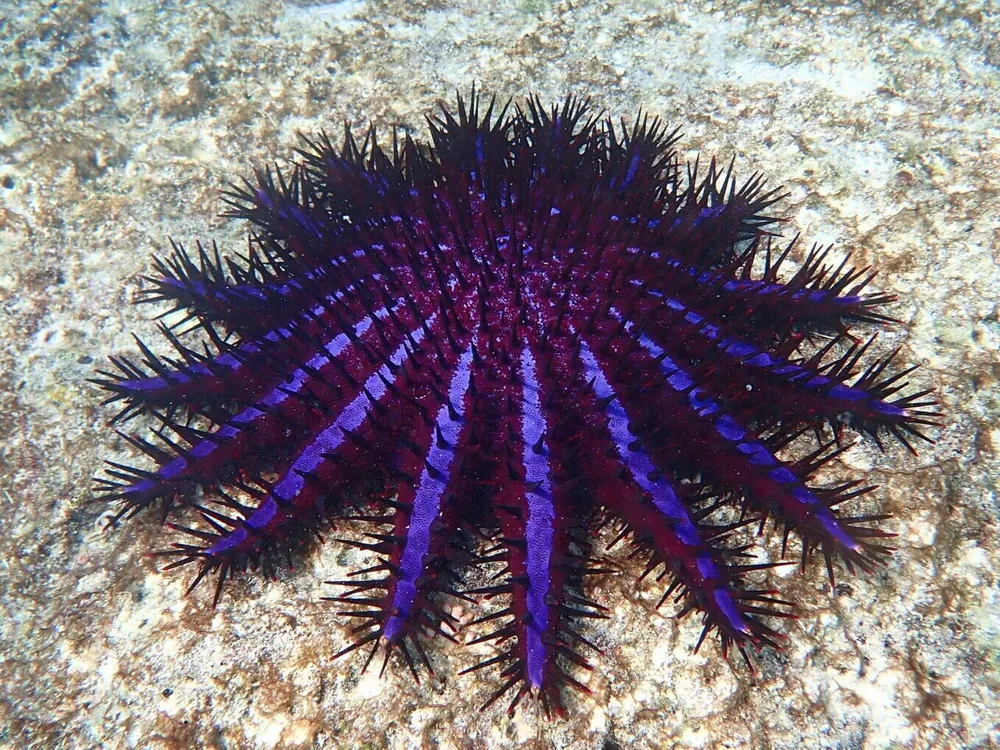
The crown-of-thorns starfish is a large starfish with long, sharp spines that look like a crown of thorns. It lives on coral reefs across the Indo-Pacific, from the Red Sea to the west coast of Central America, and it is most common around Australia. It feeds on hard coral, so it can change the reefs it lives on.1

 Tsela ya go e lemoga
- Adults are normally 25 to 35 cm across.1
- Up to 21 arms, with long, stiff, very sharp spines that are 4 to 5 cm long on the top and sides of the arms.1
- Colour varies with diet or region: purple, purple-blue, reddish grey or brown with red spine tips, or green with yellow spine tips.1
- The body is flexible and can bend and twist around coral surfaces.1
Gantsi e tlhakanngwa le: A close relative, Acanthaster brevispinus, lives on soft sea floors at moderate depths rather than on coral reefs. The two are considered sibling species.1
Maatla a botlhole
Mitlwa e e bogale e rwala botlhole. Go e gata kgotsa go e tshwara go a utlwisa botlhoko.
Botlhole jo e bo tsenyang bo dira eng?
The spines do not inject venom. When they pierce skin, tissue containing saponins (detergent-like chemicals) is left in the wound. In humans this causes a sharp, stinging pain that can last several hours, persistent bleeding, and nausea and swelling that may last a week or more.1
E kotsi go le kae go batho?
Kotsi go batho: E masisiFa mitlwa ya yone e go tlhaba, ya kwa ngakeng. Go swa go seoka thata.The spines can cause sharp pain, long-lasting bleeding, nausea and swelling. Brittle spines can break off and stay in the tissue.1
 Fa mitlwa ya yone e go tlhaba
- Spines that become embedded in the tissue must be removed surgically.1
- Tsenya ntho mo metsing a a mogote, a a bollo jo motho a ka bo itshokang a sa fiswe, mme o batle thuso ya bongaka go ntsha mitlwa. O se ka wa e epa ka bowena.
Ka gale leletsa nomoro ya gago ya tshoganyetso pele (112, 000, 911). Se ke kaelo e e akaretsang ya thuso ya ntlha, ga se kgakololo ya bongaka. Motheo wa thuso ya ntlha
 Nna o babalesegile
- O se ka wa ama, wa tshwara kgotsa wa tshwenya phologolo ya naga, le fa e le e nnye, le fa e lebega e robetse kgotsa e sule.
- E fe sebaka. Fa o kopana le yone, ritibala, boela morago ka bonya mme o e tlogele e tsamaye ka tsela ya yone.
- Fa mitlwa ya yone e go tlhaba: ritibala, o se ka wa tshikinyega, leletsa nomoro ya gago ya tshoganyetso (112, 000, 911) kgotsa o ye bookelong ka bonako. Gopola gore e ne e lebega jang, setshwantsho se a thusa.
Ga e go batle. E dirisa botlhole jwa yone go tshwara dijo kgotsa go itshireletsa, mme e rata go iphitlha go feta. Go le gontsi ka go nna o babalesegile
Kae mo lefatsheng?
E kgolo go le kae?
E telele go le kae?
 boleele jo bo lekanang le diboloko tsa go aga tsa ditshamekisi di le 11 mo moleng
 bonya go feta kgopa ya tshingwana
Crown-of-thorns starfish e kgolo go le kae fa e bapisiwa le WENA?
Ke dipalo fela mo sefetleng sa gago (browser). Ga go sepe se se bolokwang kgotsa se se romelwang gope.
E bonako go le kae?

.jpg)
Dintlha
An individual starfish can consume up to 6 square metres of living coral reef per year.1
When taken out of water, its soft body ruptures and collapses, but its spines can recover their shape if it is put back in the water while still alive.1
Its body contains detergent-like saponins, so keeping starfish in small volumes of water with aeration produces large amounts of foam.1
It is one of the largest starfish in the world.1
It has lost the usual five-fold symmetry of starfish as it grew more arms, although it begins life with five-fold symmetry.1
Mosenyi wa ditlhamane
Tlhamane: Its spines inject venom like a snake or stinging animal.
Nnete: It has no mechanism for injecting toxin. Its spines pierce skin and leave saponin-containing tissue in the wound.1
Ya baitseanape ba botlhole
- Leina la saense
- Acanthaster planci
- Setlhopha
- Di-urchin, dinaledi tsa lewatle le diboko
- Lelapa
- Acanthasteridae2
- Lekoko
- Valvatida
- Dikontinente
- Lewatle la India, Lewatle la Pacific, Lewatle le Lehibidu, Lewatle la Coral, Lewatle la Philippines, Lewatle la China Borwa, Lewatle la Andaman, Lewatle la Arabia le Gulf ya Peresia, Lewatle la Timor le la Arafura, Kou ya Bengal, Mawatle
- Masea
- It releases vast amounts of eggs and sperm (gametes) during mass spawning events in summer, and the eggs contain saponins similar to those in adults.1
- Kotsi go batho
- 3 / 5: E masisi3
Kwa dintlha di tswang teng
- Crown-of-thorns starfish (Wikipedia (CC BY-SA 4.0))
- Acanthaster planci (iNaturalist): maina le thulaganyo ya mefuta.
- Venom Wiki: seelo sa kotsi, bogolo jo bo tlwaelegileng le kakanyo ya lebelo ke tsa rona. Bona kafa re di balang ka teng: Kafa re lekanyang kotsi ka teng.
Ntlha nngwe le nngwe mo tsebeng e e na le nomoro e e supang motswedi wa yone. Fa re dirile phoso, maitshwarelo, re barati ba diphologolo, e seng kgatiso ya saense. Re bolelele kwa [email protected] mme re tla e baakanya.
 Phepheng e tshwerwe ke tlala! Venom Wiki ke porojeke ya motho a le mongwe: ke mahala, ga e na dipapatso le ditraka. Mpho e nnye e thusa go e tshegetsa mo inthaneteng.Fepa phepheng
Tse dingwe tsa setlhopha se se tshwanang: Di-urchin, dinaledi tsa lewatle le diboko
 Flower urchinDi-urchin, dinaledi tsa lewatle le dibokoE ka bolaya
 Fire urchinDi-urchin, dinaledi tsa lewatle le dibokoE tlhoka ngakaO se ka wa ama
 Bearded firewormDi-urchin, dinaledi tsa lewatle le dibokoE utlwisa botlhoko felaO se ka wa ama
 Black long-spined urchinDi-urchin, dinaledi tsa lewatle le dibokoE utlwisa botlhoko felaO se ka wa ama
 BloodwormDi-urchin, dinaledi tsa lewatle le dibokoE utlwisa botlhoko fela
 Bobbit wormDi-urchin, dinaledi tsa lewatle le dibokoE utlwisa botlhoko fela
E tshela gape kwa: Lewatle la India
 Australian box jellyfishDijelifishi le dibopiwa tsa lewatle tse di tlhabangE a bolayaO se ka wa ama
 Geography coneDikgopa tsa khouno le diokotopaseE a bolaya
 Greater blue-ringed octopusDikgopa tsa khouno le diokotopaseE a bolaya
 Southern blue-ringed octopusDikgopa tsa khouno le diokotopaseE a bolaya
 Hawksbill sea turtleDiphologolo tse dingwe tse di botlhole go di ama kgotsa go di jaE ka bolaya
 Irukandji jellyfishDijelifishi le dibopiwa tsa lewatle tse di tlhabangE ka bolayaO se ka wa ama