
 Aforika
 Asia
Asia Yuropa
 Amerika Borwa
 Australia le Oceania
 Antarctica
 Lewatle la Pacific
 Lewatle la Atlantic
 Lewatle la India
 Lewatle la Arctic
 Lewatle la Mediterranean
 Lewatle le Lehibidu
 Lewatle la Caribbean
 Lewatle la Coral
 Lewatle la China Borwa
 Lewatle la Philippines
 Lewatle la Andaman
 Lewatle la Bokone
 Lewatle la Timor le la Arafura
 Kou ya Bengal
 Gulf ya California
Australian box jellyfish
 Mesela e e tlhabang
The Australian box jellyfish is one of the most venomous animals in the world. It lives in the warm coastal waters of northern Australia and nearby parts of Southeast Asia. Its sting can cause extreme pain and can be deadly, so it is important to know how to recognise it and what to do.1



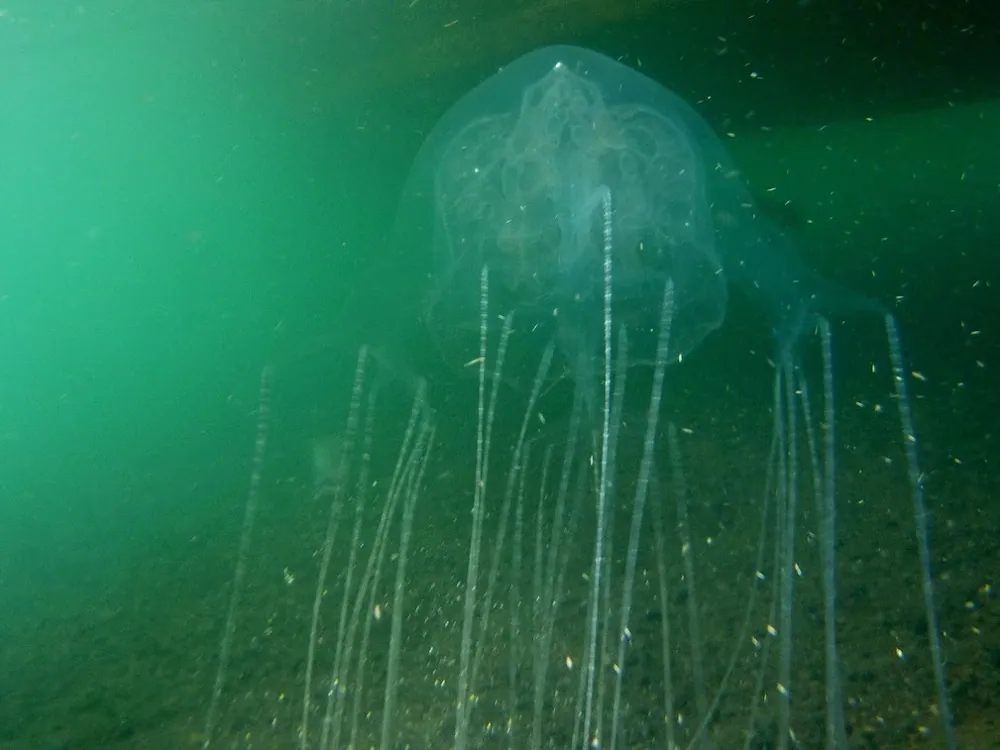
 Tsela ya go e lemoga
- The bell is box-shaped and pale blue, with faint markings.1
- The bell is usually about 16 cm across and can reach 35 cm.1
- A cluster of 15 tentacles hangs from each of the four corners of the bell.1
- It is almost completely transparent, so it is very hard to see in the water.1
- When hunting, its tentacles can stretch to about 3 m long.1
Maatla a botlhole
Dikete tsa disele tse dinnye tse di tlhabang di a thuntsha fa sengwe se di ama.
Botlhole jo e bo tsenyang bo dira eng?
Its venom makes cells porous, so potassium leaks out of them. This causes hyperkalemia, a dangerous build-up of potassium in the blood, which can lead to heart and circulation failure. Stings cause excruciating pain and a burning feeling, and an untreated victim can die within two to five minutes.1
E kotsi go le kae go batho?
Kotsi go batho: E a bolayaNngwe ya diphologolo tse di kotsi go gaisa mo lefatsheng.At least 64 deaths have been recorded in Australia. Most deaths in recent decades have been children, because their smaller bodies are at higher risk. Most stings are mild, but one animal's venom is said to be enough to kill 60 adults.1
 Dikgang tse di molemo: dingaka di na le molemo (antivenom) kgotsa kalafi ya se.1
 Fa e tlhaba
- Diluted acetic acid, such as vinegar, is the recommended treatment, because it deactivates stinging cells that have not yet fired. Some North American toxicologists advise applying it for around 30 seconds. Pressure bandages are no longer recommended, because they can cause more stinging cells to fire.1
- Tswa mo metsing mme o tlose mesela (tentacles) epe fela e e setseng (ka ditlelafo kgotsa ka lesela).
- Ya dijelifishi tsa lebokoso tsa tropiki: tshela asene mo mafelong a a tlhabilweng bonnye metsotswana e le 30, bitsa thuso mme o ipaakanyetse go dira CPR. Ya dibluebottle le tse dingwe tse dintsi: tlhatswa ka metsi a lewatle, morago ka metsi a a mogote go fokotsa botlhoko.
Ka gale leletsa nomoro ya gago ya tshoganyetso pele (112, 000, 911). Se ke kaelo e e akaretsang ya thuso ya ntlha, ga se kgakololo ya bongaka. Motheo wa thuso ya ntlha
 Nna o babalesegile
- O se ka wa ama, wa tshwara kgotsa wa tshwenya phologolo ya naga, le fa e le e nnye, le fa e lebega e robetse kgotsa e sule.
- E fe sebaka. Fa o kopana le yone, ritibala, boela morago ka bonya mme o e tlogele e tsamaye ka tsela ya yone.
- Fa e nngwe e go tlhaba: ritibala, o se ka wa tshikinyega, leletsa nomoro ya gago ya tshoganyetso (112, 000, 911) kgotsa o ye bookelong ka bonako. Gopola gore e ne e lebega jang, setshwantsho se a thusa.
Ga e go batle. E dirisa botlhole jwa yone go tshwara dijo kgotsa go itshireletsa, mme e rata go iphitlha go feta. Go le gontsi ka go nna o babalesegile
Kae mo lefatsheng?
E kgolo go le kae?
E telele go le kae?
 boleele jo bo lekanang le diboloko tsa go aga tsa ditshamekisi di le 11 mo moleng
 e ka thuma boleele jwa bodiba jo bogolo jwa go thuma (50 m) ka metsotswana e le 26
Australian box jellyfish e kgolo go le kae fa e bapisiwa le WENA?
Ke dipalo fela mo sefetleng sa gago (browser). Ga go sepe se se bolokwang kgotsa se se romelwang gope.
E bonako go le kae?
Dintlha
It has four clusters of eyes with 24 eyes in total, even though it has no central nervous system.1
Its tentacles are covered with millions of stinging cells that fire microscopic darts carrying venom.1
Its only known predators are green sea turtles and leatherback turtles, whose thick skin protects them from its stings.1
It is attracted to blue light, which makes it stream out its tentacles, while black objects make it move away.1
From certain angles, its pale blue bell looks like a human head or skull.1
Its name, 'hand of death', comes from its four appendages, which look like hands.1
Mosenyi wa ditlhamane
Tlhamane: Pressure bandages are the best first aid for a box jellyfish sting.
Nnete: Pressure bandages were used until 2005, but health authorities no longer recommend them because they can trigger more venom release. Diluted vinegar is the recommended treatment.1
Ya baitseanape ba botlhole
- Leina la saense
- Chironex fleckeri
- Setlhopha
- Dijelifishi le dibopiwa tsa lewatle tse di tlhabang
- Lelapa
- Chirodropidae2
- Lekoko
- Chirodropida
- Dikontinente
- Lewatle la India, Lewatle la Pacific, Lewatle la Coral, Lewatle la China Borwa, Lewatle la Philippines, Lewatle la Timor le la Arafura, Mawatle
- Masea
- It lays eggs, and fertilised eggs develop into tiny polyps that bud into new young jellyfish, which return to the ocean.1
- Kotsi go batho
- 5 / 5: E a bolaya3
Kwa dintlha di tswang teng
- Chironex fleckeri (Wikipedia (CC BY-SA 4.0))
- Chironex fleckeri (iNaturalist): maina le thulaganyo ya mefuta.
- Venom Wiki: seelo sa kotsi, bogolo jo bo tlwaelegileng le kakanyo ya lebelo ke tsa rona. Bona kafa re di balang ka teng: Kafa re lekanyang kotsi ka teng.
Ntlha nngwe le nngwe mo tsebeng e e na le nomoro e e supang motswedi wa yone. Fa re dirile phoso, maitshwarelo, re barati ba diphologolo, e seng kgatiso ya saense. Re bolelele kwa [email protected] mme re tla e baakanya.
 Phepheng e tshwerwe ke tlala! Venom Wiki ke porojeke ya motho a le mongwe: ke mahala, ga e na dipapatso le ditraka. Mpho e nnye e thusa go e tshegetsa mo inthaneteng.Fepa phepheng
Tse dingwe tsa setlhopha se se tshwanang: Dijelifishi le dibopiwa tsa lewatle tse di tlhabang
 Irukandji jellyfishDijelifishi le dibopiwa tsa lewatle tse di tlhabangE ka bolayaO se ka wa ama
 Portuguese man o' warDijelifishi le dibopiwa tsa lewatle tse di tlhabangE tlhoka ngakaO se ka wa ama
 Lion's mane jellyfishDijelifishi le dibopiwa tsa lewatle tse di tlhabangE utlwisa botlhoko felaO se ka wa ama
 Moon jellyfishDijelifishi le dibopiwa tsa lewatle tse di tlhabangGa e na kotsi
 Common kingslayerDijelifishi le dibopiwa tsa lewatle tse di tlhabangE ka bolayaO se ka wa ama
 Hell's fire anemoneDijelifishi le dibopiwa tsa lewatle tse di tlhabangE tlhoka ngakaO se ka wa ama
E tshela gape kwa: Lewatle la India
 Geography coneDikgopa tsa khouno le diokotopaseE a bolaya
 Greater blue-ringed octopusDikgopa tsa khouno le diokotopaseE a bolaya
 Southern blue-ringed octopusDikgopa tsa khouno le diokotopaseE a bolaya
 Hawksbill sea turtleDiphologolo tse dingwe tse di botlhole go di ama kgotsa go di jaE ka bolaya
 Reef stonefishDitlhapi tse di tsenyang botlholeE ka bolayaO se ka wa ama
 Crown-of-thorns starfishDi-urchin, dinaledi tsa lewatle le dibokoE tlhoka ngakaO se ka wa ama