
 Aforika
 Asia
Asia Yuropa
 Amerika Borwa
 Australia le Oceania
 Antarctica
 Lewatle la Pacific
 Lewatle la Atlantic
 Lewatle la India
 Lewatle la Arctic
 Lewatle la Mediterranean
 Lewatle le Lehibidu
 Lewatle la Caribbean
 Lewatle la Coral
 Lewatle la China Borwa
 Lewatle la Philippines
 Lewatle la Andaman
 Lewatle la Bokone
 Lewatle la Timor le la Arafura
 Kou ya Bengal
 Gulf ya California
Desert night snake
 Go loma
The desert nightsnake is a small, slender snake that hunts at night and spends the day hidden. It lives in dry parts of western North America, from the southwestern United States into northwestern Mexico. It is mildly venomous, but it poses no danger to people.1



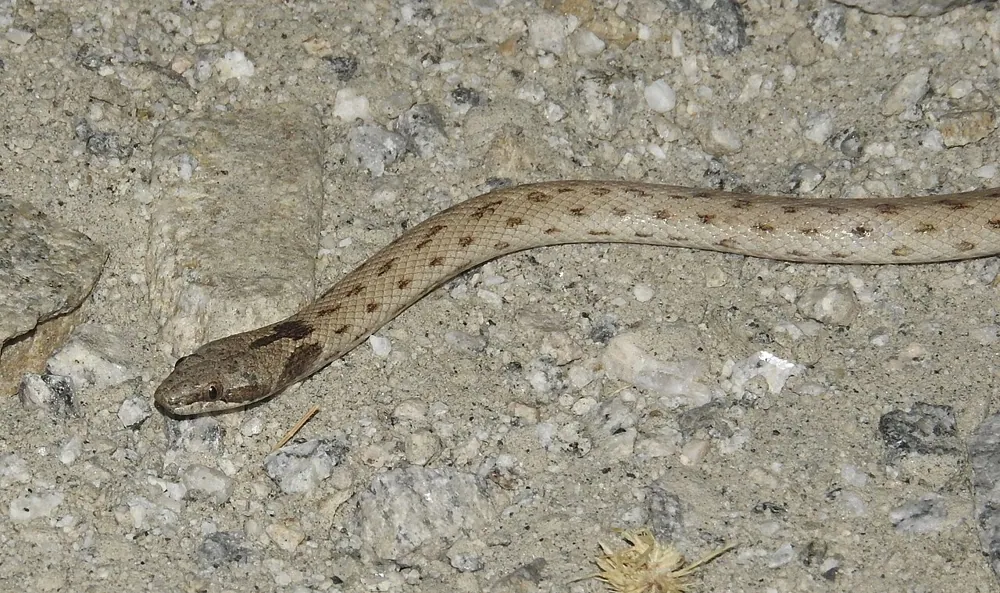
 Tsela ya go e lemoga
- Small and slender, usually 30 to 66 cm long in total.1
- Base colour is beige, yellowish or grey, with dark grey-brown blotches that usually form offset pairs down the back.1
- Three long dark blotches on the neck and one behind each eye.1
- Triangular head with vertical pupils.1
- Smooth scales on the back and no rattle at the tail.1
Gantsi e tlhakanngwa le: It is often mistaken for a juvenile rattlesnake because of its triangular head, vertical pupils and blotched pattern. Unlike a rattlesnake, it has no rattle and its back scales are smooth.1
Maatla a botlhole
Botlhole bo tswa ka meno a yone fa e loma.
Botlhole jo e bo tsenyang bo dira eng?
It is mildly venomous and uses its venom to subdue prey. It has rear fangs, which are grooved teeth at the back of the upper jaw.1
E kotsi go le kae go batho?
Kotsi go batho: Kotsi e nnyeJaaka go tlhabiwa ke notshe kgotsa go le kwa tlase. Ga e na kotsi go batho.It is mildly venomous and poses no danger to humans.1
 Fa e loma
- Tlhatswa fa go lomilweng, dira gore motho a ritibale mme o batle thuso ya bongaka. Mefuta mengwe (jaaka boomslang) e ka bolaya diura morago.
Ka gale leletsa nomoro ya gago ya tshoganyetso pele (112, 000, 911). Se ke kaelo e e akaretsang ya thuso ya ntlha, ga se kgakololo ya bongaka. Motheo wa thuso ya ntlha
 Nna o babalesegile
- O se ka wa ama, wa tshwara kgotsa wa tshwenya phologolo ya naga, le fa e le e nnye, le fa e lebega e robetse kgotsa e sule.
- E fe sebaka. Fa o kopana le yone, ritibala, boela morago ka bonya mme o e tlogele e tsamaye ka tsela ya yone.
- Fa e nngwe e go loma: ritibala, o se ka wa tshikinyega, leletsa nomoro ya gago ya tshoganyetso (112, 000, 911) kgotsa o ye bookelong ka bonako. Gopola gore e ne e lebega jang, setshwantsho se a thusa.
Ga e go batle. E dirisa botlhole jwa yone go tshwara dijo kgotsa go itshireletsa, mme e rata go iphitlha go feta. Go le gontsi ka go nna o babalesegile
Kae mo lefatsheng?
E kgolo go le kae?
E telele go le kae?
 boleele jo bo lekanang le dipanana di le 4 di latelana
 e ka taboga dimetara di le 100 ka metsotswana e le 80 (motho yo o bonako go gaisa o tlhoka 9,6)
Desert night snake e kgolo go le kae fa e bapisiwa le WENA?
Ke dipalo fela mo sefetleng sa gago (browser). Ga go sepe se se bolokwang kgotsa se se romelwang gope.
E bonako go le kae?


Dintlha
It is a rear-fanged snake, with enlarged grooved teeth at the back of the upper jaw that help it subdue prey.1
In Canada, it is federally listed as Endangered, because its small population is threatened by habitat loss.1
Females are generally longer and heavier than males.1
It is mainly active at night and at dusk, which is why it has the name nightsnake.1
Mosenyi wa ditlhamane
Tlhamane: It is a juvenile rattlesnake.
Nnete: It is a separate species. It has no rattle and its back scales are smooth.1
Ya baitseanape ba botlhole
- Leina la saense
- Hypsiglena chlorophaea
- Setlhopha
- Dinoga tse di nang le meno a botlhole kwa morago
- Lelapa
- Colubridae2
- Lekoko
- Squamata
- Dikontinente
- Amerika Bokone
- Masea
- It lays eggs. Females lay a single clutch of 2 to 9 eggs, usually around 4, between April and July, hidden in rock crevices or abandoned burrows. The eggs hatch in late summer, and the hatchlings are about 17 cm long.1
- Seemo sa yone kwa nageng
- Least Concern globally (IUCN); Endangered in Canada (COSEWIC)1
- Kotsi go batho
- 1 / 5: Kotsi e nnye3
Kwa dintlha di tswang teng
- Hypsiglena chlorophaea (Wikipedia (CC BY-SA 4.0))
- Hypsiglena chlorophaea (iNaturalist): maina le thulaganyo ya mefuta.
- Venom Wiki: seelo sa kotsi, bogolo jo bo tlwaelegileng le kakanyo ya lebelo ke tsa rona. Bona kafa re di balang ka teng: Kafa re lekanyang kotsi ka teng.
Ntlha nngwe le nngwe mo tsebeng e e na le nomoro e e supang motswedi wa yone. Fa re dirile phoso, maitshwarelo, re barati ba diphologolo, e seng kgatiso ya saense. Re bolelele kwa [email protected] mme re tla e baakanya.
 Phepheng e tshwerwe ke tlala! Venom Wiki ke porojeke ya motho a le mongwe: ke mahala, ga e na dipapatso le ditraka. Mpho e nnye e thusa go e tshegetsa mo inthaneteng.Fepa phepheng
Tse dingwe tsa setlhopha se se tshwanang: Dinoga tse di nang le meno a botlhole kwa morago
 Western hognose snakeDinoga tse di nang le meno a botlhole kwa moragoGa e na kotsi
 Brown vine snakeDinoga tse di nang le meno a botlhole kwa moragoGa e na kotsi
 Eastern hognose snakeDinoga tse di nang le meno a botlhole kwa moragoGa e na kotsi
 Green vine snakeDinoga tse di nang le meno a botlhole kwa moragoGa e na kotsi
 Night snakeDinoga tse di nang le meno a botlhole kwa moragoGa e na kotsi
 Sonoran lyre snakeDinoga tse di nang le meno a botlhole kwa moragoGa e na kotsi
E tshela gape kwa: Amerika Bokone
 TerciopeloDivaepara tsa mesima (pit vipers)E a bolaya
 Eastern coral snakeDinoga tsa khoraleE ka bolaya
 Eastern diamondback rattlesnakeDinoga tsa ratheleE ka bolaya
 Eyelash viperDivaepara tsa mesima (pit vipers)E ka bolaya
 Timber rattlesnakeDinoga tsa ratheleE ka bolaya
 Western diamondback rattlesnakeDinoga tsa ratheleE ka bolaya