
 Aforika
 Asia
Asia Yuropa
 Amerika Borwa
 Australia le Oceania
 Antarctica
 Lewatle la Pacific
 Lewatle la Atlantic
 Lewatle la India
 Lewatle la Arctic
 Lewatle la Mediterranean
 Lewatle le Lehibidu
 Lewatle la Caribbean
 Lewatle la Coral
 Lewatle la China Borwa
 Lewatle la Philippines
 Lewatle la Andaman
 Lewatle la Bokone
 Lewatle la Timor le la Arafura
 Kou ya Bengal
 Gulf ya California
Sonoran lyre snake
 Go loma
The Sonoran lyre snake is a slender, medium to large snake with a distinctive V-shaped mark on top of its head. It lives among rocks in the American Southwest and northwestern Mexico. It is a rear-fanged snake, so its fangs sit at the back of its mouth.1



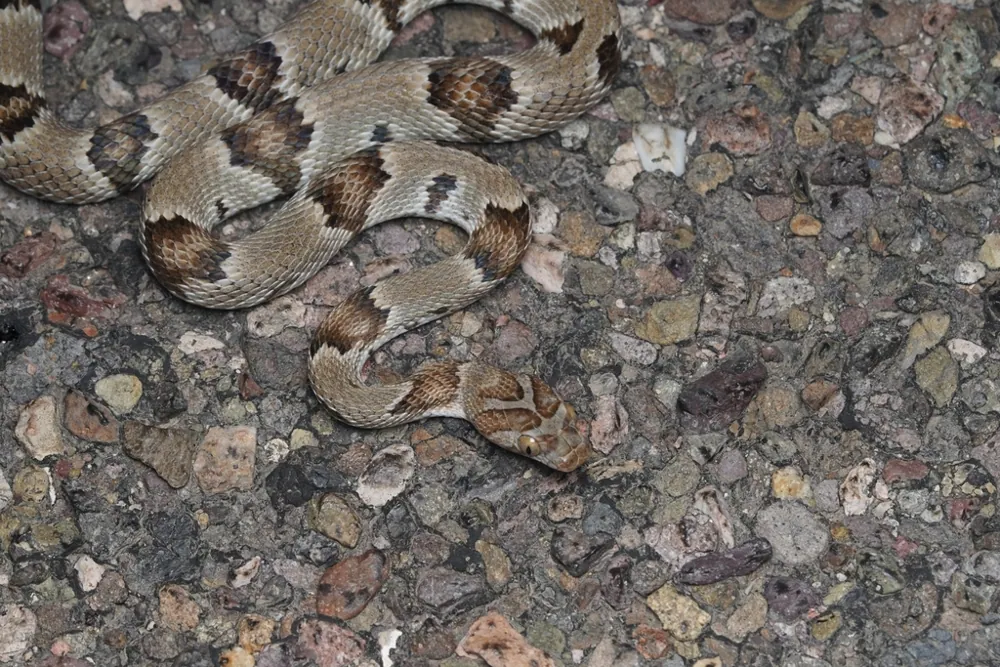
 Tsela ya go e lemoga
- A V-shaped or lyre-like mark on the top of the head, which gives it its name1
- Pale grey, tan or light brown ground colour1
- 18 to 31 dark brown saddles or blotches along the back, with pale edges1
- A dark bar across the snout between the eyes1
- A broad, flat head that is clearly wider than its slim neck, with large eyes that have vertical pupils1
Maatla a botlhole
Botlhole bo tswa ka meno a yone fa e loma.
Botlhole jo e bo tsenyang bo dira eng?
It is a rear-fanged (opisthoglyphous) snake, meaning its fangs are at the back of the mouth. Its venom is relatively mild and is adapted to subdue small, fast lizards and mammals. Because the fangs are at the back, it usually has to chew on its target to inject enough venom.1
E kotsi go le kae go batho?
Kotsi go batho: Kotsi e nnyeJaaka go tlhabiwa ke notshe kgotsa go le kwa tlase. Ga e na kotsi go batho.The venom is generally considered harmless to people. A bite may cause mild pain and swelling around the bite, but it is not medically significant.1
 Fa e loma
- Tlhatswa fa go lomilweng, dira gore motho a ritibale mme o batle thuso ya bongaka. Mefuta mengwe (jaaka boomslang) e ka bolaya diura morago.
Ka gale leletsa nomoro ya gago ya tshoganyetso pele (112, 000, 911). Se ke kaelo e e akaretsang ya thuso ya ntlha, ga se kgakololo ya bongaka. Motheo wa thuso ya ntlha
 Nna o babalesegile
- O se ka wa ama, wa tshwara kgotsa wa tshwenya phologolo ya naga, le fa e le e nnye, le fa e lebega e robetse kgotsa e sule.
- E fe sebaka. Fa o kopana le yone, ritibala, boela morago ka bonya mme o e tlogele e tsamaye ka tsela ya yone.
- Fa e nngwe e go loma: ritibala, o se ka wa tshikinyega, leletsa nomoro ya gago ya tshoganyetso (112, 000, 911) kgotsa o ye bookelong ka bonako. Gopola gore e ne e lebega jang, setshwantsho se a thusa.
Ga e go batle. E dirisa botlhole jwa yone go tshwara dijo kgotsa go itshireletsa, mme e rata go iphitlha go feta. Go le gontsi ka go nna o babalesegile
Kae mo lefatsheng?
E kgolo go le kae?
E telele go le kae?
 boleele jo bo lekanang le dikatse tsa ntlo di le 2 go tloga kwa nkong go ya mogatleng
 boleele jo bo lekanang le dipanana di le 5 di latelana
 e ka taboga dimetara di le 100 ka metsotswana e le 71 (motho yo o bonako go gaisa o tlhoka 9,6)
Sonoran lyre snake e kgolo go le kae fa e bapisiwa le WENA?
Ke dipalo fela mo sefetleng sa gago (browser). Ga go sepe se se bolokwang kgotsa se se romelwang gope.
E bonako go le kae?


Dintlha
Its front teeth are long and curved, its middle teeth are shorter, and its rear fangs are long and grooved.1
Its genus name, Trimorphodon, means 'three-shaped teeth', because it has three kinds of teeth in its upper jaw.1
Although it is mostly a rock dweller, it can climb steep cliffs and sometimes trees or shrubs.1
Ya baitseanape ba botlhole
- Leina la saense
- Trimorphodon lambda
- Setlhopha
- Dinoga tse di nang le meno a botlhole kwa morago
- Lelapa
- Colubridae2
- Lekoko
- Squamata
- Dikontinente
- Amerika Bokone
- Masea
- It lays eggs. A female lays a clutch of 7 to 20 eggs in summer, and the young hatch in late summer to early fall.1
- Seemo sa yone kwa nageng
- Least Concern (IUCN Red List)1
- Kotsi go batho
- 1 / 5: Kotsi e nnye3
Kwa dintlha di tswang teng
- Trimorphodon lambda (Wikipedia (CC BY-SA 4.0))
- Trimorphodon lambda (iNaturalist): maina le thulaganyo ya mefuta.
- Venom Wiki: seelo sa kotsi, bogolo jo bo tlwaelegileng le kakanyo ya lebelo ke tsa rona. Bona kafa re di balang ka teng: Kafa re lekanyang kotsi ka teng.
Ntlha nngwe le nngwe mo tsebeng e e na le nomoro e e supang motswedi wa yone. Fa re dirile phoso, maitshwarelo, re barati ba diphologolo, e seng kgatiso ya saense. Re bolelele kwa [email protected] mme re tla e baakanya.
 Phepheng e tshwerwe ke tlala! Venom Wiki ke porojeke ya motho a le mongwe: ke mahala, ga e na dipapatso le ditraka. Mpho e nnye e thusa go e tshegetsa mo inthaneteng.Fepa phepheng
Tse dingwe tsa setlhopha se se tshwanang: Dinoga tse di nang le meno a botlhole kwa morago
 Western hognose snakeDinoga tse di nang le meno a botlhole kwa moragoGa e na kotsi
 Brown vine snakeDinoga tse di nang le meno a botlhole kwa moragoGa e na kotsi
 Eastern hognose snakeDinoga tse di nang le meno a botlhole kwa moragoGa e na kotsi
 Green vine snakeDinoga tse di nang le meno a botlhole kwa moragoGa e na kotsi
 Desert night snakeDinoga tse di nang le meno a botlhole kwa moragoGa e na kotsi
 Night snakeDinoga tse di nang le meno a botlhole kwa moragoGa e na kotsi
E tshela gape kwa: Amerika Bokone
 TerciopeloDivaepara tsa mesima (pit vipers)E a bolaya
 Eastern coral snakeDinoga tsa khoraleE ka bolaya
 Eastern diamondback rattlesnakeDinoga tsa ratheleE ka bolaya
 Eyelash viperDivaepara tsa mesima (pit vipers)E ka bolaya
 Timber rattlesnakeDinoga tsa ratheleE ka bolaya
 Western diamondback rattlesnakeDinoga tsa ratheleE ka bolaya