
 Aforika
 Asia
Asia Yuropa
 Amerika Borwa
 Australia le Oceania
 Antarctica
 Lewatle la Pacific
 Lewatle la Atlantic
 Lewatle la India
 Lewatle la Arctic
 Lewatle la Mediterranean
 Lewatle le Lehibidu
 Lewatle la Caribbean
 Lewatle la Coral
 Lewatle la China Borwa
 Lewatle la Philippines
 Lewatle la Andaman
 Lewatle la Bokone
 Lewatle la Timor le la Arafura
 Kou ya Bengal
 Gulf ya California
Florida bark scorpion
 Go tlhaba
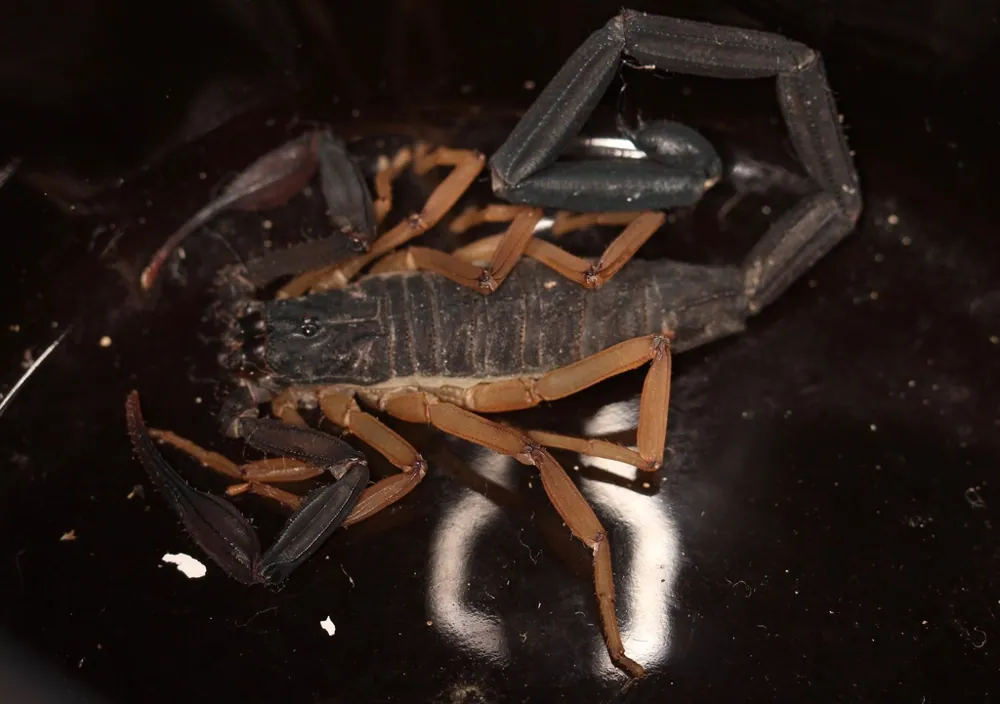
The Florida bark scorpion is a small scorpion with a sting that can cause serious harm. It is not really from Florida: it is native to northern Middle America and has spread to other places, including Florida. It hides under rocks, bark and rubbish, and sometimes lives inside houses.1


 Tsela ya go e lemoga
- Its colour varies. It may be reddish, black with reddish pincers, or dark brown with yellowish legs and red pincers.1
- Some individuals are dark brown with reddish and black tail sections.1
- Females reach up to 10 cm long. Males can grow over 15 cm long.1
Gantsi e tlhakanngwa le: In Florida it lives alongside two native scorpions, the Hentz striped scorpion and the Guiana striped scorpion.1
Maatla a botlhole
Botlhole bo tswa ka lemao le le tlhabang.
Botlhole jo e bo tsenyang bo dira eng?
This scorpion is venomous, but much less toxic than others in its genus. Its venom is neurotoxic (it attacks the nerves) and cardiotoxic (it affects the heart), and it causes the release of catecholamines, hormones that speed up the body. Local effects include pain, redness, itching and swelling. Possible symptoms include irregular or fast heartbeat, fluid in the lungs, nausea, vomiting, sweating, diarrhoea, shock, convulsions and coma.1
E kotsi go le kae go batho?
Kotsi go batho: E botlhokoE ka utlwisa botlhoko tota, mme go seoka thata gore e nne masisi.It is much less toxic than other scorpions in its genus. Serious symptoms can still occur, and death is possible.1
 Fa e tlhaba
- Tsidifatsa fa go tlhabilweng ka pakana ya aese mme o dire gore motho a nne a sa tshikinyege. Batla thuso ya bongaka ka bonako, bogolo jang go bana: diphepheng dingwe di bolaya bana.
Ka gale leletsa nomoro ya gago ya tshoganyetso pele (112, 000, 911). Se ke kaelo e e akaretsang ya thuso ya ntlha, ga se kgakololo ya bongaka. Motheo wa thuso ya ntlha
 Nna o babalesegile
- O se ka wa ama, wa tshwara kgotsa wa tshwenya phologolo ya naga, le fa e le e nnye, le fa e lebega e robetse kgotsa e sule.
- E fe sebaka. Fa o kopana le yone, ritibala, boela morago ka bonya mme o e tlogele e tsamaye ka tsela ya yone.
- Fa e nngwe e go tlhaba: ritibala, o se ka wa tshikinyega, leletsa nomoro ya gago ya tshoganyetso (112, 000, 911) kgotsa o ye bookelong ka bonako. Gopola gore e ne e lebega jang, setshwantsho se a thusa.
Ga e go batle. E dirisa botlhole jwa yone go tshwara dijo kgotsa go itshireletsa, mme e rata go iphitlha go feta. Go le gontsi ka go nna o babalesegile
Kae mo lefatsheng?
E kgolo go le kae?
E telele go le kae?
 boleele jo bo lekanang le diboloko tsa go aga tsa ditshamekisi di le 5 mo moleng
 e ka taboga dimetara di le 100 ka metsotswana e le 180 (motho yo o bonako go gaisa o tlhoka 9,6)
Florida bark scorpion e kgolo go le kae fa e bapisiwa le WENA?
Ke dipalo fela mo sefetleng sa gago (browser). Ga go sepe se se bolokwang kgotsa se se romelwang gope.
E bonako go le kae?


Dintlha
Females can reproduce without a male, through a process called parthenogenesis.1
Newborn young ride on their mother's back.1
Tarantulas such as Tliltocatl vagans prey on it, and a tarantula may kill it even if the scorpion strikes first.1
In a laboratory study, males lived about 33 months on average and females about 38 months.1
Despite its name, it is native to northern Middle America, not Florida.1
Mosenyi wa ditlhamane
Tlhamane: It is a Florida native scorpion, as its name suggests.
Nnete: It is not native to Florida. It comes from northern Middle America and was introduced to Florida and other places.1
Ya baitseanape ba botlhole
Kwa dintlha di tswang teng
- Centruroides gracilis (Wikipedia (CC BY-SA 4.0))
- Centruroides gracilis (iNaturalist): maina le thulaganyo ya mefuta.
- Venom Wiki: seelo sa kotsi, bogolo jo bo tlwaelegileng le kakanyo ya lebelo ke tsa rona. Bona kafa re di balang ka teng: Kafa re lekanyang kotsi ka teng.
Ntlha nngwe le nngwe mo tsebeng e e na le nomoro e e supang motswedi wa yone. Fa re dirile phoso, maitshwarelo, re barati ba diphologolo, e seng kgatiso ya saense. Re bolelele kwa [email protected] mme re tla e baakanya.
 Phepheng e tshwerwe ke tlala! Venom Wiki ke porojeke ya motho a le mongwe: ke mahala, ga e na dipapatso le ditraka. Mpho e nnye e thusa go e tshegetsa mo inthaneteng.Fepa phepheng
Tse dingwe tsa setlhopha se se tshwanang: Diphepheng
 Arizona bark scorpion
 Brazilian yellow scorpion
 Cuban blue scorpion
 Striped bark scorpion
 Giant desert hairy scorpion
 Amazonian black scorpion
E tshela gape kwa: Amerika Bokone
 TerciopeloDivaepara tsa mesima (pit vipers)E a bolaya
 Eastern coral snakeDinoga tsa khoraleE ka bolaya
 Eastern diamondback rattlesnakeDinoga tsa ratheleE ka bolaya
 Eyelash viperDivaepara tsa mesima (pit vipers)E ka bolaya
 Timber rattlesnakeDinoga tsa ratheleE ka bolaya
 Western diamondback rattlesnakeDinoga tsa ratheleE ka bolaya