
 Aforika
 Asia
Asia Yuropa
 Amerika Borwa
 Australia le Oceania
 Antarctica
 Lewatle la Pacific
 Lewatle la Atlantic
 Lewatle la India
 Lewatle la Arctic
 Lewatle la Mediterranean
 Lewatle le Lehibidu
 Lewatle la Caribbean
 Lewatle la Coral
 Lewatle la China Borwa
 Lewatle la Philippines
 Lewatle la Andaman
 Lewatle la Bokone
 Lewatle la Timor le la Arafura
 Kou ya Bengal
 Gulf ya California
Guinea paper wasp
 Go tlhaba
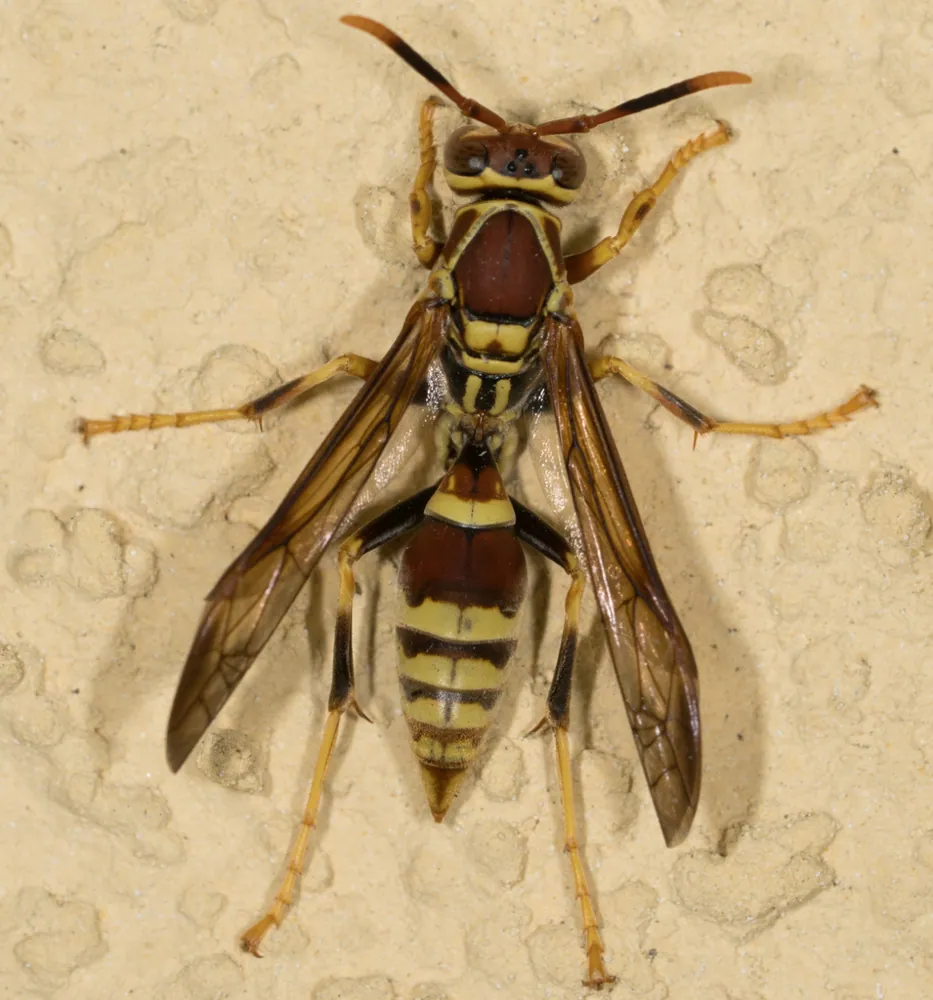
The Guinea paper wasp is a social wasp that builds small, open nests in colonies of up to about one hundred individuals. It lives in parts of North America, including the eastern United States, Ontario in Canada, and Mexico. Its colonies are often found near buildings and other man-made structures.1
 Tsela ya go e lemoga
- Typical form: mostly yellow markings on the back of the thorax and the propodeum (the rear part of the thorax), and wings that are purple-tinged rather than yellow.1
- Variable form: red-brown body with dark, almost black, markings on the middle of the antennae, the bases of the abdominal segments and the wings, and pale ivory-white markings spread across the body.1
- Antennae banded with red, black and yellow, unlike most paper wasps, which have only one antenna colour.1
- Females have forewings of 13.0 to 16.5 mm; males have forewings of 12.0 to 15.0 mm.1
- Males have bulging eyes and slender antennae.1
Gantsi e tlhakanngwa le: The typical form is often confused with Polistes fuscatus, Polistes crinitus and Polistes minor.1
Maatla a botlhole
Botlhole bo tswa ka lemao le le tlhabang.
E kotsi go le kae go batho?
Kotsi go batho: E botlhokoE ka utlwisa botlhoko tota, mme go seoka thata gore e nne masisi. Fa e tlhaba
- Ntsha lemao la notshe ka go le kgwaratla, mme o tsidifatse lefelo leo.
- Fa motho a hema ka bothata, sefatlhego kgotsa mometso o ruruga, kgotsa a ikutlwa a tla idibala, ke tshoganyetso ya aletshi: leletsa nomoro ya gago ya tshoganyetso mme o dirise pene ya gagwe ya adrenaline fa a na le yone.
Ka gale leletsa nomoro ya gago ya tshoganyetso pele (112, 000, 911). Se ke kaelo e e akaretsang ya thuso ya ntlha, ga se kgakololo ya bongaka. Motheo wa thuso ya ntlha
 Nna o babalesegile
- O se ka wa ama, wa tshwara kgotsa wa tshwenya phologolo ya naga, le fa e le e nnye, le fa e lebega e robetse kgotsa e sule.
- E fe sebaka. Fa o kopana le yone, ritibala, boela morago ka bonya mme o e tlogele e tsamaye ka tsela ya yone.
- Fa e nngwe e go tlhaba: ritibala, o se ka wa tshikinyega, leletsa nomoro ya gago ya tshoganyetso (112, 000, 911) kgotsa o ye bookelong ka bonako. Gopola gore e ne e lebega jang, setshwantsho se a thusa.
Ga e go batle. E dirisa botlhole jwa yone go tshwara dijo kgotsa go itshireletsa, mme e rata go iphitlha go feta. Go le gontsi ka go nna o babalesegile
Kae mo lefatsheng?
E kgolo go le kae?
E telele go le kae?
 khutshwane go feta monwana wa gago o monnye
 e ka fofa go kgabaganya lebala lotlhe la kgwele ya dinao ka metsotswana e le 15
Guinea paper wasp e kgolo go le kae fa e bapisiwa le WENA?
Ke dipalo fela mo sefetleng sa gago (browser). Ga go sepe se se bolokwang kgotsa se se romelwang gope.
E bonako go le kae?


Dintlha
Queens survive cold better than workers. In one test at 5 °C over 15 days, 76% of queens survived compared with 17% of workers, partly because they build up sugars that act as antifreeze and a layer of body fat.1
When a queen dies, the oldest female worker becomes the new queen, because the colony ranks its members by age.1
Whether a wasp becomes a worker or a queen is set by the temperature it experiences as an immature wasp.1
Nests are small, usually with fewer than one hundred individuals, so the queen is often the most active wasp in the nest and directly controls the nest's activity.1
Out of six wasp species studied, this was the only one that nested in artificial sites.1
Kwa dintlha di tswang teng
- Polistes exclamans (Wikipedia (CC BY-SA 4.0))
- Polistes exclamans (iNaturalist): maina le thulaganyo ya mefuta.
- Venom Wiki: seelo sa kotsi, bogolo jo bo tlwaelegileng le kakanyo ya lebelo ke tsa rona. Bona kafa re di balang ka teng: Kafa re lekanyang kotsi ka teng.
Ntlha nngwe le nngwe mo tsebeng e e na le nomoro e e supang motswedi wa yone. Fa re dirile phoso, maitshwarelo, re barati ba diphologolo, e seng kgatiso ya saense. Re bolelele kwa [email protected] mme re tla e baakanya.
 Phepheng e tshwerwe ke tlala! Venom Wiki ke porojeke ya motho a le mongwe: ke mahala, ga e na dipapatso le ditraka. Mpho e nnye e thusa go e tshegetsa mo inthaneteng.Fepa phepheng
Tse dingwe tsa setlhopha se se tshwanang: Dinotshe, diwasepe le dihonete
 Tarantula hawkDinotshe, diwasepe le dihoneteE utlwisa botlhoko fela
 Executioner waspDinotshe, diwasepe le dihoneteE tlhoka ngaka
 Warrior waspDinotshe, diwasepe le dihoneteE tlhoka ngaka
 Bald-faced hornetDinotshe, diwasepe le dihoneteE utlwisa botlhoko fela
 Cow killer velvet antDinotshe, diwasepe le dihoneteE utlwisa botlhoko fela
 Eastern cicada killerDinotshe, diwasepe le dihoneteGa e na kotsi
E tshela gape kwa: Amerika Bokone
 TerciopeloDivaepara tsa mesima (pit vipers)E a bolaya
 Eastern coral snakeDinoga tsa khoraleE ka bolaya
 Eastern diamondback rattlesnakeDinoga tsa ratheleE ka bolaya
 Eyelash viperDivaepara tsa mesima (pit vipers)E ka bolaya
 Timber rattlesnakeDinoga tsa ratheleE ka bolaya
 Western diamondback rattlesnakeDinoga tsa ratheleE ka bolaya