
 Aforika
 Asia
Asia Yuropa
 Amerika Borwa
 Australia le Oceania
 Antarctica
 Lewatle la Pacific
 Lewatle la Atlantic
 Lewatle la India
 Lewatle la Arctic
 Lewatle la Mediterranean
 Lewatle le Lehibidu
 Lewatle la Caribbean
 Lewatle la Coral
 Lewatle la China Borwa
 Lewatle la Philippines
 Lewatle la Andaman
 Lewatle la Bokone
 Lewatle la Timor le la Arafura
 Kou ya Bengal
 Gulf ya California
Montpellier snake
 Go loma
The Montpellier snake is a rear-fanged snake found in southern Europe and North Africa. It is mildly venomous, and it is active during the day, mainly hunting lizards. It is one of the most common snakes across its range, even in areas where people live.1

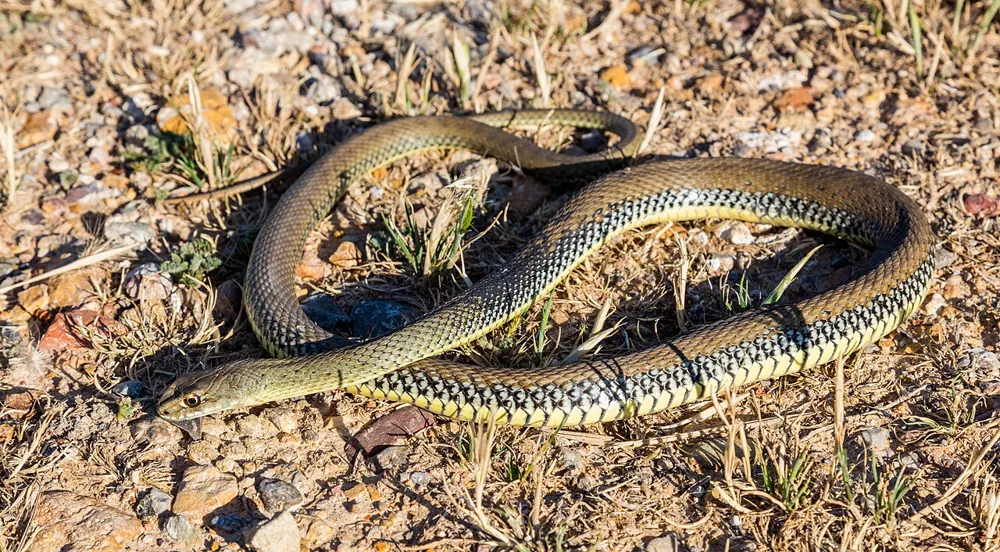
 Tsela ya go e lemoga
Maatla a botlhole
Botlhole bo tswa ka meno a yone fa e loma.
Botlhole jo e bo tsenyang bo dira eng?
It is mildly venomous. Its rear fangs, which sit towards the back of the mouth, make it less likely to inject venom, and the venom is of low toxicity. Venom can still be injected by bites from large individuals.1
E kotsi go le kae go batho?
Kotsi go batho: E botlhokoE ka utlwisa botlhoko tota, mme go seoka thata gore e nne masisi.The Montpellier snake is not dangerous to humans. Only a few cases of envenomation of people are known, and one of these happened when a finger was put into the snake's mouth. The venom is not very dangerous.1
 Fa e loma
- Symptomatic treatment, which means treating the symptoms as they appear, is enough to deal with an envenomation.1
- Tlhatswa fa go lomilweng, dira gore motho a ritibale mme o batle thuso ya bongaka. Mefuta mengwe (jaaka boomslang) e ka bolaya diura morago.
Ka gale leletsa nomoro ya gago ya tshoganyetso pele (112, 000, 911). Se ke kaelo e e akaretsang ya thuso ya ntlha, ga se kgakololo ya bongaka. Motheo wa thuso ya ntlha
 Nna o babalesegile
- O se ka wa ama, wa tshwara kgotsa wa tshwenya phologolo ya naga, le fa e le e nnye, le fa e lebega e robetse kgotsa e sule.
- E fe sebaka. Fa o kopana le yone, ritibala, boela morago ka bonya mme o e tlogele e tsamaye ka tsela ya yone.
- Fa e nngwe e go loma: ritibala, o se ka wa tshikinyega, leletsa nomoro ya gago ya tshoganyetso (112, 000, 911) kgotsa o ye bookelong ka bonako. Gopola gore e ne e lebega jang, setshwantsho se a thusa.
Ga e go batle. E dirisa botlhole jwa yone go tshwara dijo kgotsa go itshireletsa, mme e rata go iphitlha go feta. Go le gontsi ka go nna o babalesegile
Kae mo lefatsheng?
E kgolo go le kae?
E telele go le kae?
E kima go le kae?
 boleele jo bo lekanang le dintša di le 2,5 go tloga kwa nkong go ya mogatleng
 boleele jo bo lekanang le dipanana di le 14 di latelana
 e ka nna bokima jo bo lekanang le jwa katse ya ntlo
 e ka taboga dimetara di le 100 ka metsotswana e le 59 (motho yo o bonako go gaisa o tlhoka 9,6)
Montpellier snake e kgolo go le kae fa e bapisiwa le WENA?
Ke dipalo fela mo sefetleng sa gago (browser). Ga go sepe se se bolokwang kgotsa se se romelwang gope.
E bonako go le kae?


,_Nig%C3%BCella,_Zaragoza,_Espa%C3%B1a,_2017-05-24,_DD_07.jpg)
Dintlha
Genetic evidence suggests it originated in the Maghreb and migrated into southwestern Europe between 83,000 and 168,000 years ago.1
It is often killed by cars and farmers, and it is sometimes used by snake charmers and sold as a curio.1
Its common, relatively mild persecution by people has helped it become one of the most common snakes across its range.1
Mosenyi wa ditlhamane
Tlhamane: That the Montpellier snake is a dangerous snake for humans.
Nnete: It is not dangerous to humans. Its rear fangs and low-toxicity venom mean serious harm is very unlikely.1
Kwa dintlha di tswang teng
- Malpolon monspessulanus (Wikipedia (CC BY-SA 4.0))
- Malpolon monspessulanus (iNaturalist): maina le thulaganyo ya mefuta.
- Venom Wiki: seelo sa kotsi, bogolo jo bo tlwaelegileng le kakanyo ya lebelo ke tsa rona. Bona kafa re di balang ka teng: Kafa re lekanyang kotsi ka teng.
Ntlha nngwe le nngwe mo tsebeng e e na le nomoro e e supang motswedi wa yone. Fa re dirile phoso, maitshwarelo, re barati ba diphologolo, e seng kgatiso ya saense. Re bolelele kwa [email protected] mme re tla e baakanya.
 Phepheng e tshwerwe ke tlala! Venom Wiki ke porojeke ya motho a le mongwe: ke mahala, ga e na dipapatso le ditraka. Mpho e nnye e thusa go e tshegetsa mo inthaneteng.Fepa phepheng
Tse dingwe tsa setlhopha se se tshwanang: Dinoga tse di nang le meno a botlhole kwa morago
 BoomslangDinoga tse di nang le meno a botlhole kwa moragoE ka bolaya
 Cape twig snakeDinoga tse di nang le meno a botlhole kwa moragoE ka bolaya
 Forest twig snakeDinoga tse di nang le meno a botlhole kwa moragoE ka bolaya
 Bibron's stiletto snakeDinoga tse di nang le meno a botlhole kwa moragoE tlhoka ngaka
 Madagascar leaf-nosed snakeDinoga tse di nang le meno a botlhole kwa moragoE utlwisa botlhoko fela
 Eastern twig snakeDinoga tse di nang le meno a botlhole kwa moragoE ka bolaya
E tshela gape kwa: Yuropa
 Common European adderDivaepara le diboloboloE tlhoka ngaka
 Spanish flyDiphologolo tse dingwe tse di botlhole go di ama kgotsa go di jaE tlhoka ngakaO se ka wa ama
 Common waspDinotshe, diwasepe le dihoneteE utlwisa botlhoko fela
 European hornetDinotshe, diwasepe le dihoneteE utlwisa botlhoko fela
 Fire salamanderDigwagwa tsa botlhole, digwagwa tse dingwe le dinewtE utlwisa botlhoko felaO se ka wa ama
 Western honey beeDinotshe, diwasepe le dihoneteE utlwisa botlhoko fela