
 Aforika
 Asia
Asia Yuropa
 Amerika Borwa
 Australia le Oceania
 Antarctica
 Lewatle la Pacific
 Lewatle la Atlantic
 Lewatle la India
 Lewatle la Arctic
 Lewatle la Mediterranean
 Lewatle le Lehibidu
 Lewatle la Caribbean
 Lewatle la Coral
 Lewatle la China Borwa
 Lewatle la Philippines
 Lewatle la Andaman
 Lewatle la Bokone
 Lewatle la Timor le la Arafura
 Kou ya Bengal
 Gulf ya California
Prairie rattlesnake
 Go loma
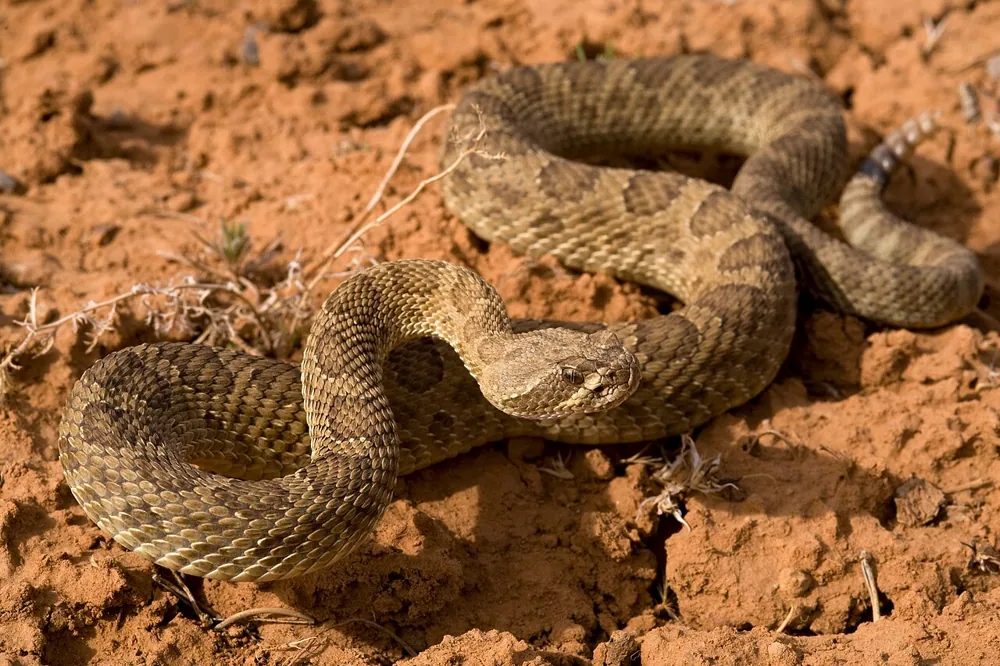
The prairie rattlesnake is a venomous pit viper that lives across the Great Plains and the foothills of the Rocky Mountains. It is found in the western United States, southwestern Canada and northern Mexico. It shakes its tail to give a rattling warning when it feels threatened.1



 Tsela ya go e lemoga
- Usually lightly coloured in shades of brown, with patches of dark brown along the back1
- A colour band may be seen at the back of the eye1
- A triangle-shaped head with pit sensory organs on either side1
- Usually four internasal scales on the snout, with three or more in total1
- Commonly grows to more than 100 cm long1
Gantsi e tlhakanngwa le: Other rattlesnakes can look similar. A key difference is that two internasal scales touch the rostral scale, at the tip of the snout, in the prairie rattlesnake.1
Maatla a botlhole
Botlhole bo tswa ka meno a yone fa e loma.
Botlhole jo e bo tsenyang bo dira eng?
The venom is a complex mixture of proteins, including enzymes such as proteases and peptidases. It is hemotoxic, meaning it damages blood and destroys tissue. It also has neurotoxic properties, meaning it attacks the nerves.1
E kotsi go le kae go batho?
Kotsi go batho: E masisiGo lomiwa ke yone go tlhoka ngaka. Go swa go seoka thata.The species has powerful venom and uses about 20 to 55% of its venom in one bite. It will defend itself if it is threatened or injured.1
E dira eng fa e tshogile?
It rapidly vibrates its tail to make a rasping rattle that warns intruders, and it will defend itself if threatened or injured.1
 Fa e loma
- Dira gore motho a nne a sa tshikinyege a ritibetse, tshegetsa setho se se lomilweng mo boemong jwa pelo, tlosa direng le dilo tse di tiileng, mme o mo ise bookelong ka bonako.
Ka gale leletsa nomoro ya gago ya tshoganyetso pele (112, 000, 911). Se ke kaelo e e akaretsang ya thuso ya ntlha, ga se kgakololo ya bongaka. Motheo wa thuso ya ntlha
 Nna o babalesegile
- O se ka wa ama, wa tshwara kgotsa wa tshwenya phologolo ya naga, le fa e le e nnye, le fa e lebega e robetse kgotsa e sule.
- E fe sebaka. Fa o kopana le yone, ritibala, boela morago ka bonya mme o e tlogele e tsamaye ka tsela ya yone.
- Fa e nngwe e go loma: ritibala, o se ka wa tshikinyega, leletsa nomoro ya gago ya tshoganyetso (112, 000, 911) kgotsa o ye bookelong ka bonako. Gopola gore e ne e lebega jang, setshwantsho se a thusa.
Ga e go batle. E dirisa botlhole jwa yone go tshwara dijo kgotsa go itshireletsa, mme e rata go iphitlha go feta. Go le gontsi ka go nna o babalesegile
Kae mo lefatsheng?
E kgolo go le kae?
E telele go le kae?
 boleele jo bo lekanang le dikatse tsa ntlo di le 3 go tloga kwa nkong go ya mogatleng
 boleele jo bo lekanang le dipanana di le 8 di latelana
 e ka taboga dimetara di le 100 ka metsotswana e le 97 (motho yo o bonako go gaisa o tlhoka 9,6)
Prairie rattlesnake e kgolo go le kae fa e bapisiwa le WENA?
Ke dipalo fela mo sefetleng sa gago (browser). Ga go sepe se se bolokwang kgotsa se se romelwang gope.
E bonako go le kae?


.jpg)
Dintlha
Females often gather in communal dens to give birth and care for their young. Some females even look after unrelated young while the mothers take a break.1
Newborn snakelets measure 22 to 28 cm and are venomous from the moment they are born.1
Prairie rattlesnakes prefer a straight migration path, even in areas dominated by humans, because it gives them a better chance of survival.1
In Montana, the species reaches its largest size, with specimens sometimes exceeding 120 cm.1
In Canada, the species is listed as a species of special concern because its numbers have steadily declined since the 1930s.1
Ya baitseanape ba botlhole
- Leina la saense
- Crotalus viridis
- Setlhopha
- Dinoga tsa rathele
- Lelapa
- Viperidae2
- Lekoko
- Squamata
- Dikontinente
- Amerika Bokone
- Masea
- It gives birth to one to 25 live young per litter, typically four to 12, in late summer or early fall.1
- Seemo sa yone kwa nageng
- Least concern on the IUCN Red List. It is listed as endangered in Iowa and as a species of special concern in Canada.1
- Kotsi go batho
- 3 / 5: E masisi3
Kwa dintlha di tswang teng
- Crotalus viridis (Wikipedia (CC BY-SA 4.0))
- Crotalus viridis (iNaturalist): maina le thulaganyo ya mefuta.
- Venom Wiki: seelo sa kotsi, bogolo jo bo tlwaelegileng le kakanyo ya lebelo ke tsa rona. Bona kafa re di balang ka teng: Kafa re lekanyang kotsi ka teng.
Ntlha nngwe le nngwe mo tsebeng e e na le nomoro e e supang motswedi wa yone. Fa re dirile phoso, maitshwarelo, re barati ba diphologolo, e seng kgatiso ya saense. Re bolelele kwa [email protected] mme re tla e baakanya.
 Phepheng e tshwerwe ke tlala! Venom Wiki ke porojeke ya motho a le mongwe: ke mahala, ga e na dipapatso le ditraka. Mpho e nnye e thusa go e tshegetsa mo inthaneteng.Fepa phepheng
Tse dingwe tsa setlhopha se se tshwanang: Dinoga tsa rathele
 Eastern diamondback rattlesnakeDinoga tsa ratheleE ka bolaya
 Timber rattlesnakeDinoga tsa ratheleE ka bolaya
 Western diamondback rattlesnakeDinoga tsa ratheleE ka bolaya
 SidewinderDinoga tsa ratheleE tlhoka ngaka
 Mojave rattlesnakeDinoga tsa ratheleE ka bolaya
 Aruba rattlesnakeDinoga tsa ratheleE tlhoka ngaka
E tshela gape kwa: Amerika Bokone
 TerciopeloDivaepara tsa mesima (pit vipers)E a bolaya
 Eastern coral snakeDinoga tsa khoraleE ka bolaya
 Eyelash viperDivaepara tsa mesima (pit vipers)E ka bolaya
 Arizona bark scorpionDiphephengE tlhoka ngaka
 Brown recluseDigokgoE tlhoka ngaka
 Cane toadDigwagwa tsa botlhole, digwagwa tse dingwe le dinewtE tlhoka ngakaO se ka wa ama