
 Aforika
 Asia
Asia Yuropa
 Amerika Borwa
 Australia le Oceania
 Antarctica
 Lewatle la Pacific
 Lewatle la Atlantic
 Lewatle la India
 Lewatle la Arctic
 Lewatle la Mediterranean
 Lewatle le Lehibidu
 Lewatle la Caribbean
 Lewatle la Coral
 Lewatle la China Borwa
 Lewatle la Philippines
 Lewatle la Andaman
 Lewatle la Bokone
 Lewatle la Timor le la Arafura
 Kou ya Bengal
 Gulf ya California
Rusty spider wasp
 Go tlhaba
The rusty spider wasp is a reddish-brown wasp that hunts large spiders, mainly wolf spiders. It lives across a huge area of the Americas, from southern Canada to South America and the Caribbean. Females catch a spider, paralyse it and use it to feed their young.1


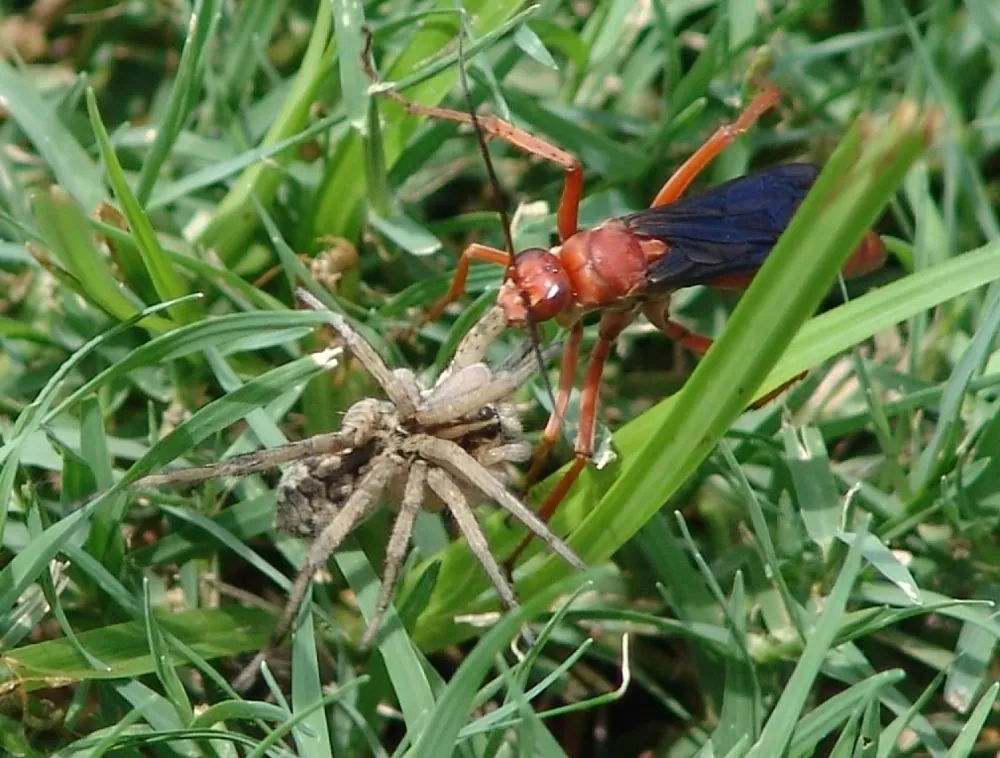
 Tsela ya go e lemoga
- Mostly reddish-brown body1
- Four narrow dark bands circling the abdomen1
- Violet-blue wings1
- Body length of 15 to 25 mm1
Gantsi e tlhakanngwa le: The red-tailed spider wasp name is also used for the Asian species Tachypompilus analis, so the name alone does not tell you which species you have.1
Maatla a botlhole
Botlhole bo tswa ka lemao le le tlhabang.
E kotsi go le kae go batho?
Kotsi go batho: E botlhokoE ka utlwisa botlhoko tota, mme go seoka thata gore e nne masisi. Fa e tlhaba
- Ntsha lemao la notshe ka go le kgwaratla, mme o tsidifatse lefelo leo.
- Fa motho a hema ka bothata, sefatlhego kgotsa mometso o ruruga, kgotsa a ikutlwa a tla idibala, ke tshoganyetso ya aletshi: leletsa nomoro ya gago ya tshoganyetso mme o dirise pene ya gagwe ya adrenaline fa a na le yone.
Ka gale leletsa nomoro ya gago ya tshoganyetso pele (112, 000, 911). Se ke kaelo e e akaretsang ya thuso ya ntlha, ga se kgakololo ya bongaka. Motheo wa thuso ya ntlha
 Nna o babalesegile
- O se ka wa ama, wa tshwara kgotsa wa tshwenya phologolo ya naga, le fa e le e nnye, le fa e lebega e robetse kgotsa e sule.
- E fe sebaka. Fa o kopana le yone, ritibala, boela morago ka bonya mme o e tlogele e tsamaye ka tsela ya yone.
- Fa e nngwe e go tlhaba: ritibala, o se ka wa tshikinyega, leletsa nomoro ya gago ya tshoganyetso (112, 000, 911) kgotsa o ye bookelong ka bonako. Gopola gore e ne e lebega jang, setshwantsho se a thusa.
Ga e go batle. E dirisa botlhole jwa yone go tshwara dijo kgotsa go itshireletsa, mme e rata go iphitlha go feta. Go le gontsi ka go nna o babalesegile
Kae mo lefatsheng?
E kgolo go le kae?
E telele go le kae?
 e ka nna boleele jo bo lekanang le jwa kelipi ya pampiri
 e ka fofa go kgabaganya lebala lotlhe la kgwele ya dinao ka metsotswana e le 14
Rusty spider wasp e kgolo go le kae fa e bapisiwa le WENA?
Ke dipalo fela mo sefetleng sa gago (browser). Ga go sepe se se bolokwang kgotsa se se romelwang gope.
E bonako go le kae?


Dintlha
Mating pairs scissor their wings face to face, which is unusual for spider wasps, which normally flick their wings vertically.1
Males and females both shelter in a crevice at the base of a monument at night and when it rains, and up to eight wasps have been seen there at once.1
The female camouflages the nest with pieces of debris from nearby.1
Females have been seen dragging leaves into their nests in Ohio.1
In southern Canada, the dark fishing spider Dolomedes tenebrosus has been recorded as prey.1
Ya baitseanape ba botlhole
Kwa dintlha di tswang teng
- Tachypompilus ferrugineus (Wikipedia (CC BY-SA 4.0))
- Tachypompilus ferrugineus (iNaturalist): maina le thulaganyo ya mefuta.
- Venom Wiki: seelo sa kotsi, bogolo jo bo tlwaelegileng le kakanyo ya lebelo ke tsa rona. Bona kafa re di balang ka teng: Kafa re lekanyang kotsi ka teng.
Ntlha nngwe le nngwe mo tsebeng e e na le nomoro e e supang motswedi wa yone. Fa re dirile phoso, maitshwarelo, re barati ba diphologolo, e seng kgatiso ya saense. Re bolelele kwa [email protected] mme re tla e baakanya.
 Phepheng e tshwerwe ke tlala! Venom Wiki ke porojeke ya motho a le mongwe: ke mahala, ga e na dipapatso le ditraka. Mpho e nnye e thusa go e tshegetsa mo inthaneteng.Fepa phepheng
Tse dingwe tsa setlhopha se se tshwanang: Dinotshe, diwasepe le dihonete
 Tarantula hawkDinotshe, diwasepe le dihoneteE utlwisa botlhoko fela
 Executioner waspDinotshe, diwasepe le dihoneteE tlhoka ngaka
 Warrior waspDinotshe, diwasepe le dihoneteE tlhoka ngaka
 Bald-faced hornetDinotshe, diwasepe le dihoneteE utlwisa botlhoko fela
 Cow killer velvet antDinotshe, diwasepe le dihoneteE utlwisa botlhoko fela
 Eastern cicada killerDinotshe, diwasepe le dihoneteGa e na kotsi
E tshela gape kwa: Amerika Bokone
 TerciopeloDivaepara tsa mesima (pit vipers)E a bolaya
 Eastern coral snakeDinoga tsa khoraleE ka bolaya
 Eastern diamondback rattlesnakeDinoga tsa ratheleE ka bolaya
 Eyelash viperDivaepara tsa mesima (pit vipers)E ka bolaya
 Timber rattlesnakeDinoga tsa ratheleE ka bolaya
 Western diamondback rattlesnakeDinoga tsa ratheleE ka bolaya