
 Aforika
 Asia
Asia Yuropa
 Amerika Borwa
 Australia le Oceania
 Antarctica
 Lewatle la Pacific
 Lewatle la Atlantic
 Lewatle la India
 Lewatle la Arctic
 Lewatle la Mediterranean
 Lewatle le Lehibidu
 Lewatle la Caribbean
 Lewatle la Coral
 Lewatle la China Borwa
 Lewatle la Philippines
 Lewatle la Andaman
 Lewatle la Bokone
 Lewatle la Timor le la Arafura
 Kou ya Bengal
 Gulf ya California
Shield-nosed cobra
 Go loma
The shield-nosed cobra is a venomous snake from the cobra family, Elapidae. It lives in dry, sandy savanna across southern Africa. It is a night-time digger that spends much of its life underground, and its venom is strong enough to be a serious danger to people.1



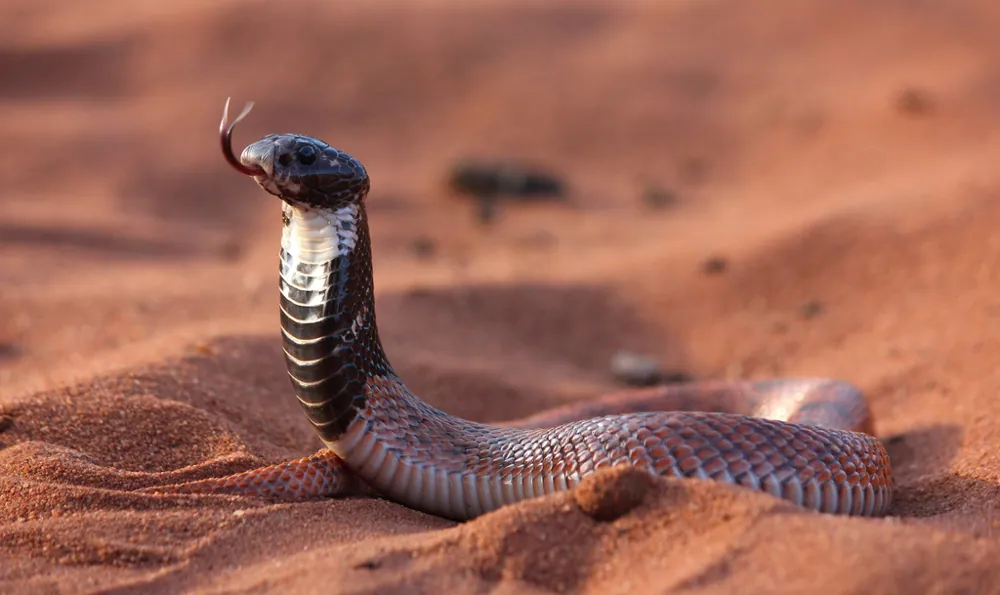
 Tsela ya go e lemoga
- Adults have an average snout-to-vent length of 63.5 cm.1
- It has a uniquely large rostral scale, the scale at the tip of the snout, which helps it dig.1
- Its dorsal (back) scales are arranged in 21 to 25 rows at midbody.1
- The scales on the rear part of the body are keeled, meaning they have a ridge along the middle.1
- It is nocturnal, so it is mostly active at night.1
Maatla a botlhole
Botlhole bo tswa ka meno a yone fa e loma.
Botlhole jo e bo tsenyang bo dira eng?
Its venom is highly neurotoxic, meaning it attacks the nerves. Symptoms include slurred speech, drooping eyelids (ptosis) and partial paralysis.1
E kotsi go le kae go batho?
Kotsi go batho: E masisiGo lomiwa ke yone go tlhoka ngaka. Go swa go seoka thata.The shield-nosed cobra is highly venomous. Its bite has caused at least one reported human death, even though it has a fairly low tendency to bite.1
 Fa e loma
- No antivenin is available for this species. Any bite or venom spat by any elapid snake should be treated as an urgent medical emergency.1
- Dira gore motho a nne a sa tshikinyege a ritibetse, tlosa direng le dilo tse di tiileng, mme o mo ise bookelong ka bonako: antivenom ke yone kalafi.
Ka gale leletsa nomoro ya gago ya tshoganyetso pele (112, 000, 911). Se ke kaelo e e akaretsang ya thuso ya ntlha, ga se kgakololo ya bongaka. Motheo wa thuso ya ntlha
 Nna o babalesegile
- O se ka wa ama, wa tshwara kgotsa wa tshwenya phologolo ya naga, le fa e le e nnye, le fa e lebega e robetse kgotsa e sule.
- E fe sebaka. Fa o kopana le yone, ritibala, boela morago ka bonya mme o e tlogele e tsamaye ka tsela ya yone.
- Fa e nngwe e go loma: ritibala, o se ka wa tshikinyega, leletsa nomoro ya gago ya tshoganyetso (112, 000, 911) kgotsa o ye bookelong ka bonako. Gopola gore e ne e lebega jang, setshwantsho se a thusa.
Ga e go batle. E dirisa botlhole jwa yone go tshwara dijo kgotsa go itshireletsa, mme e rata go iphitlha go feta. Go le gontsi ka go nna o babalesegile
Kae mo lefatsheng?
E kgolo go le kae?
E telele go le kae?
 boleele jo bo lekanang le dipanana di le 4 di latelana
 e ka taboga dimetara di le 100 ka metsotswana e le 58 (motho yo o bonako go gaisa o tlhoka 9,6)
Shield-nosed cobra e kgolo go le kae fa e bapisiwa le WENA?
Ke dipalo fela mo sefetleng sa gago (browser). Ga go sepe se se bolokwang kgotsa se se romelwang gope.
E bonako go le kae?


Dintlha
Its skull has a specialised structure, and its uniquely large rostral scale makes it very good at digging and tunnelling.1
The female may stay coiled around her eggs after laying them, guarding the clutch.1
The shield-nosed cobra can live for 20 to 28 years in captivity, but this age is normally not reached in the wild because of predation, accidents and other dangers.1
Kwa dintlha di tswang teng
- Shield-nosed cobra (Wikipedia (CC BY-SA 4.0))
- Aspidelaps scutatus (iNaturalist): maina le thulaganyo ya mefuta.
- Venom Wiki: seelo sa kotsi, bogolo jo bo tlwaelegileng le kakanyo ya lebelo ke tsa rona. Bona kafa re di balang ka teng: Kafa re lekanyang kotsi ka teng.
Ntlha nngwe le nngwe mo tsebeng e e na le nomoro e e supang motswedi wa yone. Fa re dirile phoso, maitshwarelo, re barati ba diphologolo, e seng kgatiso ya saense. Re bolelele kwa [email protected] mme re tla e baakanya.
 Phepheng e tshwerwe ke tlala! Venom Wiki ke porojeke ya motho a le mongwe: ke mahala, ga e na dipapatso le ditraka. Mpho e nnye e thusa go e tshegetsa mo inthaneteng.Fepa phepheng
Tse dingwe tsa setlhopha se se tshwanang: Dikobra, dimamba le dikrait
 Black mambaDikobra, dimamba le dikraitE a bolaya
 Egyptian cobraDikobra, dimamba le dikraitE a bolaya
 Cape cobraDikobra, dimamba le dikraitE a bolaya
 Eastern green mambaDikobra, dimamba le dikraitE a bolaya
 Jameson's mambaDikobra, dimamba le dikraitE a bolaya
 Western green mambaDikobra, dimamba le dikraitE a bolaya
 Deathstalker
 Puff adder
 Boomslang
 Fat-tailed scorpion
 Gaboon viper
 Western honey bee