
 Aforika
 Asia
Asia Yuropa
 Amerika Borwa
 Australia le Oceania
 Antarctica
 Lewatle la Pacific
 Lewatle la Atlantic
 Lewatle la India
 Lewatle la Arctic
 Lewatle la Mediterranean
 Lewatle le Lehibidu
 Lewatle la Caribbean
 Lewatle la Coral
 Lewatle la China Borwa
 Lewatle la Philippines
 Lewatle la Andaman
 Lewatle la Bokone
 Lewatle la Timor le la Arafura
 Kou ya Bengal
 Gulf ya California
Speckled rattlesnake
 Go loma
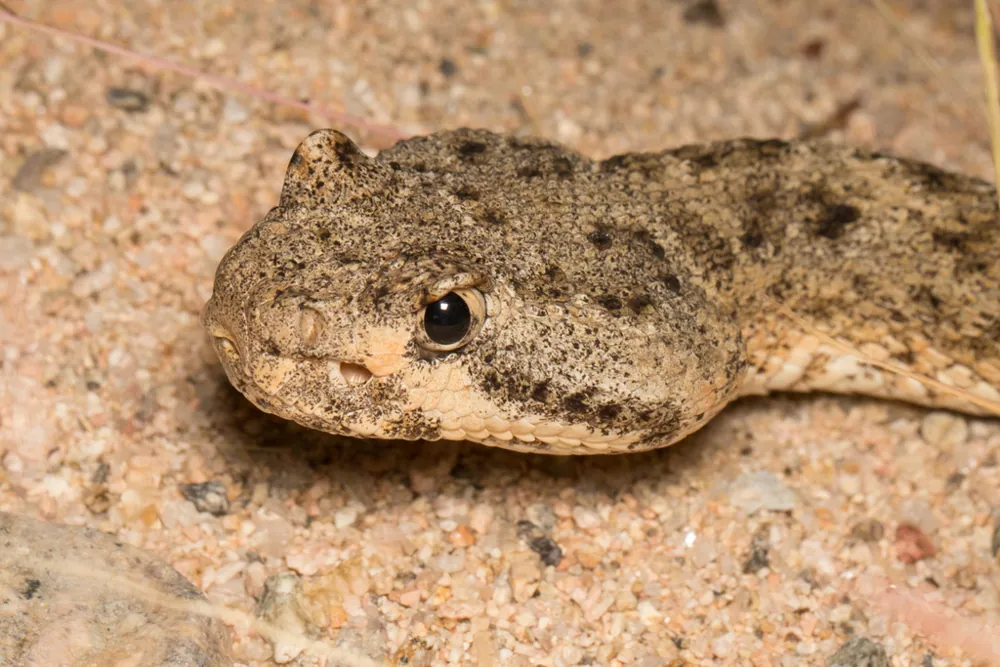
The speckled rattlesnake is a venomous pit viper that lives in the rocky deserts and shrubland of the south-western United States and north-western Mexico. Its back is patterned so that it looks like a piece of granite, which helps it hide among rocks. Keep a safe distance from any rattlesnake you see in the wild.1
 Tsela ya go e lemoga
- About thirty markings run along the back, often in the form of crossbars.1
- Some markings are clearly defined geometric shapes, such as diamonds, hexagons or hourglasses.1
- The markings are always darker than the ground colour, but the exact colour varies from snake to snake.1
- Colouring usually matches the rocks where the snake lives.1
- Adults generally do not exceed 100 cm in total length, including the tail.1
Maatla a botlhole
Botlhole bo tswa ka meno a yone fa e loma.
E kotsi go le kae go batho?
Kotsi go batho: E masisiGo lomiwa ke yone go tlhoka ngaka. Go swa go seoka thata.E dira eng fa e tshogile?
Its patterned colouring blends with rock, so it is hard to see. It has a rattle at the end of its tail.1
 Fa e loma
- Dira gore motho a nne a sa tshikinyege a ritibetse, tshegetsa setho se se lomilweng mo boemong jwa pelo, tlosa direng le dilo tse di tiileng, mme o mo ise bookelong ka bonako.
Ka gale leletsa nomoro ya gago ya tshoganyetso pele (112, 000, 911). Se ke kaelo e e akaretsang ya thuso ya ntlha, ga se kgakololo ya bongaka. Motheo wa thuso ya ntlha
 Nna o babalesegile
- O se ka wa ama, wa tshwara kgotsa wa tshwenya phologolo ya naga, le fa e le e nnye, le fa e lebega e robetse kgotsa e sule.
- E fe sebaka. Fa o kopana le yone, ritibala, boela morago ka bonya mme o e tlogele e tsamaye ka tsela ya yone.
- Fa e nngwe e go loma: ritibala, o se ka wa tshikinyega, leletsa nomoro ya gago ya tshoganyetso (112, 000, 911) kgotsa o ye bookelong ka bonako. Gopola gore e ne e lebega jang, setshwantsho se a thusa.
Ga e go batle. E dirisa botlhole jwa yone go tshwara dijo kgotsa go itshireletsa, mme e rata go iphitlha go feta. Go le gontsi ka go nna o babalesegile
Kae mo lefatsheng?
E kgolo go le kae?
E telele go le kae?
 boleele jo bo lekanang le dikatse tsa ntlo di le 2,5 go tloga kwa nkong go ya mogatleng
 boleele jo bo lekanang le dipanana di le 8 di latelana
 e ka taboga dimetara di le 100 ka metsotswana e le 100 (motho yo o bonako go gaisa o tlhoka 9,6)
Speckled rattlesnake e kgolo go le kae fa e bapisiwa le WENA?
Ke dipalo fela mo sefetleng sa gago (browser). Ga go sepe se se bolokwang kgotsa se se romelwang gope.
E bonako go le kae?


Dintlha
Snakes on Isla Ángel de la Guarda can grow larger than mainland snakes, with one recorded specimen reaching 136.7 cm.1
Snakes on El Muerto Island are much smaller, reaching a maximum of 63.7 cm.1
Scientists have debated its classification. Some researchers have proposed that its island populations should be treated as separate species.1
Mosenyi wa ditlhamane
Tlhamane: It is sometimes called the tiger rattlesnake.
Nnete: The name tiger rattlesnake is wrong. It is a speckled rattlesnake, named for its markings.1
Ya baitseanape ba botlhole
- Leina la saense
- Crotalus mitchellii
- Setlhopha
- Dinoga tsa rathele
- Lelapa
- Viperidae2
- Lekoko
- Squamata
- Dikontinente
- Amerika Bokone
- Masea
- It is ovoviviparous, meaning the young develop inside eggs within the mother's body and are born live.1
- Seemo sa yone kwa nageng
- Least Concern (IUCN Red List, for the nominate subspecies)1
- Kotsi go batho
- 3 / 5: E masisi3
Kwa dintlha di tswang teng
- Crotalus mitchellii (Wikipedia (CC BY-SA 4.0))
- Crotalus mitchellii (iNaturalist): maina le thulaganyo ya mefuta.
- Venom Wiki: seelo sa kotsi, bogolo jo bo tlwaelegileng le kakanyo ya lebelo ke tsa rona. Bona kafa re di balang ka teng: Kafa re lekanyang kotsi ka teng.
Ntlha nngwe le nngwe mo tsebeng e e na le nomoro e e supang motswedi wa yone. Fa re dirile phoso, maitshwarelo, re barati ba diphologolo, e seng kgatiso ya saense. Re bolelele kwa [email protected] mme re tla e baakanya.
 Phepheng e tshwerwe ke tlala! Venom Wiki ke porojeke ya motho a le mongwe: ke mahala, ga e na dipapatso le ditraka. Mpho e nnye e thusa go e tshegetsa mo inthaneteng.Fepa phepheng
Tse dingwe tsa setlhopha se se tshwanang: Dinoga tsa rathele
 Eastern diamondback rattlesnakeDinoga tsa ratheleE ka bolaya
 Timber rattlesnakeDinoga tsa ratheleE ka bolaya
 Western diamondback rattlesnakeDinoga tsa ratheleE ka bolaya
 SidewinderDinoga tsa ratheleE tlhoka ngaka
 Mojave rattlesnakeDinoga tsa ratheleE ka bolaya
 Aruba rattlesnakeDinoga tsa ratheleE tlhoka ngaka
E tshela gape kwa: Amerika Bokone
 TerciopeloDivaepara tsa mesima (pit vipers)E a bolaya
 Eastern coral snakeDinoga tsa khoraleE ka bolaya
 Eyelash viperDivaepara tsa mesima (pit vipers)E ka bolaya
 Arizona bark scorpionDiphephengE tlhoka ngaka
 Brown recluseDigokgoE tlhoka ngaka
 Cane toadDigwagwa tsa botlhole, digwagwa tse dingwe le dinewtE tlhoka ngakaO se ka wa ama