
 Aforika
 Asia
Asia Yuropa
 Amerika Borwa
 Australia le Oceania
 Antarctica
 Lewatle la Pacific
 Lewatle la Atlantic
 Lewatle la India
 Lewatle la Arctic
 Lewatle la Mediterranean
 Lewatle le Lehibidu
 Lewatle la Caribbean
 Lewatle la Coral
 Lewatle la China Borwa
 Lewatle la Philippines
 Lewatle la Andaman
 Lewatle la Bokone
 Lewatle la Timor le la Arafura
 Kou ya Bengal
 Gulf ya California
Spiny bush viper
 Go loma
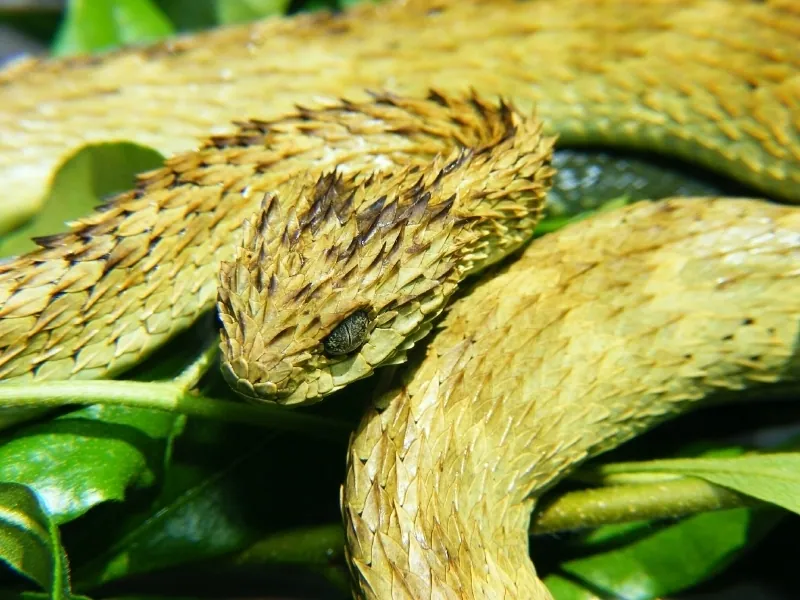
The spiny bush viper is a venomous snake with a bristly, shaggy look caused by spiky scales along its body. It lives in parts of Central and East Africa, mostly in forests and reedy places. Its venom can be dangerous to people, so it is important to know what it looks like.1



 Tsela ya go e lemoga
- Its body is covered in long, heavily keeled scales (scales with a raised ridge), which make it look shaggy and bristly.1
- The scales around the head and neck are the longest, and they get shorter towards the tail.1
- It has a short snout, more so in males than in females.1
- Males are surprisingly long and slender compared with females.1
Maatla a botlhole
Botlhole bo tswa ka meno a yone fa e loma.
Botlhole jo e bo tsenyang bo dira eng?
Its venom is mainly neurotoxic, meaning it attacks the nerves. It also contains cytotoxins, which damage cells, and fasciculins, which affect nerve signals. The strength of the venom varies between individual snakes and can be influenced by region, weather and altitude. Reports of bites show severe bleeding of internal organs.1
E kotsi go le kae go batho?
Kotsi go batho: E masisiGo lomiwa ke yone go tlhoka ngaka. Go swa go seoka thata.A bite can be fatal to people who do not get proper first aid and antivenom treatment. Its venom was once thought to be weaker than that of many other snakes, possibly because bites are uncommon, but recent reports show this is not the case.1
 Dikgang tse di molemo: dingaka di na le molemo (antivenom) kgotsa kalafi ya se.1
 Fa e loma
- A bite needs proper first aid, followed by antivenom treatment. Without these, a bite can be fatal.1
- Dira gore motho a nne a sa tshikinyege a ritibetse, tshegetsa setho se se lomilweng mo boemong jwa pelo, tlosa direng le dilo tse di tiileng, mme o mo ise bookelong ka bonako.
Ka gale leletsa nomoro ya gago ya tshoganyetso pele (112, 000, 911). Se ke kaelo e e akaretsang ya thuso ya ntlha, ga se kgakololo ya bongaka. Motheo wa thuso ya ntlha
 Nna o babalesegile
- O se ka wa ama, wa tshwara kgotsa wa tshwenya phologolo ya naga, le fa e le e nnye, le fa e lebega e robetse kgotsa e sule.
- E fe sebaka. Fa o kopana le yone, ritibala, boela morago ka bonya mme o e tlogele e tsamaye ka tsela ya yone.
- Fa e nngwe e go loma: ritibala, o se ka wa tshikinyega, leletsa nomoro ya gago ya tshoganyetso (112, 000, 911) kgotsa o ye bookelong ka bonako. Gopola gore e ne e lebega jang, setshwantsho se a thusa.
Ga e go batle. E dirisa botlhole jwa yone go tshwara dijo kgotsa go itshireletsa, mme e rata go iphitlha go feta. Go le gontsi ka go nna o babalesegile
Kae mo lefatsheng?
E kgolo go le kae?
E telele go le kae?
 boleele jo bo lekanang le dipanana di le 4 di latelana
 e ka taboga dimetara di le 100 ka metsotswana e le 110 (motho yo o bonako go gaisa o tlhoka 9,6)
Spiny bush viper e kgolo go le kae fa e bapisiwa le WENA?
Ke dipalo fela mo sefetleng sa gago (browser). Ga go sepe se se bolokwang kgotsa se se romelwang gope.
E bonako go le kae?


Dintlha
Its venom can vary greatly between individuals of the same species, even depending on the weather and altitude.1
Its scales are heavily keeled, meaning each has a raised ridge, and these are often called spikes.1
It can climb reeds and stalks and often rests on top of flowers.1
Males are much longer and more slender than females.1
Mosenyi wa ditlhamane
Tlhamane: Its venom is weaker than that of many other snakes.
Nnete: Its venom was once thought to be less toxic, but there are now reports of bites causing severe bleeding of internal organs.1
Kwa dintlha di tswang teng
- Atheris hispida (Wikipedia (CC BY-SA 4.0))
- Atheris hispida (iNaturalist): maina le thulaganyo ya mefuta.
- Venom Wiki: seelo sa kotsi, bogolo jo bo tlwaelegileng le kakanyo ya lebelo ke tsa rona. Bona kafa re di balang ka teng: Kafa re lekanyang kotsi ka teng.
Ntlha nngwe le nngwe mo tsebeng e e na le nomoro e e supang motswedi wa yone. Fa re dirile phoso, maitshwarelo, re barati ba diphologolo, e seng kgatiso ya saense. Re bolelele kwa [email protected] mme re tla e baakanya.
 Phepheng e tshwerwe ke tlala! Venom Wiki ke porojeke ya motho a le mongwe: ke mahala, ga e na dipapatso le ditraka. Mpho e nnye e thusa go e tshegetsa mo inthaneteng.Fepa phepheng
Tse dingwe tsa setlhopha se se tshwanang: Divaepara le dibolobolo
 Puff adderDivaepara le diboloboloE a bolaya
 Gaboon viperDivaepara le diboloboloE ka bolaya
 Northeast African carpet viperDivaepara le diboloboloE a bolaya
 West African carpet viperDivaepara le diboloboloE a bolaya
 Rhinoceros viperDivaepara le diboloboloE ka bolaya
 West African Gaboon viperDivaepara le diboloboloE ka bolaya
E tshela gape kwa: Aforika
 Black mambaDikobra, dimamba le dikraitE a bolaya
 DeathstalkerDiphephengE a bolaya
 Egyptian cobraDikobra, dimamba le dikraitE a bolaya
 BoomslangDinoga tse di nang le meno a botlhole kwa moragoE ka bolaya
 Fat-tailed scorpionDiphephengE ka bolaya
 Western honey beeDinotshe, diwasepe le dihoneteE utlwisa botlhoko fela