
 Aforika
 Asia
Asia Yuropa
 Amerika Borwa
 Australia le Oceania
 Antarctica
 Lewatle la Pacific
 Lewatle la Atlantic
 Lewatle la India
 Lewatle la Arctic
 Lewatle la Mediterranean
 Lewatle le Lehibidu
 Lewatle la Caribbean
 Lewatle la Coral
 Lewatle la China Borwa
 Lewatle la Philippines
 Lewatle la Andaman
 Lewatle la Bokone
 Lewatle la Timor le la Arafura
 Kou ya Bengal
 Gulf ya California
Thistledown velvet ant
 Go tlhaba
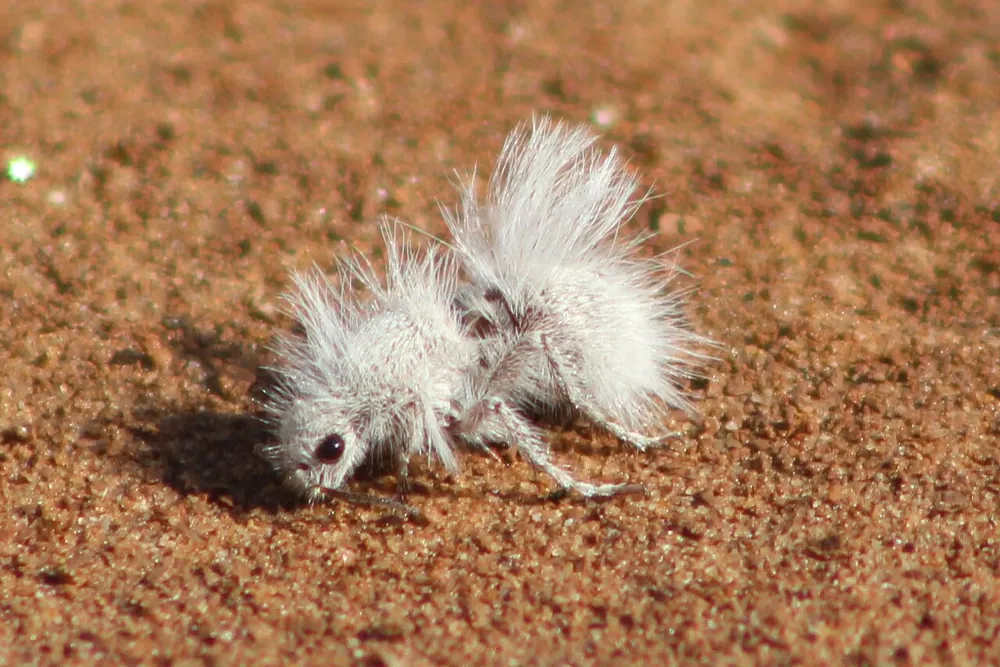
The thistledown velvet ant is a mid-sized member of the Dasymutilla genus, a group known as velvet ants. Its females have no wings and live in hot deserts in the south-western United States and northern Mexico. Females can deliver a very painful sting, so it is best to leave them alone.1
 Tsela ya go e lemoga
- Only the females are wingless.1
- It is mid-sized for a velvet ant, larger than some of the smallest species but smaller than some of the largest.1
- Females are camouflaged. They look like the fruit of the Creosotebush rather than having the bright warning colours seen in many other velvet ants.1
Gantsi e tlhakanngwa le: Unlike the orange Dasymutilla species found in the same habitat, this species does not use bright orange or warning colours. Its camouflage helps it blend into the desert plants around it.1
Maatla a botlhole
Botlhole bo tswa ka lemao le le tlhabang.
E kotsi go le kae go batho?
Kotsi go batho: E botlhokoE ka utlwisa botlhoko tota, mme go seoka thata gore e nne masisi.Females can deliver a very painful sting when threatened. Its sting is more powerful than those of most smaller velvet ants, but weaker than those of most larger ones.1
E dira eng fa e tshogile?
Females use their sting to defend themselves when threatened.1
 Fa e tlhaba
- Ntsha lemao la notshe ka go le kgwaratla, mme o tsidifatse lefelo leo.
- Fa motho a hema ka bothata, sefatlhego kgotsa mometso o ruruga, kgotsa a ikutlwa a tla idibala, ke tshoganyetso ya aletshi: leletsa nomoro ya gago ya tshoganyetso mme o dirise pene ya gagwe ya adrenaline fa a na le yone.
Ka gale leletsa nomoro ya gago ya tshoganyetso pele (112, 000, 911). Se ke kaelo e e akaretsang ya thuso ya ntlha, ga se kgakololo ya bongaka. Motheo wa thuso ya ntlha
 Nna o babalesegile
- O se ka wa ama, wa tshwara kgotsa wa tshwenya phologolo ya naga, le fa e le e nnye, le fa e lebega e robetse kgotsa e sule.
- E fe sebaka. Fa o kopana le yone, ritibala, boela morago ka bonya mme o e tlogele e tsamaye ka tsela ya yone.
- Fa e nngwe e go tlhaba: ritibala, o se ka wa tshikinyega, leletsa nomoro ya gago ya tshoganyetso (112, 000, 911) kgotsa o ye bookelong ka bonako. Gopola gore e ne e lebega jang, setshwantsho se a thusa.
Ga e go batle. E dirisa botlhole jwa yone go tshwara dijo kgotsa go itshireletsa, mme e rata go iphitlha go feta. Go le gontsi ka go nna o babalesegile
Kae mo lefatsheng?
E kgolo go le kae?
E telele go le kae?
 khutshwane go feta monwana wa gago o monnye
Thistledown velvet ant e kgolo go le kae fa e bapisiwa le WENA?
Ke dipalo fela mo sefetleng sa gago (browser). Ga go sepe se se bolokwang kgotsa se se romelwang gope.
E bonako go le kae?


Dintlha
Its females are camouflaged to look like Creosotebush fruit, instead of using the bright warning colours common to other velvet ants.1
Its colouring seems to be mainly an adaptation to hot desert conditions, not a defence against predators.1
Its internal and external body temperatures are lower than those of orange Dasymutilla species living in the same habitat.1
Its sting is stronger than those of most smaller velvet ants, but weaker than those of most larger ones.1
Like other velvet ants, only the wingless females have the sting used for defence.1
Kwa dintlha di tswang teng
- Dasymutilla gloriosa (Wikipedia (CC BY-SA 4.0))
- Dasymutilla gloriosa (iNaturalist): maina le thulaganyo ya mefuta.
- Venom Wiki: seelo sa kotsi, bogolo jo bo tlwaelegileng le kakanyo ya lebelo ke tsa rona. Bona kafa re di balang ka teng: Kafa re lekanyang kotsi ka teng.
Ntlha nngwe le nngwe mo tsebeng e e na le nomoro e e supang motswedi wa yone. Fa re dirile phoso, maitshwarelo, re barati ba diphologolo, e seng kgatiso ya saense. Re bolelele kwa [email protected] mme re tla e baakanya.
 Phepheng e tshwerwe ke tlala! Venom Wiki ke porojeke ya motho a le mongwe: ke mahala, ga e na dipapatso le ditraka. Mpho e nnye e thusa go e tshegetsa mo inthaneteng.Fepa phepheng
Tse dingwe tsa setlhopha se se tshwanang: Dinotshe, diwasepe le dihonete
 Tarantula hawkDinotshe, diwasepe le dihoneteE utlwisa botlhoko fela
 Executioner waspDinotshe, diwasepe le dihoneteE tlhoka ngaka
 Warrior waspDinotshe, diwasepe le dihoneteE tlhoka ngaka
 Bald-faced hornetDinotshe, diwasepe le dihoneteE utlwisa botlhoko fela
 Cow killer velvet antDinotshe, diwasepe le dihoneteE utlwisa botlhoko fela
 Eastern cicada killerDinotshe, diwasepe le dihoneteGa e na kotsi
E tshela gape kwa: Amerika Bokone
 TerciopeloDivaepara tsa mesima (pit vipers)E a bolaya
 Eastern coral snakeDinoga tsa khoraleE ka bolaya
 Eastern diamondback rattlesnakeDinoga tsa ratheleE ka bolaya
 Eyelash viperDivaepara tsa mesima (pit vipers)E ka bolaya
 Timber rattlesnakeDinoga tsa ratheleE ka bolaya
 Western diamondback rattlesnakeDinoga tsa ratheleE ka bolaya