
 Aforika
 Asia
Asia Yuropa
 Amerika Borwa
 Australia le Oceania
 Antarctica
 Lewatle la Pacific
 Lewatle la Atlantic
 Lewatle la India
 Lewatle la Arctic
 Lewatle la Mediterranean
 Lewatle le Lehibidu
 Lewatle la Caribbean
 Lewatle la Coral
 Lewatle la China Borwa
 Lewatle la Philippines
 Lewatle la Andaman
 Lewatle la Bokone
 Lewatle la Timor le la Arafura
 Kou ya Bengal
 Gulf ya California
West African night adder
 Go loma
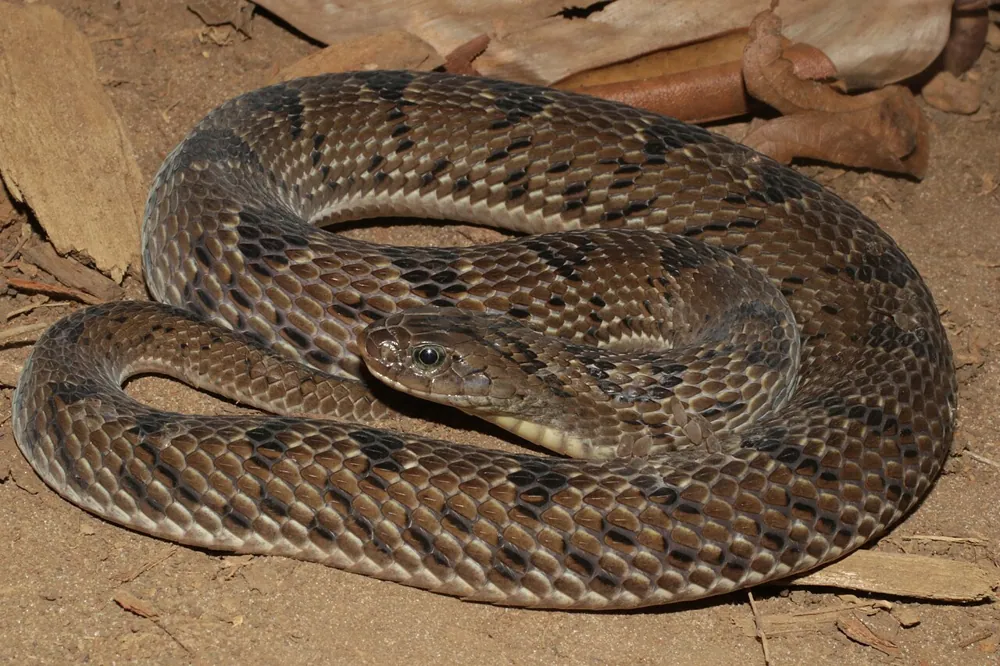
The West African night adder is a small, stout snake that lives in forests, savannas and dry semi-desert across West and Central Africa. It is venomous, but its bite usually causes only mild symptoms. It is known for hunting frogs and toads.1

 Tsela ya go e lemoga
- Small and stout, usually 30 to 60 cm (12 to 24 in) long including the tail.1
- Brown background colour, sometimes grey, olive or light green, with a row of dark brown or blackish patches down the back.1
- Flanks sprinkled with black scales.1
- A distinct V-shaped mark on the head. It is solid black in young snakes and brown with a black outline in adults.1
- Some snakes, especially from drier areas, have no back pattern at all, which makes them hard to identify. Those from DR Congo are often plain brown.1
Maatla a botlhole
Botlhole bo tswa ka meno a yone fa e loma.
Botlhole jo e bo tsenyang bo dira eng?
Bites cause mild symptoms, including pain, moderate swelling, swollen lymph nodes near the bite (local lymphadenitis) and a mild fever. Blistering has not been reported, and tissue death (necrosis) is rare and usually happens only as a secondary effect. The symptoms usually fade after two to three days, normally without complications.1
E kotsi go le kae go batho?
Kotsi go batho: E botlhokoE ka utlwisa botlhoko tota, mme go seoka thata gore e nne masisi.Bites from this snake are described as causing mild symptoms that normally clear up without complications.1
 Fa e loma
- Dira gore motho a nne a sa tshikinyege a ritibetse, tshegetsa setho se se lomilweng mo boemong jwa pelo, tlosa direng le dilo tse di tiileng, mme o mo ise bookelong ka bonako.
Ka gale leletsa nomoro ya gago ya tshoganyetso pele (112, 000, 911). Se ke kaelo e e akaretsang ya thuso ya ntlha, ga se kgakololo ya bongaka. Motheo wa thuso ya ntlha
 Nna o babalesegile
- O se ka wa ama, wa tshwara kgotsa wa tshwenya phologolo ya naga, le fa e le e nnye, le fa e lebega e robetse kgotsa e sule.
- E fe sebaka. Fa o kopana le yone, ritibala, boela morago ka bonya mme o e tlogele e tsamaye ka tsela ya yone.
- Fa e nngwe e go loma: ritibala, o se ka wa tshikinyega, leletsa nomoro ya gago ya tshoganyetso (112, 000, 911) kgotsa o ye bookelong ka bonako. Gopola gore e ne e lebega jang, setshwantsho se a thusa.
Ga e go batle. E dirisa botlhole jwa yone go tshwara dijo kgotsa go itshireletsa, mme e rata go iphitlha go feta. Go le gontsi ka go nna o babalesegile
Kae mo lefatsheng?
E kgolo go le kae?
E telele go le kae?
 boleele jo bo lekanang le dipanana di le 4 di latelana
 e ka taboga dimetara di le 100 ka metsotswana e le 110 (motho yo o bonako go gaisa o tlhoka 9,6)
West African night adder e kgolo go le kae fa e bapisiwa le WENA?
Ke dipalo fela mo sefetleng sa gago (browser). Ga go sepe se se bolokwang kgotsa se se romelwang gope.
E bonako go le kae?


Dintlha
Despite its name, the night adder is active at any time of day or night, and it has sometimes been seen basking in the sun.1
It is a slow-moving snake, but it can strike quickly. It tends to lash at its target rather than stab.1
It is most active in the rainy season, from March to October, when its prey is plentiful. It almost disappears during the dry season.1
Its back pattern varies a lot. Some snakes have no pattern at all, and snakes from DR Congo are often a uniform brown.1
Ya baitseanape ba botlhole
Kwa dintlha di tswang teng
- Causus maculatus (Wikipedia (CC BY-SA 4.0))
- Causus maculatus (iNaturalist): maina le thulaganyo ya mefuta.
- Venom Wiki: seelo sa kotsi, bogolo jo bo tlwaelegileng le kakanyo ya lebelo ke tsa rona. Bona kafa re di balang ka teng: Kafa re lekanyang kotsi ka teng.
Ntlha nngwe le nngwe mo tsebeng e e na le nomoro e e supang motswedi wa yone. Fa re dirile phoso, maitshwarelo, re barati ba diphologolo, e seng kgatiso ya saense. Re bolelele kwa [email protected] mme re tla e baakanya.
 Phepheng e tshwerwe ke tlala! Venom Wiki ke porojeke ya motho a le mongwe: ke mahala, ga e na dipapatso le ditraka. Mpho e nnye e thusa go e tshegetsa mo inthaneteng.Fepa phepheng
Tse dingwe tsa setlhopha se se tshwanang: Divaepara le dibolobolo
 Puff adderDivaepara le diboloboloE a bolaya
 Gaboon viperDivaepara le diboloboloE ka bolaya
 Northeast African carpet viperDivaepara le diboloboloE a bolaya
 West African carpet viperDivaepara le diboloboloE a bolaya
 Rhinoceros viperDivaepara le diboloboloE ka bolaya
 West African Gaboon viperDivaepara le diboloboloE ka bolaya
E tshela gape kwa: Aforika
 Black mambaDikobra, dimamba le dikraitE a bolaya
 DeathstalkerDiphephengE a bolaya
 Egyptian cobraDikobra, dimamba le dikraitE a bolaya
 BoomslangDinoga tse di nang le meno a botlhole kwa moragoE ka bolaya
 Fat-tailed scorpionDiphephengE ka bolaya
 Western honey beeDinotshe, diwasepe le dihoneteE utlwisa botlhoko fela