
 Afrika
 Osiyo
Osiyo Yevropa
 Janubiy Amerika
 Avstraliya va Okeaniya
 Antarktida
 Tinch okeani
 Atlantika okeani
 Hind okeani
 Shimoliy Muz okeani
 Oʻrta yer dengizi
 Qizil dengiz
 Karib dengizi
 Marjon dengizi
 Janubiy Xitoy dengizi
 Filippin dengizi
 Andaman dengizi
 Shimoliy dengiz
 Timor va Arafura dengizi
 Bengal koʻrfazi
 Kaliforniya koʻrfazi
European purseweb spider
 Chaqadi
The European purseweb spider is a small, hidden spider that lives in the ground. It is found in mainland Europe, Great Britain and North Africa, and it is the only mygalomorph spider found in the Nordic countries and the United Kingdom. It is special because it builds a silk tube partly under the ground and catches insects that walk onto it.1

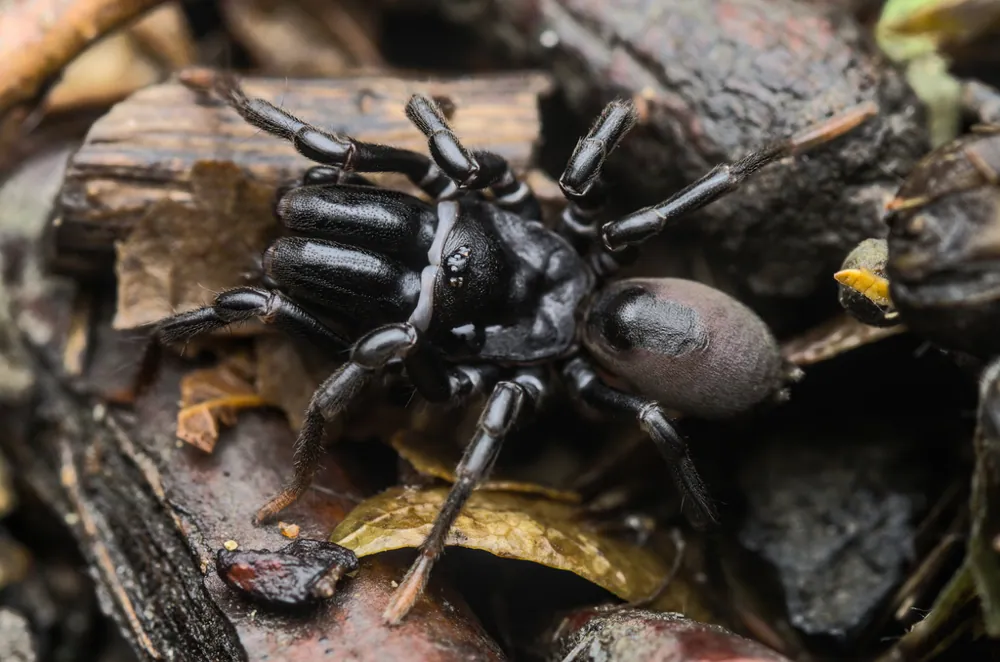
 Uni qanday tanish mumkin
- Black or brownish in colour1
- Not particularly large: males are 7–9 mm and females are 10–15 mm long1
- Builds a silk tube that is partly underground, with the part above ground covered in leaves and other debris1
- Usually stays inside its web and does not leave except to mate1
- Young spiderlings are often very lightly coloured1
Koʻpincha adashtiriladi: It looks much like Atypus piceus. Spiderlings of the European purseweb spider are often very lightly coloured, and its three-part posterior spinnerets do not have a light blot, which helps tell them apart.1
Zahar quvvati
Chaqqanda zahar zaharli tishlari yoki tishlari orqali chiqadi.
Odamlar uchun qanchalik xavfli?
Odamlar uchun xavf: YengilAri nishidek yoki undan ham kam. Odamlar uchun deyarli zararsiz. Agar chaqsa
- Chaqilgan joyni yuv va sovut. Agar ogʻriq kuchli boʻlsa yoki odam oʻzini yomon his qilsa, tibbiy yordam ol.
Har doim avval favqulodda yordam raqamiga qoʻngʻiroq qil (112, 000, 911). Bu birinchi yordam boʻyicha umumiy maslahat, tibbiy maslahat emas. Birinchi yordam asoslari
 Xavfsiz boʻl
- Hech qachon yovvoyi hayvonga tegma, uni tutma yoki jigʻiga tegma, hatto kichkina boʻlsa ham va hatto uxlayotgan yoki oʻlik koʻrinsa ham.
- Unga joy ber. Agar duch kelsang, xotirjam boʻl, sekin orqaga chekin va uni oʻz yoʻliga ketishiga qoʻy.
- Agar biri seni chaqsa: xotirjam boʻl, qimirlamay tur, favqulodda yordam raqamiga qoʻngʻiroq qil (112, 000, 911) yoki tezda kasalxonaga yet. U qanday koʻrinishda ekanini eslab qol, surat yordam beradi.
U seni ovlamoqchi emas. Zaharini ovqat tutish yoki oʻzini himoya qilish uchun ishlatadi va yashirinishni ancha afzal koʻradi. Xavfsiz qolish haqida batafsil
Dunyoning qayerida?
U qanchalik katta?
U qanchalik uzun?
 kichik barmogʻingdan qisqa
 100 metrni 330 soniyada bosib oʻtishi mumkin (eng tez odamga 9,6 soniya kerak)
European purseweb spider SEN bilan solishtirganda qanchalik katta?
Faqat brauzeringdagi hisob-kitob. Hech narsa saqlanmaydi va hech qayerga yuborilmaydi.
U qanchalik tez?


Faktlar
Its fangs point straight down rather than crossing, as in other mygalomorph spiders.1
Autumn is its mating season. The male enters the female's burrow, where they live together until the male dies soon after mating.1
It is a mygalomorph spider, and it is the only mygalomorph spider found in the Nordic countries and the United Kingdom.1
It becomes sexually mature at about 4 years old.1
Afsonalarni fosh qiluvchi
Afsona: The European purseweb spider lives in Ireland.
Haqiqat: It was once listed for Ireland, based on a single silk tube found in 1896. This is now thought to be most likely from a plant nursery import, and the species is no longer recognised as living on the island.1
Zahar mutaxassislari uchun
Faktlar qayerdan olingan
- Atypus affinis (Wikipedia (CC BY-SA 4.0))
- Atypus affinis (iNaturalist): nomlar va tasnif.
- Venom Wiki: xavf darajasi, odatiy oʻlcham va taxminiy tezlik bizning oʻz baholarimiz. Ularni qanday hisoblashimizni koʻr: Xavfni qanday baholaymiz.
Bu sahifadagi har bir faktning manbasiga ishora qiluvchi raqami bor. Agar biror narsani xato yozgan boʻlsak, kechir, biz hayvon ixlosmandlarimiz, ilmiy jurnal emas. [email protected] manziliga yoz, tuzatamiz.
 Chayon och! Venom Wiki bir kishining loyihasi: bepul, reklamasiz va kuzatuvchilarsiz. Kichik xayriya uni internetda saqlab qolishga yordam beradi.Chayonni boq
Shu guruhdan yana: Tarantullar va voronka toʻrli oʻrgimchaklar
 Gibraltar funnel-web spiderTarantullar va voronka toʻrli oʻrgimchaklarFaqat ogʻritadi
 Andalusian tarantulaTarantullar va voronka toʻrli oʻrgimchaklarZararsiz
 Sydney funnel-web spiderTarantullar va voronka toʻrli oʻrgimchaklarHalokatli
 Goliath birdeaterTarantullar va voronka toʻrli oʻrgimchaklarFaqat ogʻritadi
 Mexican redknee tarantulaTarantullar va voronka toʻrli oʻrgimchaklarZararsiz
 Northern tree-dwelling funnel-web spiderTarantullar va voronka toʻrli oʻrgimchaklarHalokatli
Yana shu yerlarda yashaydi: Yevropa
 Common European adderGadyukasimon ilonlarShifokor kerak
 Spanish flyBoshqa zaharli hayvonlar (tegish yoki yeyish xavfli)Shifokor kerakTegma
 Common waspArilar, qovoqarilar va shershenlarFaqat ogʻritadi
 European hornetArilar, qovoqarilar va shershenlarFaqat ogʻritadi
 Fire salamanderZaharli qurbaqalar, baqalar va tritonlarFaqat ogʻritadiTegma
 Western honey beeArilar, qovoqarilar va shershenlarFaqat ogʻritadi