
 Afrig
Afrig Asi
Asi Tugal
Tugal Amerig gu Bëj-saalum
 Ostarali ak Oseyani
 Antarktig
 Mbàmbulaanu Pasifik
 Mbàmbulaanu Atlantig
 Mbàmbulaanu End
 Mbàmbulaanu Arktik
 Géeju Mediteraane
 Géej gu Xonq
 Géeju Karayib
 Géeju Koraay
 Géeju Siin gu Bëj-saalum
 Géeju Filipin
 Géeju Andaman
 Géeju Bëj-gànnaar
 Géeju Timor ak Arafura
 Golfu Bengal
 Golfu Kaliforni
Aquatic coral snake
 Dafay màtt
The aquatic coral snake is a venomous snake that spends much of its time in water. It is one of the heaviest and sturdiest coral snakes, and it lives in the forests of northern South America. It is special because it swims well and can stay underwater for a long time.1



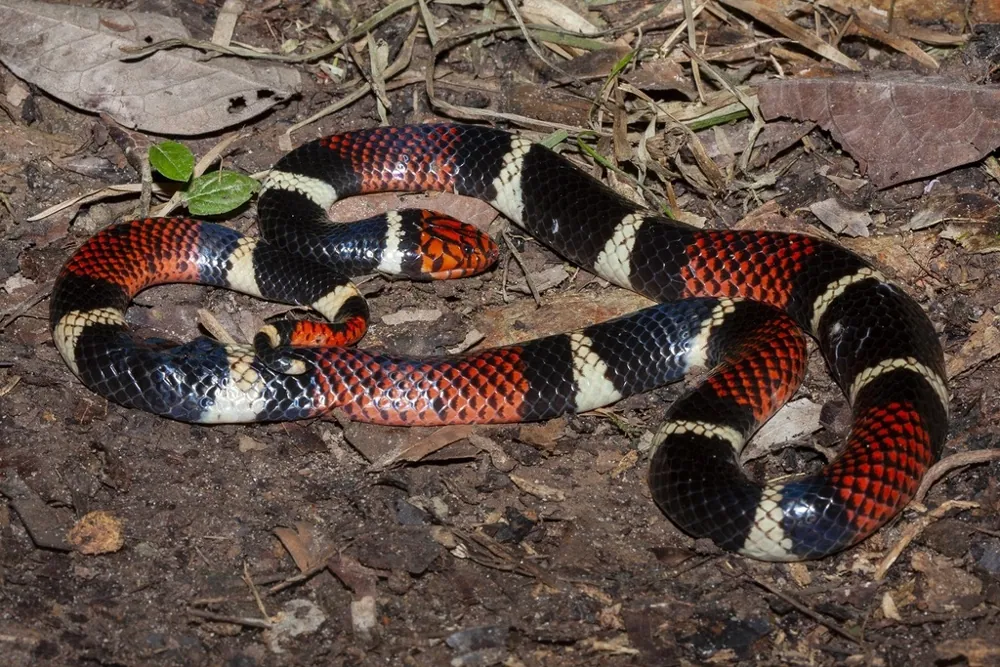
 Ni ngay ko xàmmee
- The head is mainly red with black edging on the scales.1
- The head is large with a long snout, and the eyes and nostrils sit higher on the head than in other coral snakes.1
- The body has wide red rings separated by groups of three black rings, with narrow cream or yellowish rings between the black bands.1
- The scales are smooth and shiny, and arranged in 15 rows.1
- Adults usually measure 80 to 100 cm, tail included.1
Kàttanu daŋar
Daŋar bi dafay génn ci bëñam yi su màttee.
Lan la daŋar biy sóob di def?
Its venom is neurotoxic, meaning it attacks the nerves. It blocks signals between nerves and muscles, which causes paralysis. Symptoms can include blurred vision, difficulty speaking, swallowing and walking, and breathing failure. In a well-reported case in the Amazon, the victim reached hospital about 20 minutes after the bite.1
Ni mu lore nit ñi?
Musiba ci nit: Am na musiba loolMën na rey nit ku ñu fajul.Bites are rare, but the venom can cause paralysis of the cranial nerves and can be fatal. The estimated lethal dose for an adult human is 18–20 mg, which is higher than the 4–7 mg for smaller coral snake species. Because it is a large snake, it can carry a lot of venom, with an average yield of 56 mg and a maximum of 160 mg when milked by scientists.1
 Xibaar bu baax: doktoor yi am nañu garab (sérum antivenimeux) walla ab paj ngir lii.1
Lan lay def bu tiitee?
When threatened, it flattens its body and raises its tail.1
 Su màttee
- A bite needs hospital care. In a recorded case, the victim needed mechanical ventilation because paralysis of the breathing muscles made it hard to breathe, and was given specific Micrurus antivenom.1
- Def ba nit ki bañ a yëngu te dal, te yóbbu ko lopitaan ci gaaw, doonte màtt bi dafa mel ni lu ndaw: màndarga yi mën nañu tàmbali ay waxtu ginnaaw.
Saa su nekk, woo jëkk sa nimerob urgence (112, 000, 911). Lii ay ndigal yu yaatu ci ndimbal yu jëkk la, du ndigalu doktoor. Li war a xam ci ndimbal yu jëkk
 Sàmmal sa bopp
- Bul laal mukk, bul jàpp, bul sonal ab rab bu àll, doonte bu ndaw la, te doonte dafa mel ni dafa nelaw walla dafa dee.
- May ko bérab. Su nga ko gisee, dalal, dellu ginnaaw ndànk-ndànk te bàyyi ko mu dem yoonam.
- Su benn màttee la: dalal, bul yëngu, woo sa nimerob urgence (112, 000, 911) walla dem lopitaan ci gaaw. Bul fàtte ni mu meloon, ab nataal dina dimbali.
Du la wut. Dafay jëfandikoo daŋaram ngir jàpp lu muy lekk walla ngir aar boppam, te nëbbu moo ko gën a neex. Yeneen ci ni ngay sàmme sa bopp
Ni mu réye?
Ni mu guddoo?
 guddu na ni 2,5 muusu kër, bakkan ba geen
 guddu na ni 8 banaana yu ñu toftale
 mën na daw 100 meetar ci 68 segond (nit ki gën a gaaw soxla na 9,6)
Aquatic coral snake ni mu réye ci wetu YOW?
Ay waññ rekk ci sa navigateur. Dara du denc te dara du yónnee fenn.
Ni mu gaawe?


Xibaar
It swims very well and can stay submerged for a long period.1
Although its venom is weaker than that of smaller members of its genus, it can carry a large amount of venom because of its size.1
It is one of the heaviest and most robust coral snakes.1
It is mainly active at night, though it can also be active during the day.1
It is not aggressive towards humans.1
Fa xibaar yi jóge
- Aquatic coral snake (Wikipedia (CC BY-SA 4.0))
- Micrurus surinamensis (iNaturalist): tur ak ni ñu leen séddale.
- Venom Wiki: tolluwaayu musiba bi, réyaay bu yem bi ak xalaatu gaawaay bi, nun ñoo leen defar. Seetal ni nu leen waññe: Ni nuy natte musiba.
Xibaar bu nekk ci xët wii am na ab nimero buy won fa mu jóge. Su nu juumee, baal nu, nun ay nit ñu bëgg rab lanu, du ab jurnaalu xam-xam. Wax nu ko ci [email protected] te dinanu ko jubbanti.
 Jiit bi dafa xiif! Venom Wiki ab liggéeyu kenn la: amul pay, amul piblisite te amul traceur. Ab may bu tuuti dafay dimbali ngir mu des ci internet.Leel jiit bi
 Central American coral snake
 Amazonian coral snake
 Argentinian coral snake
 Caatinga coral snake
 Dumeril's coral snake
 Mesopotamian coral snake
 Golden poison frog
 Terciopelo
 Brazilian wandering spider
 Eyelash viper
 Golden lancehead
 South American bushmaster