
 Afrig
Afrig Asi
Asi Tugal
Tugal Amerig gu Bëj-saalum
 Ostarali ak Oseyani
 Antarktig
 Mbàmbulaanu Pasifik
 Mbàmbulaanu Atlantig
 Mbàmbulaanu End
 Mbàmbulaanu Arktik
 Géeju Mediteraane
 Géej gu Xonq
 Géeju Karayib
 Géeju Koraay
 Géeju Siin gu Bëj-saalum
 Géeju Filipin
 Géeju Andaman
 Géeju Bëj-gànnaar
 Géeju Timor ak Arafura
 Golfu Bengal
 Golfu Kaliforni
Black-tailed rattlesnake
 Dafay màtt
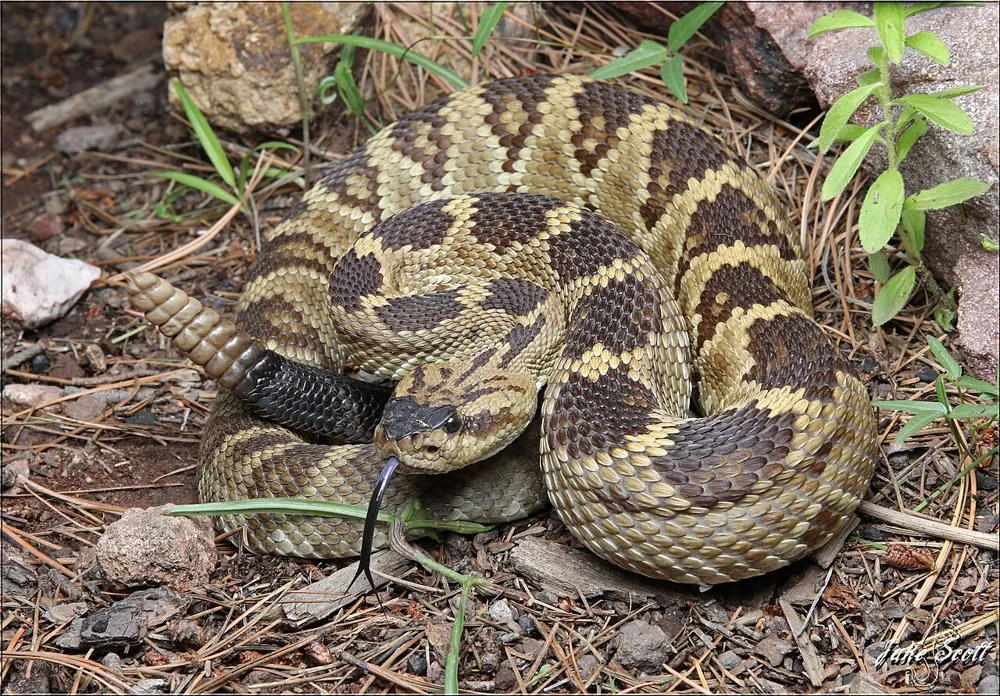
The black-tailed rattlesnake is a venomous pit viper that lives in the south-west of the United States and in Mexico. It is known as one of the calmest rattlesnakes, and it relies on camouflage rather than confrontation.1



 Ni ngay ko xàmmee
- Body colour ranges from yellows and olive greens to browns and black.1
- The tail scales are entirely black, which gives the species its name.1
- Often has a black band that runs across the eyes and down to the corners of the mouth, forming a facial 'mask'.1
- Has a rattle made of keratin at the end of the tail.1
Kàttanu daŋar
Daŋar bi dafay génn ci bëñam yi su màttee.
Lan la daŋar biy sóob di def?
Its venom is primarily hemotoxic, meaning it mainly acts on the blood and surrounding tissue, as with most crotalids (pit vipers). It is only about two-thirds as toxic as western diamondback venom. Because the venom is weaker, the snake has larger venom glands than most rattlesnakes in its region and injects large quantities into prey.1
Ni mu lore nit ñi?
Musiba ci nit: Lu bonMàtt laaj na doktoor. Ñi ciy dee dañoo néew lool.Bites are fairly rare, because the snake is considered one of the most docile rattlesnakes. The venom is generally not fatal to humans.1
 Xibaar bu baax: doktoor yi am nañu garab (sérum antivenimeux) walla ab paj ngir lii.1
Lan lay def bu tiitee?
It normally tries to slither away when confronted, but it will rattle when cornered, and it relies mostly on camouflage to avoid discovery.1
 Su màttee
- CroFab antivenom is often used to treat bites from this snake.1
- Def ba nit ki bañ a yëngu te dal, yemale cër bi ñu màtt ak kawewaayu xol bi, dindi jaaro yi ak lu xat lépp, te yóbbu ko lopitaan ci gaaw.
Saa su nekk, woo jëkk sa nimerob urgence (112, 000, 911). Lii ay ndigal yu yaatu ci ndimbal yu jëkk la, du ndigalu doktoor. Li war a xam ci ndimbal yu jëkk
 Sàmmal sa bopp
- Bul laal mukk, bul jàpp, bul sonal ab rab bu àll, doonte bu ndaw la, te doonte dafa mel ni dafa nelaw walla dafa dee.
- May ko bérab. Su nga ko gisee, dalal, dellu ginnaaw ndànk-ndànk te bàyyi ko mu dem yoonam.
- Su benn màttee la: dalal, bul yëngu, woo sa nimerob urgence (112, 000, 911) walla dem lopitaan ci gaaw. Bul fàtte ni mu meloon, ab nataal dina dimbali.
Du la wut. Dafay jëfandikoo daŋaram ngir jàpp lu muy lekk walla ngir aar boppam, te nëbbu moo ko gën a neex. Yeneen ci ni ngay sàmme sa bopp
Ni mu réye?
Ni mu guddoo?
 guddu na ni 2 muusu kër, bakkan ba geen
 guddu na ni 6 banaana yu ñu toftale
 mën na daw 100 meetar ci 100 segond (nit ki gën a gaaw soxla na 9,6)
Black-tailed rattlesnake ni mu réye ci wetu YOW?
Ay waññ rekk ci sa navigateur. Dara du denc te dara du yónnee fenn.
Ni mu gaawe?


Xibaar
Its venom glands are larger than those of most rattlesnakes in its region, which compensates for its weaker venom.1
It is considered one of the most docile rattlesnakes because of its calm demeanour and curious nature.1
In the spring and fall it is mainly active during the day, but in summer it becomes nocturnal to avoid the heat.1
In winter it hibernates in dens made and abandoned by other animals, often sharing them with other snake species.1
Its lifespan averages 15 to 20 years.1
Tasukatu léeb
Xalaat bu juum: The number of segments in a rattle shows how old a rattlesnake is.
Dëgg: Each time the snake sheds its skin, a new segment is added. Snakes can shed several times a year, and the rattle is fragile and can break, so its length is not an accurate guide to age unless the tip (terminal button) is intact.1
Ngir boroom xam-xam ci daŋar
- Turu xam-xam
- Crotalus molossus
- Mbooloo
- Serpent à sonnette
- Njaboot
- Viperidae2
- Toftal
- Squamata
- Kontinaa yi
- Amerig gu Bëj-gànnaar
- Liir yi
- The female gives birth to live young in the summer. Litters can have as many as 10 to 12 young but usually average four to six.1
- Ni mu nekke ci àll bi
- Least Concern1
- Musiba ci nit
- 3 / 5: Lu bon3
Fa xibaar yi jóge
- Black-tailed rattlesnake (Wikipedia (CC BY-SA 4.0))
- Crotalus molossus (iNaturalist): tur ak ni ñu leen séddale.
- Venom Wiki: tolluwaayu musiba bi, réyaay bu yem bi ak xalaatu gaawaay bi, nun ñoo leen defar. Seetal ni nu leen waññe: Ni nuy natte musiba.
Xibaar bu nekk ci xët wii am na ab nimero buy won fa mu jóge. Su nu juumee, baal nu, nun ay nit ñu bëgg rab lanu, du ab jurnaalu xam-xam. Wax nu ko ci [email protected] te dinanu ko jubbanti.
 Jiit bi dafa xiif! Venom Wiki ab liggéeyu kenn la: amul pay, amul piblisite te amul traceur. Ab may bu tuuti dafay dimbali ngir mu des ci internet.Leel jiit bi
Yeneen ci mbooloo mi: Serpent à sonnette
 Eastern diamondback rattlesnakeSerpent à sonnetteMën na rey
 Timber rattlesnakeSerpent à sonnetteMën na rey
 Western diamondback rattlesnakeSerpent à sonnetteMën na rey
 SidewinderSerpent à sonnetteSoxla na doktoor
 Mojave rattlesnakeSerpent à sonnetteMën na rey
 Aruba rattlesnakeSerpent à sonnetteSoxla na doktoor
 Terciopelo
 Eastern coral snake
 Eyelash viper
 Arizona bark scorpion
 Brown recluse
 Cane toad