
 Afrig
Afrig Asi
Asi Tugal
Tugal Amerig gu Bëj-saalum
 Ostarali ak Oseyani
 Antarktig
 Mbàmbulaanu Pasifik
 Mbàmbulaanu Atlantig
 Mbàmbulaanu End
 Mbàmbulaanu Arktik
 Géeju Mediteraane
 Géej gu Xonq
 Géeju Karayib
 Géeju Koraay
 Géeju Siin gu Bëj-saalum
 Géeju Filipin
 Géeju Andaman
 Géeju Bëj-gànnaar
 Géeju Timor ak Arafura
 Golfu Bengal
 Golfu Kaliforni
Green vine snake
 Dafay màtt
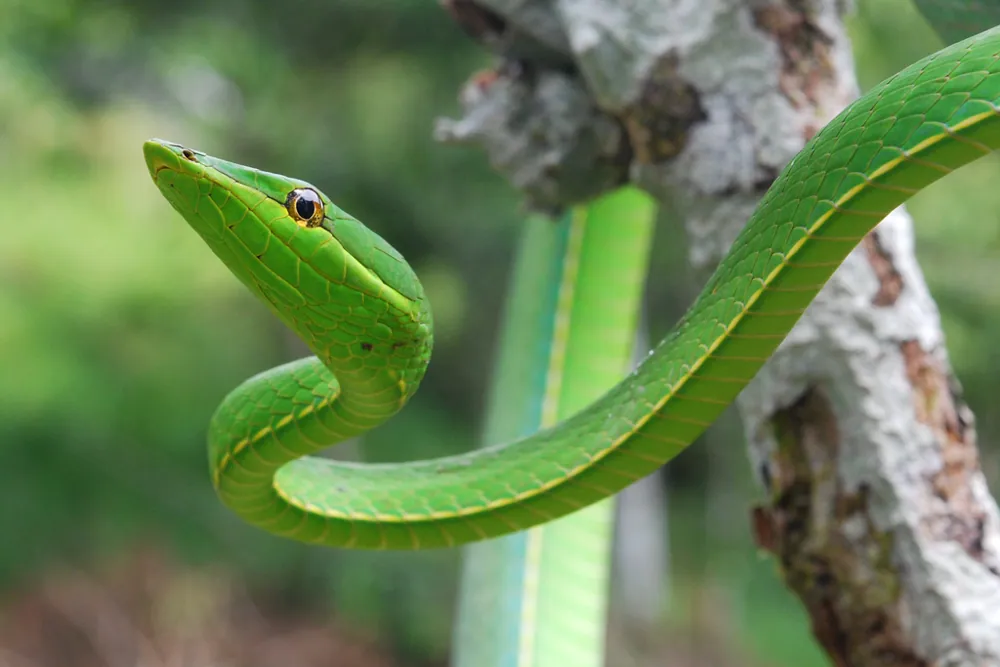
The green vine snake is a slender, bright green snake that lives high in the trees of Central and northern South America. It hunts small animals from the branches, and it is rear-fanged, which means its venom is delivered from the back of the mouth.1



 Ni ngay ko xàmmee
- Bright green on its back, with yellowish green underneath and on the upper lip1
- A narrow yellowish-white stripe runs along each side of the belly and tail1
- Very slender body with a long, pointed head and a very large mouth that reaches almost the whole length of the head1
- Long green tongue, kept outside the mouth and moved up and down1
- Long, delicate tail, used to hold on while reaching for prey1
Kàttanu daŋar
Daŋar bi dafay génn ci bëñam yi su màttee.
Lan la daŋar biy sóob di def?
Its saliva is toxic, and it works quickly on small animals, so they are stopped from fighting back. It has little to no effect on humans. In the rare reported bites, slight tingling or temporary numbness at the bite site has been reported.1
Ni mu lore nit ñi?
Musiba ci nit: WoyofNi jamu yamb walla lu ko yées. Lu jege, amul lor ci nit.Bites to people are rare, because the snake has to grab hold and chew its saliva into the skin, which most people will not allow. Serious allergic reactions are possible, as with any venomous animal, and most allergies are not known before a bite.1
 Su màttee
- Raxas fa mu màtt, def ba nit ki dal te wutal ndimbal doktoor. Am na yenn xeet (ni boomslang) yu mën a rey ay waxtu ginnaaw.
Saa su nekk, woo jëkk sa nimerob urgence (112, 000, 911). Lii ay ndigal yu yaatu ci ndimbal yu jëkk la, du ndigalu doktoor. Li war a xam ci ndimbal yu jëkk
 Sàmmal sa bopp
- Bul laal mukk, bul jàpp, bul sonal ab rab bu àll, doonte bu ndaw la, te doonte dafa mel ni dafa nelaw walla dafa dee.
- May ko bérab. Su nga ko gisee, dalal, dellu ginnaaw ndànk-ndànk te bàyyi ko mu dem yoonam.
- Su benn màttee la: dalal, bul yëngu, woo sa nimerob urgence (112, 000, 911) walla dem lopitaan ci gaaw. Bul fàtte ni mu meloon, ab nataal dina dimbali.
Du la wut. Dafay jëfandikoo daŋaram ngir jàpp lu muy lekk walla ngir aar boppam, te nëbbu moo ko gën a neex. Yeneen ci ni ngay sàmme sa bopp
Ni mu réye?
Ni mu guddoo?
 guddu na ni 4 muusu kër, bakkan ba geen
 guddu na ni 11 banaana yu ñu toftale
 mën na daw 100 meetar ci 57 segond (nit ki gën a gaaw soxla na 9,6)
Green vine snake ni mu réye ci wetu YOW?
Ay waññ rekk ci sa navigateur. Dara du denc te dara du yónnee fenn.
Ni mu gaawe?


Xibaar
Its tongue is thought to work like a cat's whiskers, helping it sense its way through branches and brush as it moves quickly.1
After biting, it coils around its prey. It does not squeeze the prey the way a constrictor does, but the coil helps to hold it.1
It is rear-fanged, with two larger but blunted, peg-like teeth at the upper back of the mouth. These teeth have grooves on the sides that deliver its saliva.1
After swallowing a meal, it usually moves to the highest point of a tree to rest.1
In captivity it readily takes mice, and some are large enough to eat rats, which makes it a prized choice among reptile collectors.1
Tasukatu léeb
Xalaat bu juum: That the bite of this snake is dangerous to people.
Dëgg: Its venom has little to no effect on humans. It is fast-acting on small animals, but bites to people are rare and usually cause only slight tingling or temporary numbness.1
Fa xibaar yi jóge
- Oxybelis fulgidus (Wikipedia (CC BY-SA 4.0))
- Oxybelis fulgidus (iNaturalist): tur ak ni ñu leen séddale.
- Venom Wiki: tolluwaayu musiba bi, réyaay bu yem bi ak xalaatu gaawaay bi, nun ñoo leen defar. Seetal ni nu leen waññe: Ni nuy natte musiba.
Xibaar bu nekk ci xët wii am na ab nimero buy won fa mu jóge. Su nu juumee, baal nu, nun ay nit ñu bëgg rab lanu, du ab jurnaalu xam-xam. Wax nu ko ci [email protected] te dinanu ko jubbanti.
 Jiit bi dafa xiif! Venom Wiki ab liggéeyu kenn la: amul pay, amul piblisite te amul traceur. Ab may bu tuuti dafay dimbali ngir mu des ci internet.Leel jiit bi
Yeneen ci mbooloo mi: Jaan yu am bëñ ci ginnaaw gémmiñ
 Western hognose snakeJaan yu am bëñ ci ginnaaw gémmiñAmul lor
 Baron's green racerJaan yu am bëñ ci ginnaaw gémmiñDafay metti rekk
 False water cobraJaan yu am bëñ ci ginnaaw gémmiñDafay metti rekk
 Brown vine snakeJaan yu am bëñ ci ginnaaw gémmiñAmul lor
 Eastern hognose snakeJaan yu am bëñ ci ginnaaw gémmiñAmul lor
 Lichtenstein's green racerJaan yu am bëñ ci ginnaaw gémmiñSoxla na doktoor
 Terciopelo
 Eastern coral snake
 Eastern diamondback rattlesnake
 Eyelash viper
 Timber rattlesnake
 Western diamondback rattlesnake