
 Afrig
Afrig Asi
Asi Tugal
Tugal Amerig gu Bëj-saalum
 Ostarali ak Oseyani
 Antarktig
 Mbàmbulaanu Pasifik
 Mbàmbulaanu Atlantig
 Mbàmbulaanu End
 Mbàmbulaanu Arktik
 Géeju Mediteraane
 Géej gu Xonq
 Géeju Karayib
 Géeju Koraay
 Géeju Siin gu Bëj-saalum
 Géeju Filipin
 Géeju Andaman
 Géeju Bëj-gànnaar
 Géeju Timor ak Arafura
 Golfu Bengal
 Golfu Kaliforni
Baron's green racer
 Dafay màtt
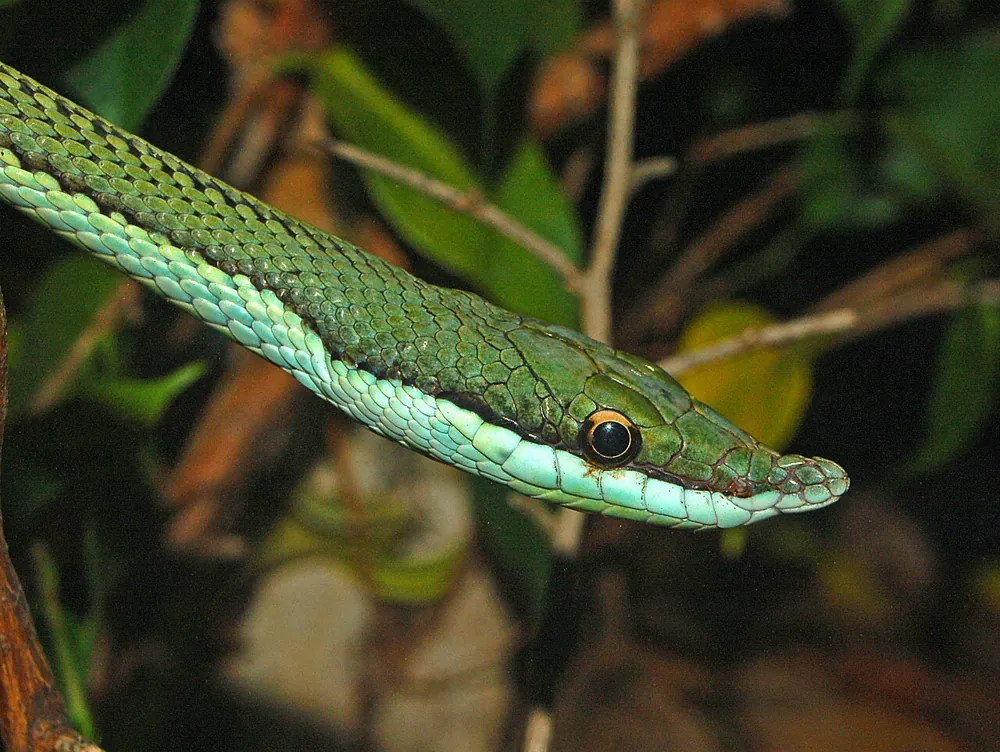
Baron's green racer is a long, green tree snake that lives in South America. It has rear fangs at the back of its mouth and its venom can harm people, so it should be treated with caution. It is one of the longest snakes in its genus, Philodryas.1



 Ni ngay ko xàmmee
- Usually green, but some individuals are blue or brown.1
- The body is either plain or has black stripes running along the back and sides, on the front third of the body.1
- The underside under the black side lines is white or yellowish-white, sometimes with green or blue shades.1
- The head is small and elongated, with a small, flexible nasal point that is more developed in males.1
- Adults can reach 150 to 180 cm, and the tail makes up about 30% of the total length.1
Kàttanu daŋar
Daŋar bi dafay génn ci bëñam yi su màttee.
Lan la daŋar biy sóob di def?
It is rear-fanged, which means its fangs sit at the back of the mouth. Its venom has proteolytic activity, meaning it breaks down proteins, and it can stop blood platelets from clumping together, which affects clotting. Local effects include bleeding, muscle death, swelling and inflammation of the tissue.1
Ni mu lore nit ñi?
Musiba ci nit: Dafay mettiMën na metti lool, waaye lu bon du faral di am.It is considered dangerous to humans and should be treated with caution. No bite numbers or deaths are recorded.1
Lan lay def bu tiitee?
When frightened, it releases a foul-smelling substance from its cloaca, which is the common opening for its digestive, urinary and reproductive systems. It is generally non-aggressive.1
 Su màttee
- Raxas fa mu màtt, def ba nit ki dal te wutal ndimbal doktoor. Am na yenn xeet (ni boomslang) yu mën a rey ay waxtu ginnaaw.
Saa su nekk, woo jëkk sa nimerob urgence (112, 000, 911). Lii ay ndigal yu yaatu ci ndimbal yu jëkk la, du ndigalu doktoor. Li war a xam ci ndimbal yu jëkk
 Sàmmal sa bopp
- Bul laal mukk, bul jàpp, bul sonal ab rab bu àll, doonte bu ndaw la, te doonte dafa mel ni dafa nelaw walla dafa dee.
- May ko bérab. Su nga ko gisee, dalal, dellu ginnaaw ndànk-ndànk te bàyyi ko mu dem yoonam.
- Su benn màttee la: dalal, bul yëngu, woo sa nimerob urgence (112, 000, 911) walla dem lopitaan ci gaaw. Bul fàtte ni mu meloon, ab nataal dina dimbali.
Du la wut. Dafay jëfandikoo daŋaram ngir jàpp lu muy lekk walla ngir aar boppam, te nëbbu moo ko gën a neex. Yeneen ci ni ngay sàmme sa bopp
Ni mu réye?
Ni mu guddoo?
 guddu na ni 4 muusu kër, bakkan ba geen
 guddu na ni 10 banaana yu ñu toftale
 mën na daw 100 meetar ci 60 segond (nit ki gën a gaaw soxla na 9,6)
Baron's green racer ni mu réye ci wetu YOW?
Ay waññ rekk ci sa navigateur. Dara du denc te dara du yónnee fenn.
Ni mu gaawe?


Xibaar
When frightened, it gives off a foul-smelling liquid from its cloaca.1
Larger members of its species have been reported eating immature individuals.1
Its colour varies, with green being most common but blue and brown individuals also found.1
It is the longest known species in the genus Philodryas.1
Its tail makes up about 30% of its total body length.1
Fa xibaar yi jóge
- Philodryas baroni (Wikipedia (CC BY-SA 4.0))
- Philodryas baroni (iNaturalist): tur ak ni ñu leen séddale.
- Venom Wiki: tolluwaayu musiba bi, réyaay bu yem bi ak xalaatu gaawaay bi, nun ñoo leen defar. Seetal ni nu leen waññe: Ni nuy natte musiba.
Xibaar bu nekk ci xët wii am na ab nimero buy won fa mu jóge. Su nu juumee, baal nu, nun ay nit ñu bëgg rab lanu, du ab jurnaalu xam-xam. Wax nu ko ci [email protected] te dinanu ko jubbanti.
 Jiit bi dafa xiif! Venom Wiki ab liggéeyu kenn la: amul pay, amul piblisite te amul traceur. Ab may bu tuuti dafay dimbali ngir mu des ci internet.Leel jiit bi
Yeneen ci mbooloo mi: Jaan yu am bëñ ci ginnaaw gémmiñ
 False water cobraJaan yu am bëñ ci ginnaaw gémmiñDafay metti rekk
 Brown vine snakeJaan yu am bëñ ci ginnaaw gémmiñAmul lor
 Green vine snakeJaan yu am bëñ ci ginnaaw gémmiñAmul lor
 Lichtenstein's green racerJaan yu am bëñ ci ginnaaw gémmiñSoxla na doktoor
 Peruvian slender snakeJaan yu am bëñ ci ginnaaw gémmiñSoxla na doktoor
 Chilean green racerJaan yu am bëñ ci ginnaaw gémmiñDafay metti rekk
 Golden poison frog
 Terciopelo
 Brazilian wandering spider
 Eyelash viper
 Golden lancehead
 South American bushmaster