
 Afrig
Afrig Asi
Asi Tugal
Tugal Amerig gu Bëj-saalum
 Ostarali ak Oseyani
 Antarktig
 Mbàmbulaanu Pasifik
 Mbàmbulaanu Atlantig
 Mbàmbulaanu End
 Mbàmbulaanu Arktik
 Géeju Mediteraane
 Géej gu Xonq
 Géeju Karayib
 Géeju Koraay
 Géeju Siin gu Bëj-saalum
 Géeju Filipin
 Géeju Andaman
 Géeju Bëj-gànnaar
 Géeju Timor ak Arafura
 Golfu Bengal
 Golfu Kaliforni
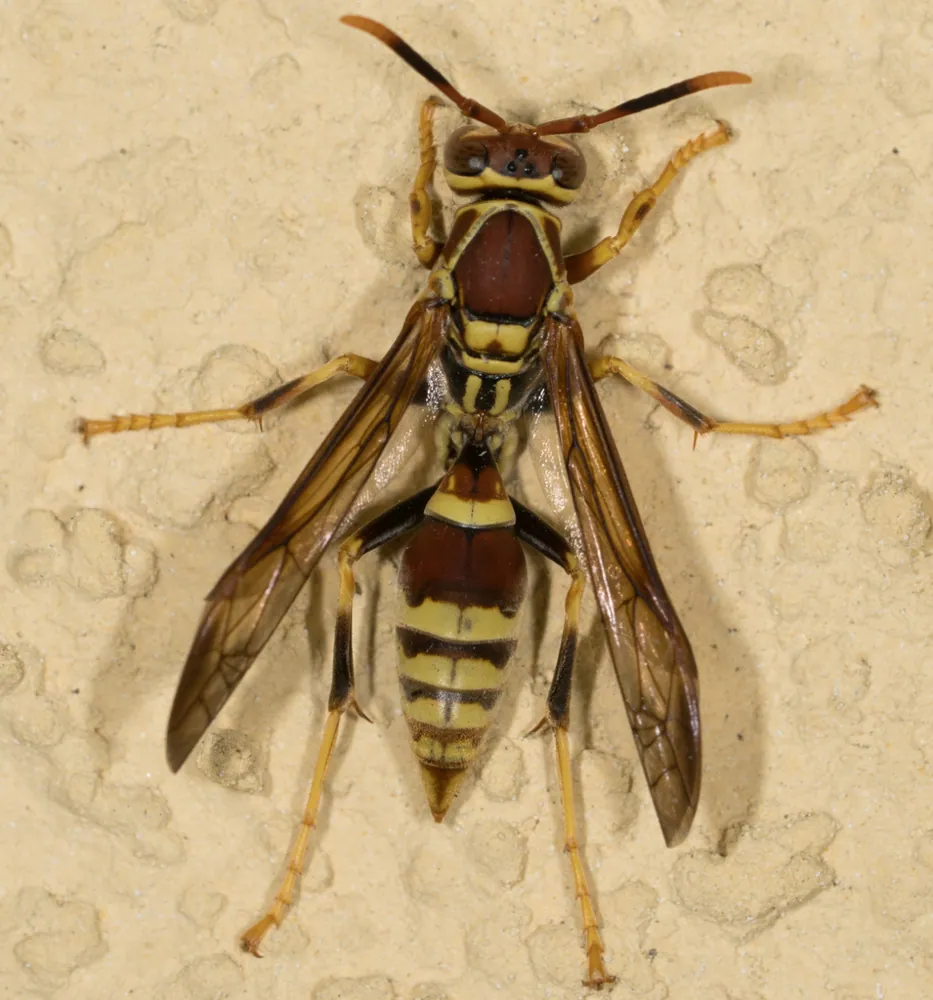
Guinea paper wasp
 Dafay jam
The Guinea paper wasp is a social wasp that builds small, open nests in colonies of up to about one hundred individuals. It lives in parts of North America, including the eastern United States, Ontario in Canada, and Mexico. Its colonies are often found near buildings and other man-made structures.1
 Ni ngay ko xàmmee
- Typical form: mostly yellow markings on the back of the thorax and the propodeum (the rear part of the thorax), and wings that are purple-tinged rather than yellow.1
- Variable form: red-brown body with dark, almost black, markings on the middle of the antennae, the bases of the abdominal segments and the wings, and pale ivory-white markings spread across the body.1
- Antennae banded with red, black and yellow, unlike most paper wasps, which have only one antenna colour.1
- Females have forewings of 13.0 to 16.5 mm; males have forewings of 12.0 to 15.0 mm.1
- Males have bulging eyes and slender antennae.1
Ñu ngi koy faral di jaxasoo ak: The typical form is often confused with Polistes fuscatus, Polistes crinitus and Polistes minor.1
Kàttanu daŋar
Daŋar bi dafay génn ci ab dag buy jam.
Ni mu lore nit ñi?
Musiba ci nit: Dafay mettiMën na metti lool, waaye lu bon du faral di am. Su jamee
- Xuufal dagu yamb bi ba mu génn, te sedal fa mu jam.
- Su nit ki am jafe-jafe ci noyyi, kanamam walla putam funki, walla mu bëgg a xëm, allergie bu metti la (urgence): woo sa nimerob urgence te jëfandikoo stylo adrénaline bi mu am, su am.
Saa su nekk, woo jëkk sa nimerob urgence (112, 000, 911). Lii ay ndigal yu yaatu ci ndimbal yu jëkk la, du ndigalu doktoor. Li war a xam ci ndimbal yu jëkk
 Sàmmal sa bopp
- Bul laal mukk, bul jàpp, bul sonal ab rab bu àll, doonte bu ndaw la, te doonte dafa mel ni dafa nelaw walla dafa dee.
- May ko bérab. Su nga ko gisee, dalal, dellu ginnaaw ndànk-ndànk te bàyyi ko mu dem yoonam.
- Su benn jamee la: dalal, bul yëngu, woo sa nimerob urgence (112, 000, 911) walla dem lopitaan ci gaaw. Bul fàtte ni mu meloon, ab nataal dina dimbali.
Du la wut. Dafay jëfandikoo daŋaram ngir jàpp lu muy lekk walla ngir aar boppam, te nëbbu moo ko gën a neex. Yeneen ci ni ngay sàmme sa bopp
Ni mu réye?
Ni mu guddoo?
 gën a gàtt sa baaraam bu ndaw
 mën na naaw ci benn terrain bu futbal bu mat ci 15 segond
Guinea paper wasp ni mu réye ci wetu YOW?
Ay waññ rekk ci sa navigateur. Dara du denc te dara du yónnee fenn.
Ni mu gaawe?


Xibaar
Queens survive cold better than workers. In one test at 5 °C over 15 days, 76% of queens survived compared with 17% of workers, partly because they build up sugars that act as antifreeze and a layer of body fat.1
When a queen dies, the oldest female worker becomes the new queen, because the colony ranks its members by age.1
Whether a wasp becomes a worker or a queen is set by the temperature it experiences as an immature wasp.1
Nests are small, usually with fewer than one hundred individuals, so the queen is often the most active wasp in the nest and directly controls the nest's activity.1
Out of six wasp species studied, this was the only one that nested in artificial sites.1
Fa xibaar yi jóge
- Polistes exclamans (Wikipedia (CC BY-SA 4.0))
- Polistes exclamans (iNaturalist): tur ak ni ñu leen séddale.
- Venom Wiki: tolluwaayu musiba bi, réyaay bu yem bi ak xalaatu gaawaay bi, nun ñoo leen defar. Seetal ni nu leen waññe: Ni nuy natte musiba.
Xibaar bu nekk ci xët wii am na ab nimero buy won fa mu jóge. Su nu juumee, baal nu, nun ay nit ñu bëgg rab lanu, du ab jurnaalu xam-xam. Wax nu ko ci [email protected] te dinanu ko jubbanti.
 Jiit bi dafa xiif! Venom Wiki ab liggéeyu kenn la: amul pay, amul piblisite te amul traceur. Ab may bu tuuti dafay dimbali ngir mu des ci internet.Leel jiit bi
Yeneen ci mbooloo mi: Yamb, guêpe ak frelon
 Tarantula hawkYamb, guêpe ak frelonDafay metti rekk
 Executioner waspYamb, guêpe ak frelonSoxla na doktoor
 Warrior waspYamb, guêpe ak frelonSoxla na doktoor
 Bald-faced hornetYamb, guêpe ak frelonDafay metti rekk
 Cow killer velvet antYamb, guêpe ak frelonDafay metti rekk
 Eastern cicada killerYamb, guêpe ak frelonAmul lor
 Terciopelo
 Eastern coral snake
 Eastern diamondback rattlesnake
 Eyelash viper
 Timber rattlesnake
 Western diamondback rattlesnake