
 Afrig
Afrig Asi
Asi Tugal
Tugal Amerig gu Bëj-saalum
 Ostarali ak Oseyani
 Antarktig
 Mbàmbulaanu Pasifik
 Mbàmbulaanu Atlantig
 Mbàmbulaanu End
 Mbàmbulaanu Arktik
 Géeju Mediteraane
 Géej gu Xonq
 Géeju Karayib
 Géeju Koraay
 Géeju Siin gu Bëj-saalum
 Géeju Filipin
 Géeju Andaman
 Géeju Bëj-gànnaar
 Géeju Timor ak Arafura
 Golfu Bengal
 Golfu Kaliforni
Jameson's mamba
 Dafay màtt
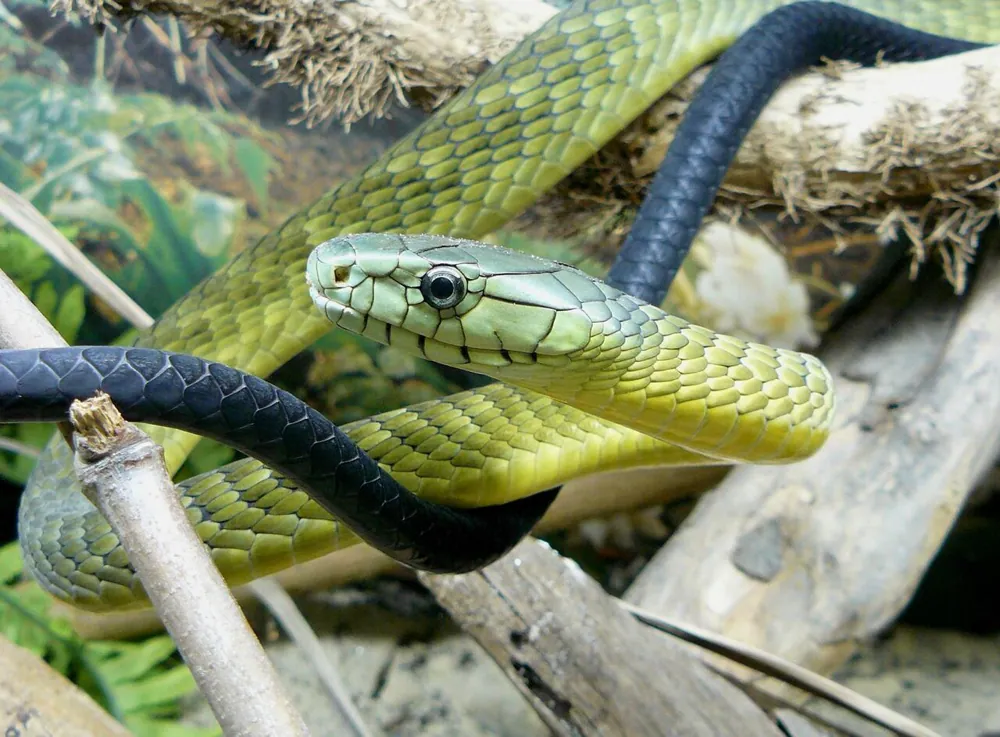
Jameson's mamba is a highly venomous snake that lives in the forests and woodlands of equatorial Africa. It spends much of its time in trees and is often found near towns, farms and plantations. Its venom attacks the nerves, so it is a snake to treat with respect and keep well away from.1



 Ni ngay ko xàmmee
- Slender body with dull green upper parts that fade to pale green towards the belly1
- Neck, throat and underparts are cream or yellowish1
- Narrow, elongated head with small eyes and round pupils1
- Tail is black in the eastern subspecies (kaimosae) and pale green or yellow in the central and western subspecies1
- Adults typically measure 1.5 to 2.2 metres in total length1
Kàttanu daŋar
Daŋar bi dafay génn ci bëñam yi su màttee.
Lan la daŋar biy sóob di def?
The venom is highly neurotoxic, meaning it attacks the nerves, and also contains cardiotoxins, which affect the heart. Bite pain and swelling are followed by chills, sweating, abdominal pain and vomiting. Later symptoms can include slurred speech, difficulty breathing and paralysis.1
Ni mu lore nit ñi?
Musiba ci nit: Mën a reyBenn ci rab yi gën a am musiba ci àddina.The World Health Organization classes it as a Snake of Medical Importance in sub-Saharan Africa, although few bites are recorded. Deaths have been recorded within three to four hours of a bite. An unconfirmed report describes a child dying within 30 minutes. Access to antivenom is difficult in some areas, and workers in palm oil plantations have died after falling from trees when they met one in the canopy.1
 Xibaar bu baax: doktoor yi am nañu garab (sérum antivenimeux) walla ab paj ngir lii.1
Lan lay def bu tiitee?
When threatened, it flattens its neck like a cobra, and it will usually try to escape rather than attack.1
 Su màttee
- Apply a pressure bandage, keep the victim as still as possible and get them to a hospital or clinic quickly. An arterial tourniquet may help because of the neurotoxic venom. Antivenom is the main treatment, and tetanus toxoid is sometimes given.1
- Def ba nit ki bañ a yëngu te dal, dindi jaaro yi ak lu xat lépp, te yóbbu ko lopitaan ci gaaw: sérum antivenimeux mooy paj mi.
Saa su nekk, woo jëkk sa nimerob urgence (112, 000, 911). Lii ay ndigal yu yaatu ci ndimbal yu jëkk la, du ndigalu doktoor. Li war a xam ci ndimbal yu jëkk
 Sàmmal sa bopp
- Bul laal mukk, bul jàpp, bul sonal ab rab bu àll, doonte bu ndaw la, te doonte dafa mel ni dafa nelaw walla dafa dee.
- May ko bérab. Su nga ko gisee, dalal, dellu ginnaaw ndànk-ndànk te bàyyi ko mu dem yoonam.
- Su benn màttee la: dalal, bul yëngu, woo sa nimerob urgence (112, 000, 911) walla dem lopitaan ci gaaw. Bul fàtte ni mu meloon, ab nataal dina dimbali.
Du la wut. Dafay jëfandikoo daŋaram ngir jàpp lu muy lekk walla ngir aar boppam, te nëbbu moo ko gën a neex. Yeneen ci ni ngay sàmme sa bopp
Ni mu réye?
Ni mu guddoo?
 guddu na ni 2,5 xaj, bakkan ba geen
 guddu na ni 15 banaana yu ñu toftale
 mën na daw 100 meetar ci 41 segond (nit ki gën a gaaw soxla na 9,6)
Jameson's mamba ni mu réye ci wetu YOW?
Ay waññ rekk ci sa navigateur. Dara du denc te dara du yónnee fenn.
Ni mu gaawe?


Xibaar
Females lay their eggs in abandoned termite colonies.1
In Nigeria, males fight each other for access to females during the dry season.1
Its main predators are birds of prey, including the martial eagle, the bateleur and the Congo serpent eagle.1
It is difficult to study in the wild because it lives in trees and its green colouring helps it hide among leaves.1
Fa xibaar yi jóge
- Jameson's mamba (Wikipedia (CC BY-SA 4.0))
- Dendroaspis jamesoni (iNaturalist): tur ak ni ñu leen séddale.
- Venom Wiki: tolluwaayu musiba bi, réyaay bu yem bi ak xalaatu gaawaay bi, nun ñoo leen defar. Seetal ni nu leen waññe: Ni nuy natte musiba.
Xibaar bu nekk ci xët wii am na ab nimero buy won fa mu jóge. Su nu juumee, baal nu, nun ay nit ñu bëgg rab lanu, du ab jurnaalu xam-xam. Wax nu ko ci [email protected] te dinanu ko jubbanti.
 Jiit bi dafa xiif! Venom Wiki ab liggéeyu kenn la: amul pay, amul piblisite te amul traceur. Ab may bu tuuti dafay dimbali ngir mu des ci internet.Leel jiit bi
 Black mamba
 Egyptian cobra
 Cape cobra
 Eastern green mamba
 Western green mamba
 Ashe's spitting cobra
 Deathstalker
 Jaan wu ñuul wi (Bitis arietans)
 Boomslang
 Fat-tailed scorpion
 Gaboon viper
 Western honey bee
.jpg)