
 Afrig
Afrig Asi
Asi Tugal
Tugal Amerig gu Bëj-saalum
 Ostarali ak Oseyani
 Antarktig
 Mbàmbulaanu Pasifik
 Mbàmbulaanu Atlantig
 Mbàmbulaanu End
 Mbàmbulaanu Arktik
 Géeju Mediteraane
 Géej gu Xonq
 Géeju Karayib
 Géeju Koraay
 Géeju Siin gu Bëj-saalum
 Géeju Filipin
 Géeju Andaman
 Géeju Bëj-gànnaar
 Géeju Timor ak Arafura
 Golfu Bengal
 Golfu Kaliforni
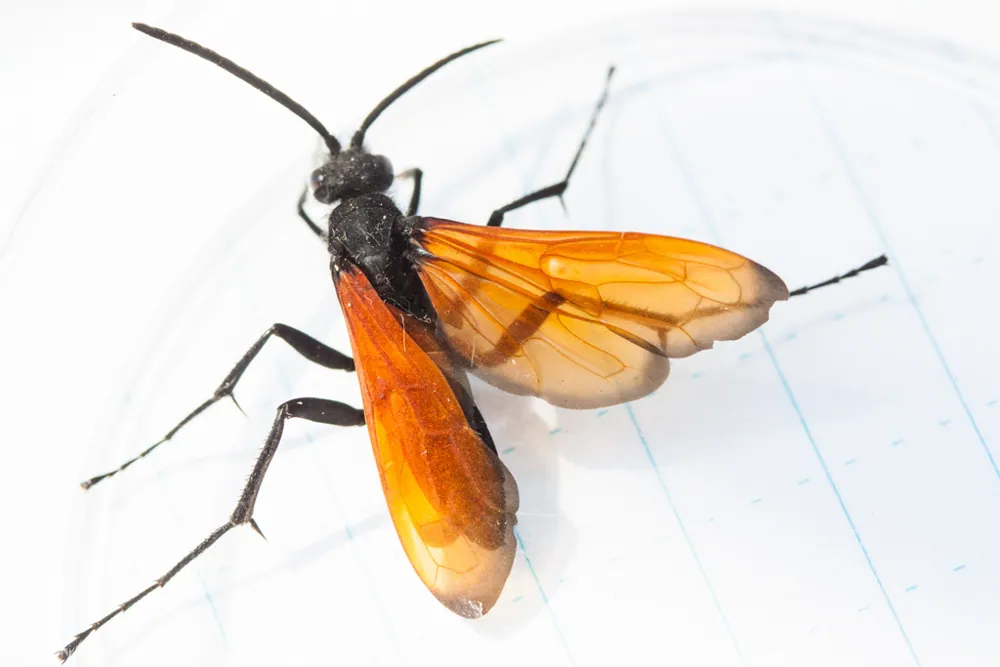
Rusty-winged tarantula hawk
 Dafay jam
The rusty-winged tarantula hawk is a large wasp, with a matte black body and rust-orange wings. It lives in the dry Southwestern United States. Its sting is strong enough to paralyse a tarantula, which the wasp then uses to feed its young.1


 Ni ngay ko xàmmee
- Matte black body with rust-orange wings1
- Grows up to 5 cm long, among the largest wasps of its order1
- Long legs, used to grapple with prey1
- Males are smaller and more slender than females, with a more vibrant wing colour1
- The antenna has twelve segments1
Ñu ngi koy faral di jaxasoo ak: Its relatives in the genus Pepsis look very similar. Pepsis wasps are more metallic black, with deep-blue striped patterns. The only reliable way to tell them apart is by the pattern of veins in their wings.1
Kàttanu daŋar
Daŋar bi dafay génn ci ab dag buy jam.
Lan la daŋar biy sóob di def?
Its sting paralyses a tarantula but keeps it alive, so the spider stays fresh food for the larva. The sting is described as powerful and debilitating. It is ranked among the most painful stings in the insect world on the Schmidt sting pain index.1
Ni mu lore nit ñi?
Musiba ci nit: Dafay mettiMën na metti lool, waaye lu bon du faral di am.Its sting is among the most painful known from insects and is described as debilitating. The sting deters nearly all predators, including birds and lizards.1
Lan lay def bu tiitee?
Its painful sting deters nearly all predators.1
 Su jamee
- Xuufal dagu yamb bi ba mu génn, te sedal fa mu jam.
- Su nit ki am jafe-jafe ci noyyi, kanamam walla putam funki, walla mu bëgg a xëm, allergie bu metti la (urgence): woo sa nimerob urgence te jëfandikoo stylo adrénaline bi mu am, su am.
Saa su nekk, woo jëkk sa nimerob urgence (112, 000, 911). Lii ay ndigal yu yaatu ci ndimbal yu jëkk la, du ndigalu doktoor. Li war a xam ci ndimbal yu jëkk
 Sàmmal sa bopp
- Bul laal mukk, bul jàpp, bul sonal ab rab bu àll, doonte bu ndaw la, te doonte dafa mel ni dafa nelaw walla dafa dee.
- May ko bérab. Su nga ko gisee, dalal, dellu ginnaaw ndànk-ndànk te bàyyi ko mu dem yoonam.
- Su benn jamee la: dalal, bul yëngu, woo sa nimerob urgence (112, 000, 911) walla dem lopitaan ci gaaw. Bul fàtte ni mu meloon, ab nataal dina dimbali.
Du la wut. Dafay jëfandikoo daŋaram ngir jàpp lu muy lekk walla ngir aar boppam, te nëbbu moo ko gën a neex. Yeneen ci ni ngay sàmme sa bopp
Ni mu réye?
Ni mu guddoo?
 gën a gàtt sa baaraam bu ndaw
 mën na naaw ci benn terrain bu futbal bu mat ci 9 segond
Rusty-winged tarantula hawk ni mu réye ci wetu YOW?
Ay waññ rekk ci sa navigateur. Dara du denc te dara du yónnee fenn.
Ni mu gaawe?


Xibaar
The larva eats its living host from the inside. It hollows out the tarantula until the spider dies, once feeding reaches the bases of its legs.1
After paralysing a tarantula, the female may drag it up to 100 m to a burrow or cavity, where she seals it in with her egg.1
Males fight for territory in mid-air. The two wasps clash wings and spiral upwards, and larger males usually win and push smaller males off the best perches.1
Males gather on mountain ridges in great numbers during the breeding season, while females are rarely seen.1
Adult wasps do not grow after they emerge, so smaller males are at a permanent disadvantage when competing with larger ones.1
Ngir boroom xam-xam ci daŋar
- Turu xam-xam
- Hemipepsis ustulata
- Mbooloo
- Yamb, guêpe ak frelon
- Njaboot
- Pompilidae2
- Toftal
- Hymenoptera
- Kontinaa yi
- Amerig gu Bëj-gànnaar
- Liir yi
- The female lays one egg on each tarantula she has paralysed. The egg is about 5 mm long, and the larva that hatches from it feeds on the spider.1
- Musiba ci nit
- 2 / 5: Dafay metti3
Fa xibaar yi jóge
- Hemipepsis ustulata (Wikipedia (CC BY-SA 4.0))
- Hemipepsis ustulata (iNaturalist): tur ak ni ñu leen séddale.
- Venom Wiki: tolluwaayu musiba bi, réyaay bu yem bi ak xalaatu gaawaay bi, nun ñoo leen defar. Seetal ni nu leen waññe: Ni nuy natte musiba.
Xibaar bu nekk ci xët wii am na ab nimero buy won fa mu jóge. Su nu juumee, baal nu, nun ay nit ñu bëgg rab lanu, du ab jurnaalu xam-xam. Wax nu ko ci [email protected] te dinanu ko jubbanti.
 Jiit bi dafa xiif! Venom Wiki ab liggéeyu kenn la: amul pay, amul piblisite te amul traceur. Ab may bu tuuti dafay dimbali ngir mu des ci internet.Leel jiit bi
Yeneen ci mbooloo mi: Yamb, guêpe ak frelon
 Tarantula hawkYamb, guêpe ak frelonDafay metti rekk
 Executioner waspYamb, guêpe ak frelonSoxla na doktoor
 Warrior waspYamb, guêpe ak frelonSoxla na doktoor
 Bald-faced hornetYamb, guêpe ak frelonDafay metti rekk
 Cow killer velvet antYamb, guêpe ak frelonDafay metti rekk
 Eastern cicada killerYamb, guêpe ak frelonAmul lor
 Terciopelo
 Eastern coral snake
 Eastern diamondback rattlesnake
 Eyelash viper
 Timber rattlesnake
 Western diamondback rattlesnake