
 Afrig
Afrig Asi
Asi Tugal
Tugal Amerig gu Bëj-saalum
 Ostarali ak Oseyani
 Antarktig
 Mbàmbulaanu Pasifik
 Mbàmbulaanu Atlantig
 Mbàmbulaanu End
 Mbàmbulaanu Arktik
 Géeju Mediteraane
 Géej gu Xonq
 Géeju Karayib
 Géeju Koraay
 Géeju Siin gu Bëj-saalum
 Géeju Filipin
 Géeju Andaman
 Géeju Bëj-gànnaar
 Géeju Timor ak Arafura
 Golfu Bengal
 Golfu Kaliforni
Southern hognose snake
 Dafay màtt
The southern hognose snake is a stout, harmless snake with a sharply upturned nose. It lives on the coastal plain of the southeastern United States, where it hunts toads and other small animals.1



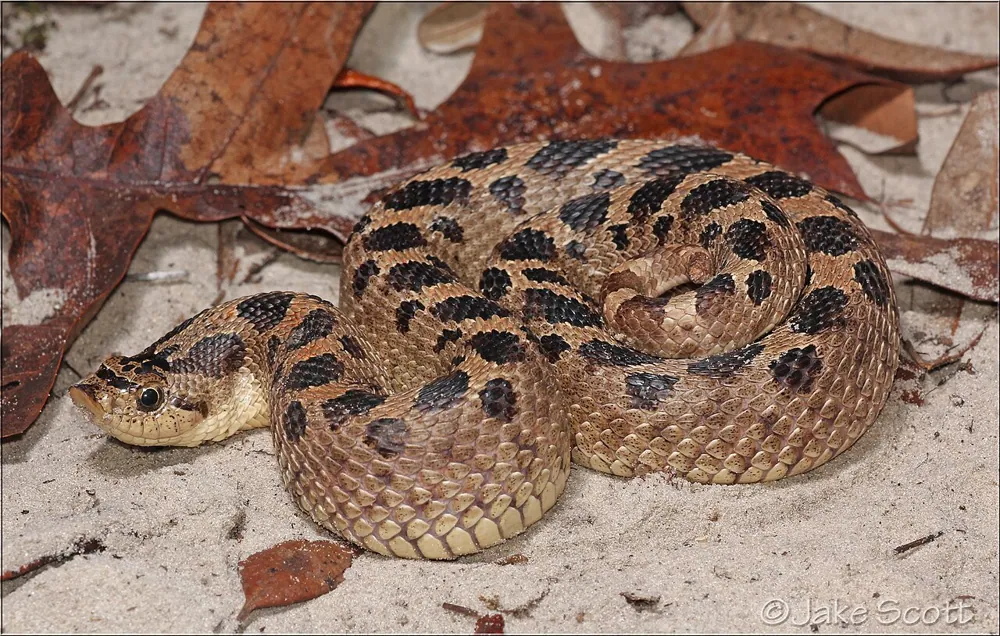
 Ni ngay ko xàmmee
- A stout body with a wide neck and a sharply upturned snout1
- A light brown, yellowish, grey or reddish base colour with a distinct row of dark blotches along the back1
- Smaller dark blotches alternate with the main blotches along the sides1
- About 25 rows of keeled (ridged) scales around the middle of the body1
- Young snakes have a belly that is clearly darker than the underside of the tail. As they age, the underside usually turns pale white1
Kàttanu daŋar
Daŋar bi dafay génn ci bëñam yi su màttee.
Ni mu lore nit ñi?
Musiba ci nit: WoyofNi jamu yamb walla lu ko yées. Lu jege, amul lor ci nit.It is described as harmless to people.1
 Su màttee
- Raxas fa mu màtt, def ba nit ki dal te wutal ndimbal doktoor. Am na yenn xeet (ni boomslang) yu mën a rey ay waxtu ginnaaw.
Saa su nekk, woo jëkk sa nimerob urgence (112, 000, 911). Lii ay ndigal yu yaatu ci ndimbal yu jëkk la, du ndigalu doktoor. Li war a xam ci ndimbal yu jëkk
 Sàmmal sa bopp
- Bul laal mukk, bul jàpp, bul sonal ab rab bu àll, doonte bu ndaw la, te doonte dafa mel ni dafa nelaw walla dafa dee.
- May ko bérab. Su nga ko gisee, dalal, dellu ginnaaw ndànk-ndànk te bàyyi ko mu dem yoonam.
- Su benn màttee la: dalal, bul yëngu, woo sa nimerob urgence (112, 000, 911) walla dem lopitaan ci gaaw. Bul fàtte ni mu meloon, ab nataal dina dimbali.
Du la wut. Dafay jëfandikoo daŋaram ngir jàpp lu muy lekk walla ngir aar boppam, te nëbbu moo ko gën a neex. Yeneen ci ni ngay sàmme sa bopp
Ni mu réye?
Ni mu guddoo?
 guddu na ni 3 banaana yu ñu toftale
 mën na daw 100 meetar ci 78 segond (nit ki gën a gaaw soxla na 9,6)
Southern hognose snake ni mu réye ci wetu YOW?
Ay waññ rekk ci sa navigateur. Dara du denc te dara du yónnee fenn.
Ni mu gaawe?


Xibaar
Toads make up most of its diet, which sets it apart from many snakes that mainly eat other animals.1
Hatchlings are already 15 to 18 cm long, which is a large size for a newborn snake.1
Its upturned snout is an adaptation that gives the species its common name.1
The Alabama Department of Conservation and Natural Resources lists it as possibly extirpated (locally extinct) in that state.1
It is classified as Vulnerable on the IUCN Red List, meaning it faces a high risk of extinction in the wild.1
Ngir boroom xam-xam ci daŋar
- Turu xam-xam
- Heterodon simus
- Mbooloo
- Jaan yu am bëñ ci ginnaaw gémmiñ
- Njaboot
- Colubridae2
- Toftal
- Squamata
- Kontinaa yi
- Amerig gu Bëj-gànnaar
- Liir yi
- It lays eggs. Clutches contain 6 to 14 thin-shelled, leathery, whitish eggs, which hatch after 55 to 60 days.1
- Ni mu nekke ci àll bi
- Vulnerable (IUCN Red List, assessed 2007)1
- Musiba ci nit
- 1 / 5: Woyof3
Fa xibaar yi jóge
- Southern hognose snake (Wikipedia (CC BY-SA 4.0))
- Heterodon simus (iNaturalist): tur ak ni ñu leen séddale.
- Venom Wiki: tolluwaayu musiba bi, réyaay bu yem bi ak xalaatu gaawaay bi, nun ñoo leen defar. Seetal ni nu leen waññe: Ni nuy natte musiba.
Xibaar bu nekk ci xët wii am na ab nimero buy won fa mu jóge. Su nu juumee, baal nu, nun ay nit ñu bëgg rab lanu, du ab jurnaalu xam-xam. Wax nu ko ci [email protected] te dinanu ko jubbanti.
 Jiit bi dafa xiif! Venom Wiki ab liggéeyu kenn la: amul pay, amul piblisite te amul traceur. Ab may bu tuuti dafay dimbali ngir mu des ci internet.Leel jiit bi
Yeneen ci mbooloo mi: Jaan yu am bëñ ci ginnaaw gémmiñ
 Western hognose snakeJaan yu am bëñ ci ginnaaw gémmiñAmul lor
 Brown vine snakeJaan yu am bëñ ci ginnaaw gémmiñAmul lor
 Eastern hognose snakeJaan yu am bëñ ci ginnaaw gémmiñAmul lor
 Green vine snakeJaan yu am bëñ ci ginnaaw gémmiñAmul lor
 Desert night snakeJaan yu am bëñ ci ginnaaw gémmiñAmul lor
 Night snakeJaan yu am bëñ ci ginnaaw gémmiñAmul lor
 Terciopelo
 Eastern coral snake
 Eastern diamondback rattlesnake
 Eyelash viper
 Timber rattlesnake
 Western diamondback rattlesnake