
 Afrig
Afrig Asi
Asi Tugal
Tugal Amerig gu Bëj-saalum
 Ostarali ak Oseyani
 Antarktig
 Mbàmbulaanu Pasifik
 Mbàmbulaanu Atlantig
 Mbàmbulaanu End
 Mbàmbulaanu Arktik
 Géeju Mediteraane
 Géej gu Xonq
 Géeju Karayib
 Géeju Koraay
 Géeju Siin gu Bëj-saalum
 Géeju Filipin
 Géeju Andaman
 Géeju Bëj-gànnaar
 Géeju Timor ak Arafura
 Golfu Bengal
 Golfu Kaliforni
Western massasauga
 Dafay màtt
The western massasauga is a small, venomous rattlesnake. It lives on the grassy plains and deserts of the southwestern United States and northern Mexico. Its rattle is higher pitched than those of bigger rattlesnakes, so it can be easy to miss as a warning.1



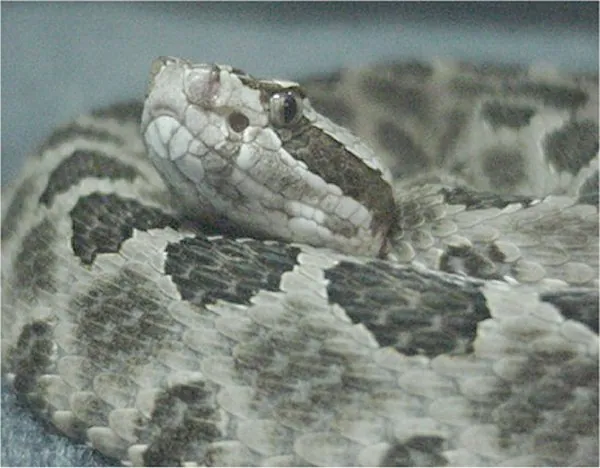
 Ni ngay ko xàmmee
- Dark brown blotches stand out strongly against a tan-grey or light grey background.1
- The belly is light, with a few dark markings.1
- Adults range from 35 to 91 cm in total length, tail included.1
- It has a rattle, but it is higher pitched than the rattles of larger rattlesnakes.1
Ñu ngi koy faral di jaxasoo ak: Its colour pattern is similar to that of the eastern massasauga, but paler. The dark brown blotches contrast more strongly with its light ground colour.1
Kàttanu daŋar
Daŋar bi dafay génn ci bëñam yi su màttee.
Lan la daŋar biy sóob di def?
Its venom is a powerful hemotoxin, which damages blood and tissue. It can cause swelling, necrosis (death of body tissue) and severe pain. Its yield is low, so each bite delivers less venom than a larger rattlesnake's bite would.1
Ni mu lore nit ñi?
Musiba ci nit: Lu bonMàtt laaj na doktoor. Ñi ciy dee dañoo néew lool.Its bite is less severe than that of larger rattlesnakes because it delivers less venom. Even so, the bite can be fatal if it is not treated.1
 Xibaar bu baax: doktoor yi am nañu garab (sérum antivenimeux) walla ab paj ngir lii.1
Lan lay def bu tiitee?
Its rattle is not a reliable warning, because its high pitch is easy to miss.1
 Su màttee
- Treatment should be sought immediately for any venomous snake bite. The antivenin CroFab is not specific to this snake, but it can be used to treat severe envenomation from massasaugas.1
- Def ba nit ki bañ a yëngu te dal, yemale cër bi ñu màtt ak kawewaayu xol bi, dindi jaaro yi ak lu xat lépp, te yóbbu ko lopitaan ci gaaw.
Saa su nekk, woo jëkk sa nimerob urgence (112, 000, 911). Lii ay ndigal yu yaatu ci ndimbal yu jëkk la, du ndigalu doktoor. Li war a xam ci ndimbal yu jëkk
 Sàmmal sa bopp
- Bul laal mukk, bul jàpp, bul sonal ab rab bu àll, doonte bu ndaw la, te doonte dafa mel ni dafa nelaw walla dafa dee.
- May ko bérab. Su nga ko gisee, dalal, dellu ginnaaw ndànk-ndànk te bàyyi ko mu dem yoonam.
- Su benn màttee la: dalal, bul yëngu, woo sa nimerob urgence (112, 000, 911) walla dem lopitaan ci gaaw. Bul fàtte ni mu meloon, ab nataal dina dimbali.
Du la wut. Dafay jëfandikoo daŋaram ngir jàpp lu muy lekk walla ngir aar boppam, te nëbbu moo ko gën a neex. Yeneen ci ni ngay sàmme sa bopp
Ni mu réye?
Ni mu guddoo?
 guddu na ni 2 muusu kër, bakkan ba geen
 guddu na ni 5 banaana yu ñu toftale
 mën na daw 100 meetar ci 110 segond (nit ki gën a gaaw soxla na 9,6)
Western massasauga ni mu réye ci wetu YOW?
Ay waññ rekk ci sa navigateur. Dara du denc te dara du yónnee fenn.
Ni mu gaawe?


Xibaar
Its venom is as potent as that of larger rattlesnakes, but its low yield greatly reduces the harm it can do.1
It is nicknamed the buzztail because of its high-pitched rattle.1
It is mainly active at night and is considered mild-mannered and sluggish, especially in summer, when it is sometimes found basking.1
It was once considered a subspecies of the eastern massasauga.1
Tasukatu léeb
Xalaat bu juum: A rattle always gives a clear warning before a rattlesnake bites.
Dëgg: The western massasauga's rattle is higher pitched than those of larger rattlesnakes, so it should not be relied on as a warning.1
Fa xibaar yi jóge
- Sistrurus tergeminus (Wikipedia (CC BY-SA 4.0))
- Sistrurus tergeminus (iNaturalist): tur ak ni ñu leen séddale.
- Venom Wiki: tolluwaayu musiba bi, réyaay bu yem bi ak xalaatu gaawaay bi, nun ñoo leen defar. Seetal ni nu leen waññe: Ni nuy natte musiba.
Xibaar bu nekk ci xët wii am na ab nimero buy won fa mu jóge. Su nu juumee, baal nu, nun ay nit ñu bëgg rab lanu, du ab jurnaalu xam-xam. Wax nu ko ci [email protected] te dinanu ko jubbanti.
 Jiit bi dafa xiif! Venom Wiki ab liggéeyu kenn la: amul pay, amul piblisite te amul traceur. Ab may bu tuuti dafay dimbali ngir mu des ci internet.Leel jiit bi
Yeneen ci mbooloo mi: Serpent à sonnette
 Eastern diamondback rattlesnakeSerpent à sonnetteMën na rey
 Timber rattlesnakeSerpent à sonnetteMën na rey
 Western diamondback rattlesnakeSerpent à sonnetteMën na rey
 SidewinderSerpent à sonnetteSoxla na doktoor
 Mojave rattlesnakeSerpent à sonnetteMën na rey
 Aruba rattlesnakeSerpent à sonnetteSoxla na doktoor
 Terciopelo
 Eastern coral snake
 Eyelash viper
 Arizona bark scorpion
 Brown recluse
 Cane toad