
 Bitten or stung?
 All animals
 Pick a continent
 Africa
 Asia
 Europe
 South America
 Australia & Oceania
 Antarctica
 Pacific Ocean
 Atlantic Ocean
 Indian Ocean
 Arctic Ocean
 Mediterranean Sea
 Red Sea
 Caribbean Sea
 Coral Sea
 South China Sea
 Philippine Sea
 Andaman Sea
 North Sea
 Timor & Arafura Sea
 Bay of Bengal
 Gulf of California
 Games
 Venom battle
 Animal race
 Field notebook
 Venom TOP lists
 Stay safe
 Surprise me

Cane toad
 Poison in its skin
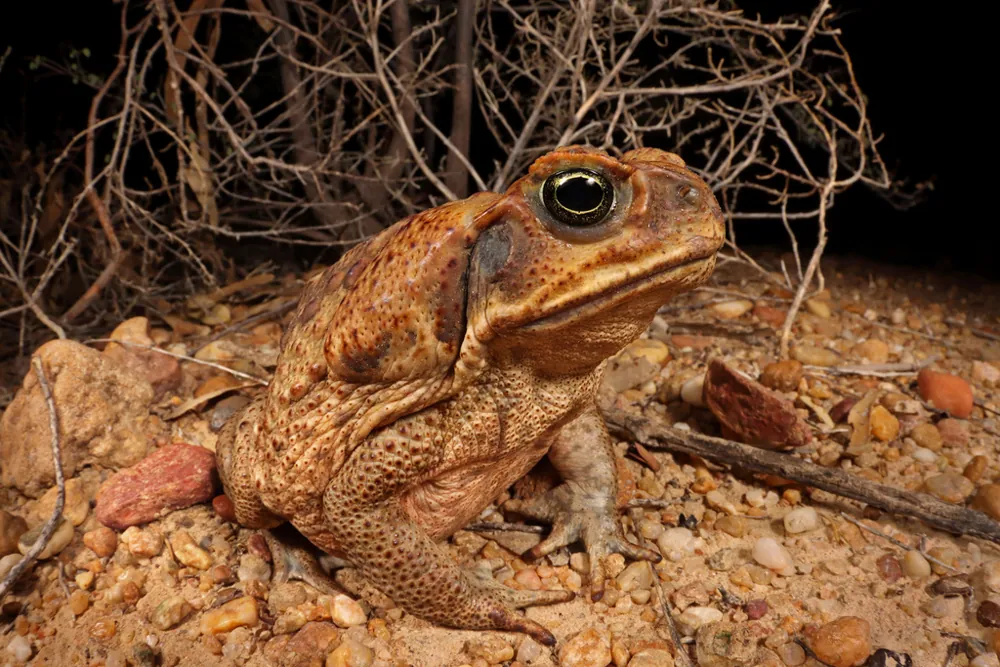
The cane toad is a large toad that is very poisonous to many animals. It is native to South and mainland Central America, but people have moved it to islands in Oceania and the Caribbean and to northern Australia. It matters because it spreads quickly and harms native wildlife and pets.1
 How to recognise it
- Very large, with adults usually 10 to 15 cm long1
- Dry, warty skin with distinct ridges above the eyes that run down the snout1
- A large parotoid gland (a swollen gland) behind each eye1
- Grey, yellowish, red-brown or olive-brown skin, often with patterns1
- Horizontal pupils and golden irises1
Often confused with: In Australia, adults can be confused with large native frogs, but these lack the large parotoid glands and the ridge between the nostril and eye. The giant burrowing frog has vertical pupils and silver-grey irises, while the cane toad has horizontal pupils and golden irises. In the United States, the southern toad has two bulbs in front of the parotoid glands.1
Poison power
Its skin is poisonous. It is dangerous to touch, lick or eat.
What does its poison do?
The toad's glands secrete a milky-white fluid called bufotoxin when it is threatened. Components of bufotoxin are toxic to many animals. In dogs, signs of poisoning include excessive drooling, extremely red gums, head-shaking, crying and loss of coordination.1
How dangerous is it to people?
Danger to people: SeriousIf someone touches or eats it, see a doctor. Deaths are very rare.The toxic skin can kill many wild and domestic animals. Dogs are especially at risk from licking or biting the toad. Human deaths have also been recorded after people ate cane toads.1
What does it do when it is scared?
When threatened, it releases bufotoxin from its glands.1
 If someone touched or ate it
Always call your emergency number first (for example 112 in Europe, 911 in North America, 000 in Australia).
- If toad poison gets in the eyes or mouth, rinse with plenty of clean water for 15 minutes, and wash skin with soap and water. If someone has licked or eaten a toad, call the emergency number or a poison centre at once. For a dog, wipe its gums with a wet cloth and go to a vet straight away.1
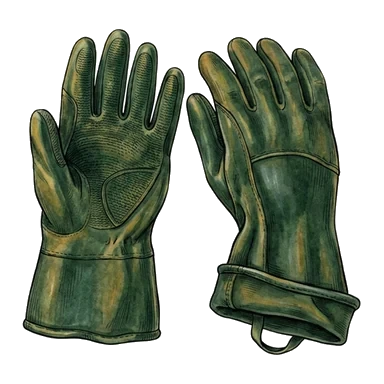
- If someone touched one: wash the hands well and do not touch the eyes or mouth. If a child or pet licked or ate one: call your poison centre or emergency number.
This is general first aid guidance, not medical advice. Based on the first aid guidelines of the World Health Organization and the Australian Resuscitation Council. Facts come from public sources and may contain mistakes. When in doubt, always get medical help. First aid basics
 Stay safe
- Never touch, catch or tease a wild animal, even a small one, and even if it looks asleep or dead.
- Give it space. If you meet one, stay calm, step back slowly and let it go its own way.
- If you touched or ate it: do not rub your eyes or mouth, wash your hands and get medical help.
It is not out to get you. Its poison is only there so that nothing eats it. More about staying safe
Where in the world?
How big is it?
How long is it?
 as long as 3 bank cards end to end
 could cover 100 metres in 180 seconds (the fastest human needs 9.6)
How big is Cane toad compared to you?
Just maths in your browser. Nothing is saved or sent anywhere.
How fast is it?


Facts
Young toads lose the toxicity they had as eggs and tadpoles, and they only develop their poison glands later. Only an estimated 0.5% of cane toads reach adulthood.1
In Australia, tadpoles have evolved to be more likely to eat their siblings than tadpoles in South America.1
A female can lay thousands of eggs in one spawn, in strings up to 20 metres long.1
In the wild, cane toads can live 10 to 15 years, and one captive toad was reported to have lived 35 years.1
The cane toad is considered the largest species in the Bufonidae, the toad family.1
Cane toads eat both living and dead matter, which is unusual among frogs and toads.1
Myth buster
Myth: The name 'marine toad' suggests that cane toads live in the sea.
Truth: Cane toads do not live in the sea. The name came from a mistaken belief by an early naturalist.1
For venom experts
- Scientific name
- Rhinella marina
- Group
- Poison frogs, toads & newts
- Also called
- Giant Toad, Marine Toad, Giant Neotropical Toad1
- Family
- Bufonidae2
- Order
- Anura
- Continents
- North America, South America, Australia & Oceania
- Babies
- A female lays 8,000 to 25,000 eggs at once, in long jelly strings that can stretch up to 20 metres.1
- Lifespan
- about 15 years1
- Danger to people
- 3 / 5: Serious3
Where the facts come from
- Cane toad (Wikipedia (CC BY-SA 4.0))
- Rhinella marina (iNaturalist): names and classification.
- Venom Wiki: the danger level, the typical size and the speed guess are our own. See how we work them out: How we rate danger.
Every fact on this page has a number that points to its source. If we got something wrong, sorry, we are animal fans, not a science journal. Tell us at [email protected] and we will fix it.
Get the Venom Wiki app
Every creature, every picture and the games in your pocket, even without internet.


 Support Venom Wiki Venom Wiki is a one-man project: free, with no ads and no cookies. A small tip helps keep it online.Feed the scorpion
More from the same group: Poison frogs, toads & newts
 Golden poison frogPoison frogs, toads & newtsDeadlyDo not touch
 Dyeing poison dart frogPoison frogs, toads & newtsPainfulDo not touch
 Strawberry poison-dart frogPoison frogs, toads & newtsPainfulDo not touch
 Black-legged poison frogPoison frogs, toads & newtsCan killDo not touch
 California newtPoison frogs, toads & newtsCan killDo not touch
 Rough-skinned newtPoison frogs, toads & newtsCan killDo not touch
 Terciopelo
 Eastern coral snake
 Eastern diamondback rattlesnake
 Timber rattlesnake
 Western diamondback rattlesnake
 Arizona bark scorpion