
Golden poison frog
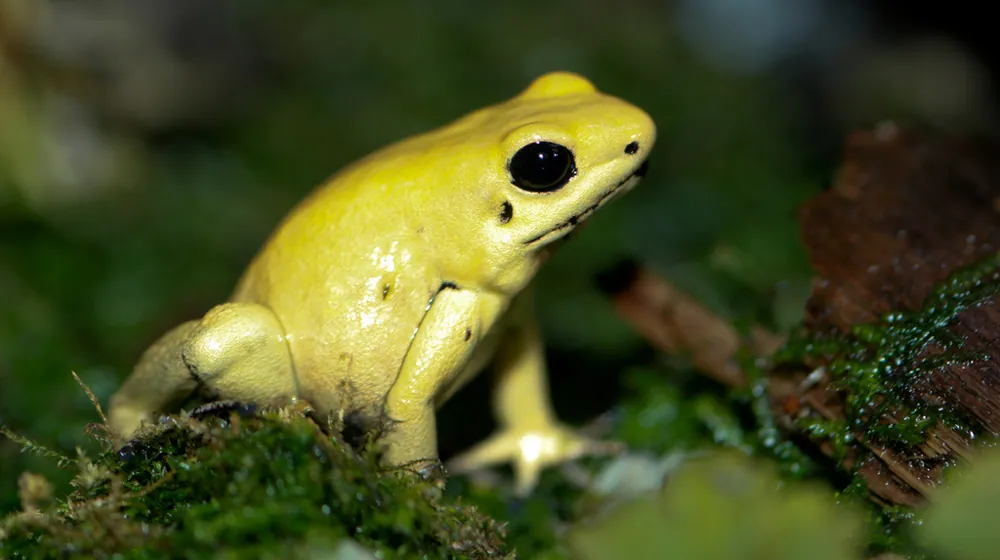
The golden poison frog is a small, bright frog from the rainforests of Colombia. It is considered the most poisonous animal species on Earth, even though it is small. Its bright colours warn predators to stay away.1
🔍 How to recognise it
- Adults are brightly coloured, in yellow, mint green, orange or golden yellow forms.1
- Juveniles are mostly black with two golden-yellow stripes along their backs.1
- Juveniles become fully coloured at about 18 weeks of age.1
- It is the largest species in the poison dart frog family.1
- Females are typically larger than males.1
Poison power
Its skin is poisonous. It is dangerous to touch, lick or eat.
What does its poison do?
The frog's skin glands produce batrachotoxin, a very strong alkaloid poison. It affects the sodium channels of nerve cells, leaving muscles stuck in a contracted state. This can lead to paralysis, heart fibrillation, heart failure and death.1
How dangerous is it to people?
Danger to people: DeadlyOne of the most dangerous animals in the world.The text estimates that an average wild frog carries about one milligram of poison, enough to kill 10 to 20 humans. A predator usually has to try to eat the frog to be poisoned, but contact with the skin is also dangerous. Captive-bred frogs are not toxic.1
What does it do when it is scared?
Its bright colours warn predators of its toxicity, a pattern called aposematic coloration.1
🚑 If someone touched or ate it
- If someone touched one: wash the hands well and do not touch the eyes or mouth. If a child or pet licked or ate one: call your poison centre or emergency number.
Always call your emergency number first (112, 000, 911). This is general first aid guidance, not medical advice. First aid basics
⛑️ Stay safe
- Never touch, catch or tease a wild animal, even a small one, and even if it looks asleep or dead.
- Give it space. If you meet one, stay calm, step back slowly and let it go its own way.
- If you touched or ate it: do not rub your eyes or mouth, wash your hands and get medical help.
It is not out to get you. Its poison is only there so that nothing eats it. More about staying safe
Where in the world?
How big is it?
How long is it?
How heavy is it?
How big is Golden poison frog compared to YOU?
Just maths in your browser. Nothing is saved or sent anywhere.
How fast is it?


Facts
Local indigenous peoples, such as the Emberá and Cofán, use the frog's poison on the tips of hunting darts and arrows. The poison stays deadly for two years or longer.1
The frog gets its toxicity from its diet. Frogs fed commercial feeder insects in captivity lose their toxicity over time.1
Scientists think a small beetle from the family Melyridae may be a key prey item that supplies the poison.1
The Leimadophis epinephelus snake has shown resistance to several frog toxins and has been seen eating juvenile frogs without harm.1
The frog's colour varies. The yellow form gives it its common name, but the species also has mint green, orange and orange blackfoot forms.1
Myth buster
Myth: All golden poison frogs are always poisonous.
Truth: The frog only becomes toxic when it eats the right prey in the wild. Captive-bred frogs raised without their natural food are non-toxic.1
For venom experts
- Scientific name
- Phyllobates terribilis
- Group
- Poison frogs, toads & newts
- Also called
- Golden dart frog, Golden poison arrow frog, Golden Poison Dart Frog1
- Family
- Dendrobatidae2
- Order
- Anura
- Continents
- South America
- Babies
- The eggs are laid on the ground, hidden under leaf litter. The number of eggs is not stated. Tadpoles stick to the mucus on the parent's back, and the parent carries them to water pools in the canopy.1
- How it is doing in the wild
- Endangered1
- Danger to people
- 5 / 5: Deadly3
Where the facts come from
- Golden poison frog (Wikipedia (CC BY-SA 4.0))
- Phyllobates terribilis (iNaturalist): names and classification.
- Venom Wiki: the danger level, the typical size and the speed guess are our own. See how we work them out: How we rate danger.
Every fact on this page has a number that points to its source. If we got something wrong, sorry, we are animal fans, not a science journal. Tell us at [email protected] and we will fix it.
 The spider is hungry! Venom Wiki is a dad's project for his animal-loving kids, free with no ads and no trackers. Grown-ups can drop a snack in the basket to help keep it online.Feed the spider
 Cane toad
 Dyeing poison dart frog
 Black-legged poison frog
 Bruno's casque-headed frog
 Harlequin poison frog
 Giant leaf frog
 Terciopelo
 Brazilian wandering spider
 Eyelash viper
 Golden lancehead
 South American bushmaster
 Peruvian giant centipede