
 Bitten or stung?
 All animals
 Pick a continent
 Africa
 Asia
 Europe
 South America
 Australia & Oceania
 Antarctica
 Pacific Ocean
 Atlantic Ocean
 Indian Ocean
 Arctic Ocean
 Mediterranean Sea
 Red Sea
 Caribbean Sea
 Coral Sea
 South China Sea
 Philippine Sea
 Andaman Sea
 North Sea
 Timor & Arafura Sea
 Bay of Bengal
 Gulf of California
 Games
 Venom battle
 Animal race
 Field notebook
 Venom TOP lists
 Stay safe
 Surprise me

Chilean rose tarantula
 Bites
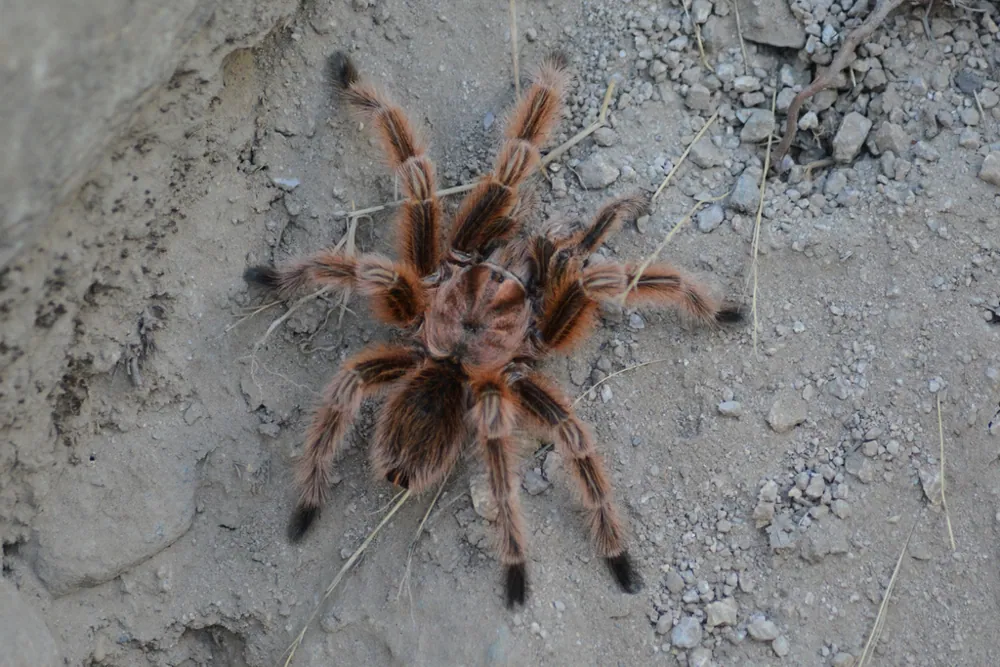
The Chilean rose tarantula is a large, hairy spider that is one of the most common tarantulas kept as a pet in America and Europe. It lives in the dry, scrubby high desert of northern Chile, Bolivia and Argentina. It is venomous, but its venom is not considered extremely dangerous to people.1
 How to recognise it
- Its colouring is reddish or rose-coloured, and this varies between colour morphs.1
- It has small, spine-like urticating hairs on its abdomen (rear body).1
- It usually lives in a straight-down burrow with one or two chambers, lined with silk.1
- It is usually skittish and runs away from danger rather than defending itself.1
Often confused with: Grammostola porteri was once widely confused with this species. In 2022, the World Spider Catalog reclassified it as a junior synonym, meaning it is now treated as the same species as the Chilean rose tarantula.1
Venom power
Venom comes out through its fangs or teeth when it bites.
What does its venom do?
Its venom contains neurotoxins, which attack the nervous system, and hemotoxins, which disrupt the circulatory system. The venom is mainly used to hunt and digest prey. It is not considered extremely dangerous to humans.1
How dangerous is it to people?
Danger to people: MildLike a bee sting or less. Basically harmless to people, unless the person is allergic.It is not dangerous to humans. Its main hazard is its urticating hairs, which cause irritation and itching on skin and eyes. In February 2009, a British man had hairs lodged in his cornea after they were thrown from his pet while he was cleaning its tank.1
What does it do when it is scared?
When threatened, it brushes urticating hairs off its abdomen with its legs, and it may raise its front legs and show its fangs.1
 If it bites
Call your emergency number at once if the person has trouble breathing, swelling of the face or throat, or feels faint.
- If hairs get into the eyes, rinse them with plenty of clean water and see a doctor, as the hairs can lodge in the eye. Remove hairs from skin with sticky tape and wash the area. Wash a bite with soap and water and use a cold pack for pain.1
- Wash the bite and cool it. Get medical help if the pain is strong or the person feels unwell.
This is general first aid guidance, not medical advice. Based on the first aid guidelines of the World Health Organization and the Australian Resuscitation Council. Facts come from public sources and may contain mistakes. When in doubt, always get medical help. First aid basics
 Stay safe
- Never touch, catch or tease a wild animal, even a small one, and even if it looks asleep or dead.
- Give it space. If you meet one, stay calm, step back slowly and let it go its own way.
- If it hurts you: wash the spot, stay calm and get medical help if the pain is strong or spreads, or the person feels unwell.
It is not out to get you. It uses its venom to catch food or to protect itself, and it would much rather hide. More about staying safe
Where in the world?
How big is it?
How long is it?
 as long as 1.5 bank cards end to end
 could cover 100 metres in 220 seconds (the fastest human needs 9.6)
How big is Chilean rose tarantula compared to you?
Just maths in your browser. Nothing is saved or sent anywhere.
How fast is it?


Facts
A peptide in its venom, called GsMTx4, has been shown to block mechanosensitive ion channels in living cells, which makes it useful for research.1
Its urticating hairs also act as sensors, helping it detect small vibrations and changes in pressure.1
It is probably the most common tarantula sold in American and European pet stores, largely because many wild-caught spiders are exported cheaply from Chile.1
Females can dig burrows reaching 40 centimetres deep.1
It can go without food for weeks to months, and fasting can sometimes signal that it is about to moult.1
Males grow tibial hooks on their front legs while maturing, which help them hold the female during mating.1
For venom experts
- Scientific name
- Grammostola rosea
- Group
- Tarantulas & funnel-webs
- Also called
- Rose hair tarantula, Chilean fire tarantula, Chilean red-haired tarantula1
- Family
- Theraphosidae2
- Order
- Araneae
- Continents
- South America
- Babies
- After mating, a female spins a web and lays 50 to 200 eggs in the weeks that follow.1
- Lifespan
- about 20 years1
- How it is doing in the wild
- Not listed as endangered. In March 2026 it was added to CITES Appendix II, which means trade in the species must be controlled.1
- Danger to people
- 1 / 5: Mild3
Where the facts come from
- Chilean rose tarantula (Wikipedia (CC BY-SA 4.0))
- Grammostola rosea (iNaturalist): names and classification.
- Venom Wiki: the danger level, the typical size and the speed guess are our own. See how we work them out: How we rate danger.
Every fact on this page has a number that points to its source. If we got something wrong, sorry, we are animal fans, not a science journal. Tell us at [email protected] and we will fix it.
Get the Venom Wiki app
Every creature, every picture and the games in your pocket, even without internet.


 Support Venom Wiki Venom Wiki is a one-man project: free, with no ads and no cookies. A small tip helps keep it online.Feed the scorpion
More from the same group: Tarantulas & funnel-webs
 Goliath birdeaterTarantulas & funnel-websPainful
 Brazilian salmon pink birdeaterTarantulas & funnel-websMild
 Greenbottle blue tarantulaTarantulas & funnel-websMild
 Pinktoe tarantulaTarantulas & funnel-websMild
 Brazilian funnel-web spiderTarantulas & funnel-websNeeds a doctor
 Burgundy goliath birdeaterTarantulas & funnel-websPainful
 Golden poison frog
 Terciopelo
 Brazilian wandering spider
 Golden lancehead
 South American bushmaster
 Cane toad