
 Bitten or stung?
 All animals
 Pick a continent
 Africa
 Asia
 Europe
 South America
 Australia & Oceania
 Antarctica
 Pacific Ocean
 Atlantic Ocean
 Indian Ocean
 Arctic Ocean
 Mediterranean Sea
 Red Sea
 Caribbean Sea
 Coral Sea
 South China Sea
 Philippine Sea
 Andaman Sea
 North Sea
 Timor & Arafura Sea
 Bay of Bengal
 Gulf of California
 Games
 Venom battle
 Animal race
 Field notebook
 Venom TOP lists
 Stay safe
 Surprise me

Eastern lubber grasshopper
 Poisonous to eat
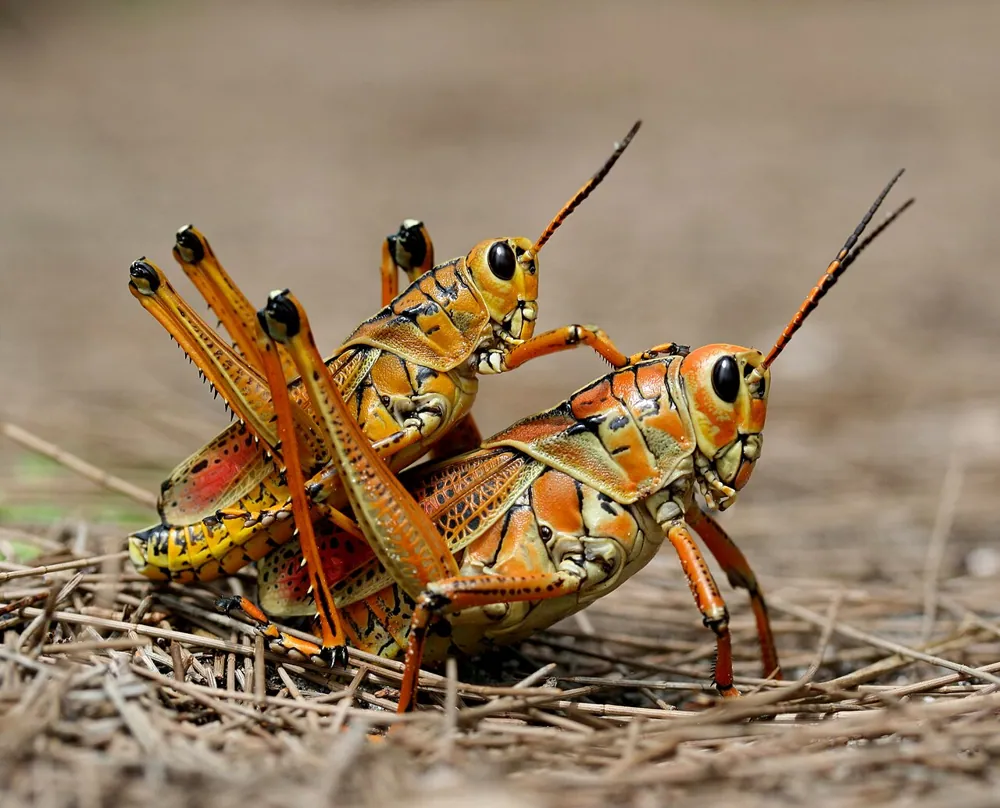
The eastern lubber grasshopper is one of the largest grasshoppers in the United States, with bright, easy-to-spot colours. It lives in the southeastern and south-central United States, including all of Florida. It is poisonous rather than venomous: it does not bite or sting, but it can harm animals that eat it.1
 How to recognise it
- Nymphs are smaller than adults, wingless and completely black, with one or more yellow, orange or red stripes.1
- Adults are dull yellow with black spots and markings, bright orange with black markings, or entirely black with yellow or red striping.1
- Adult wings are usually much shorter than the body and cannot be used for flight.1
- Adult males are typically 4.3 to 5.5 cm long and females 5 to 7 cm long, making them very large for a grasshopper.1
Poison power
It is only harmful if something eats it.
How dangerous is it to people?
Danger to people: MildLike a bee sting or less. Basically harmless to people, unless the person is allergic.What does it do when it is scared?
When disturbed, it shows its bright colours as a warning, releases a dark, foul-smelling and foul-tasting foamy liquid from its thorax, and gives off a loud hiss to scare would-be attackers.1
 If someone ate it
Call your emergency number at once if the person has trouble breathing, swelling of the face or throat, or feels faint.
- If someone ate it or has symptoms after eating it: call your emergency number or poison centre straight away.
This is general first aid guidance, not medical advice. Based on the first aid guidelines of the World Health Organization and the Australian Resuscitation Council. Facts come from public sources and may contain mistakes. When in doubt, always get medical help. First aid basics
 Stay safe
- Never touch, catch or tease a wild animal, even a small one, and even if it looks asleep or dead.
- Give it space. If you meet one, stay calm, step back slowly and let it go its own way.
- If someone ate it: call your emergency number or poison centre straight away.
It is not out to get you. Its poison is only there so that nothing eats it. More about staying safe
Where in the world?
How big is it?
How long is it?
 about as long as a bank card
How big is Eastern lubber grasshopper compared to you?
Just maths in your browser. Nothing is saved or sent anywhere.
How fast is it?


Facts
Most predatory birds and mammals avoid it because of its toxicity, but large predatory insects can still catch and kill adults.1
It is one of the largest grasshoppers in the United States, along with the western horse lubber grasshopper.1
Its wings are too small for flight in most adults, so it relies on its colours and defences instead.1
Adults in the black colour form are widely known as 'diablo' or 'black diablo'.1
In Louisiana it is called the 'devil's horse' or 'cheval-diable', and in Mississippi it is known as the 'giant locust'.1
Myth buster
Myth: Its bright colours are just for decoration.
Truth: The colours are a warning to predators that the grasshopper tastes unpleasant.1
Where the facts come from
- Romalea (Wikipedia (CC BY-SA 4.0))
- Romalea microptera (iNaturalist): names and classification.
- Venom Wiki: the danger level, the typical size and the speed guess are our own. See how we work them out: How we rate danger.
Every fact on this page has a number that points to its source. If we got something wrong, sorry, we are animal fans, not a science journal. Tell us at [email protected] and we will fix it.
Get the Venom Wiki app
Every creature, every picture and the games in your pocket, even without internet.


 Support Venom Wiki Venom Wiki is a one-man project: free, with no ads and no cookies. A small tip helps keep it online.Feed the scorpion
More from the same group: Other poisonous animals
 Monarch butterflyOther poisonous animalsMild
 Striped blister beetleOther poisonous animalsPainfulDo not touch
 Japanese pufferfishOther poisonous animalsDeadly
 Hawksbill sea turtleOther poisonous animalsCan kill
 Spanish flyOther poisonous animalsNeeds a doctorDo not touch
 Greenland sharkOther poisonous animalsPainful
 Terciopelo
 Eastern coral snake
 Eastern diamondback rattlesnake
 Timber rattlesnake
 Western diamondback rattlesnake
 Arizona bark scorpion
