
 Bitten or stung?
 All animals
 Pick a continent
 Africa
 Asia
 Europe
 South America
 Australia & Oceania
 Antarctica
 Pacific Ocean
 Atlantic Ocean
 Indian Ocean
 Arctic Ocean
 Mediterranean Sea
 Red Sea
 Caribbean Sea
 Coral Sea
 South China Sea
 Philippine Sea
 Andaman Sea
 North Sea
 Timor & Arafura Sea
 Bay of Bengal
 Gulf of California
 Games
 Venom battle
 Animal race
 Field notebook
 Venom TOP lists
 Stay safe
 Surprise me

Striped blister beetle
 Poison in its skin
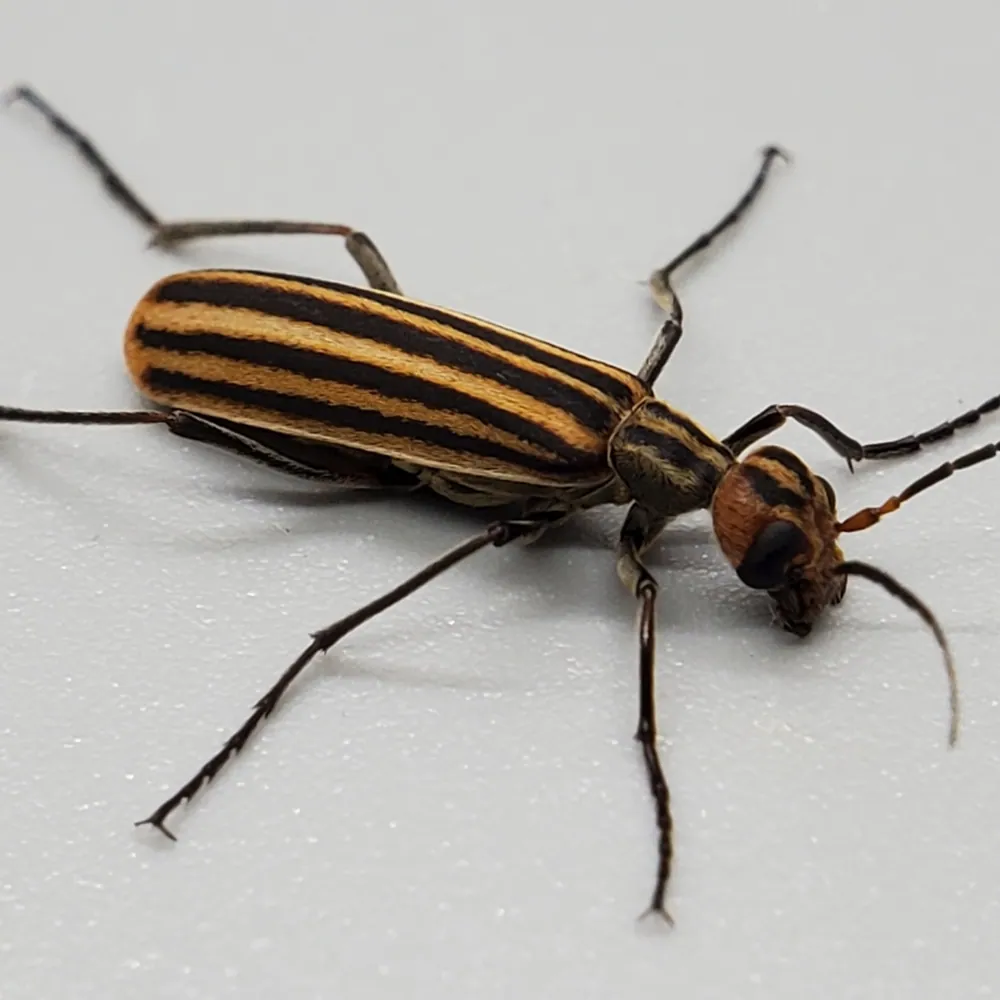
The striped blister beetle is a slender black and yellow beetle that lives in eastern North America. It is a crop pest that can damage vegetable and field plants. Its body contains a poison that blisters skin and can kill livestock, so it should be left alone.1
 How to recognise it
- Adults are 9 to 17 millimetres long, long and slender, with a hairy body.1
- The body is black and yellow.1
- It has two black spots on the head and two black stripes on the thorax (the middle body section).1
- It has two or three black stripes on each wing cover. Northern beetles have two stripes and southern beetles have three.1
- Adults often form swarms that travel together.1
Poison power
Its skin is poisonous. It is dangerous to touch, lick or eat.
What does its poison do?
This beetle is poisonous rather than venomous, as it does not bite or sting. It contains cantharidin, a toxic compound that causes blistering of the skin and mucous membranes. In horses, a dose of about one milligram per kilogram of body weight is toxic, and eating 30 to 50 beetles can be fatal. Symptoms include blisters and ulcers of the mouth, pawing, stretching, diarrhoea, and low blood calcium and magnesium.1
How dangerous is it to people?
Danger to people: PainfulIt can really hurt, but it is almost never serious.Cantharidin has been known to cause deaths, particularly of horses. Even two to five beetles can cause colic in horses, and hay containing crushed beetles can make animals ill. Cattle and sheep are less affected but can still show some symptoms. Frogs that eat these beetles keep the poison, so eating frog legs from beetle-fed frogs could cause poisoning. As little as 200 grams could contain a potentially fatal dose.1
 If someone touched or ate it
Call your emergency number at once if the person has trouble breathing, swelling of the face or throat, or feels faint.
- If someone ate it or has symptoms after eating it: call your emergency number or poison centre straight away.
This is general first aid guidance, not medical advice. Based on the first aid guidelines of the World Health Organization and the Australian Resuscitation Council. Facts come from public sources and may contain mistakes. When in doubt, always get medical help. First aid basics
 Stay safe
- Never touch, catch or tease a wild animal, even a small one, and even if it looks asleep or dead.
- Give it space. If you meet one, stay calm, step back slowly and let it go its own way.
- If you touched or ate it: do not rub your eyes or mouth, wash your hands and get medical help.
It is not out to get you. Its poison is only there so that nothing eats it. More about staying safe
Where in the world?
How big is it?
How long is it?
 shorter than your little finger
How big is Striped blister beetle compared to you?
Just maths in your browser. Nothing is saved or sent anywhere.
How fast is it?


Facts
Frogs can eat blister beetles without harm, but they store the poison in their tissues and mucus, so predators that eat the frogs can be poisoned.1
Its larvae live on grasshopper eggs, which they find and feed on.1
Some ecologists consider it one of the most problematic pest blister beetles in its range, because it feeds voraciously, damages fruit and forms swarms.1
The beetle changes its appearance as it develops. The newly hatched larva is whitish with long legs, and later becomes a reddish-brown grub with shorter legs.1
Predators include robber flies and birds such as the western meadowlark, eastern bluebird and scissor-tailed flycatcher.1
For venom experts
- Scientific name
- Epicauta vittata
- Group
- Other poisonous animals
- Also called
- old-fashioned potato beetle1
- Family
- Meloidae2
- Order
- Coleoptera
- Continents
- North America
- Babies
- The female lays eggs in masses of 100 to 200 in a chamber a few centimetres deep in the soil, and each egg is about 2 millimetres long. The eggs hatch within 16 days, and there are one or two generations per year.1
- Danger to people
- 2 / 5: Painful3
Where the facts come from
- Epicauta vittata (Wikipedia (CC BY-SA 4.0))
- Epicauta vittata (iNaturalist): names and classification.
- Venom Wiki: the danger level, the typical size and the speed guess are our own. See how we work them out: How we rate danger.
Every fact on this page has a number that points to its source. If we got something wrong, sorry, we are animal fans, not a science journal. Tell us at [email protected] and we will fix it.
Get the Venom Wiki app
Every creature, every picture and the games in your pocket, even without internet.


 Support Venom Wiki Venom Wiki is a one-man project: free, with no ads and no cookies. A small tip helps keep it online.Feed the scorpion
More from the same group: Other poisonous animals
 Monarch butterflyOther poisonous animalsMild
 Eastern lubber grasshopperOther poisonous animalsMild
 Japanese pufferfishOther poisonous animalsDeadly
 Hawksbill sea turtleOther poisonous animalsCan kill
 Spanish flyOther poisonous animalsNeeds a doctorDo not touch
 Greenland sharkOther poisonous animalsPainful
 Terciopelo
 Eastern coral snake
 Eastern diamondback rattlesnake
 Timber rattlesnake
 Western diamondback rattlesnake
 Arizona bark scorpion