
 Bitten or stung?
 All animals
 Pick a continent
 Africa
 Asia
 Europe
 South America
 Australia & Oceania
 Antarctica
 Pacific Ocean
 Atlantic Ocean
 Indian Ocean
 Arctic Ocean
 Mediterranean Sea
 Red Sea
 Caribbean Sea
 Coral Sea
 South China Sea
 Philippine Sea
 Andaman Sea
 North Sea
 Timor & Arafura Sea
 Bay of Bengal
 Gulf of California
 Games
 Venom battle
 Animal race
 Field notebook
 Venom TOP lists
 Stay safe
 Surprise me

Eurasian water shrew
 Bites
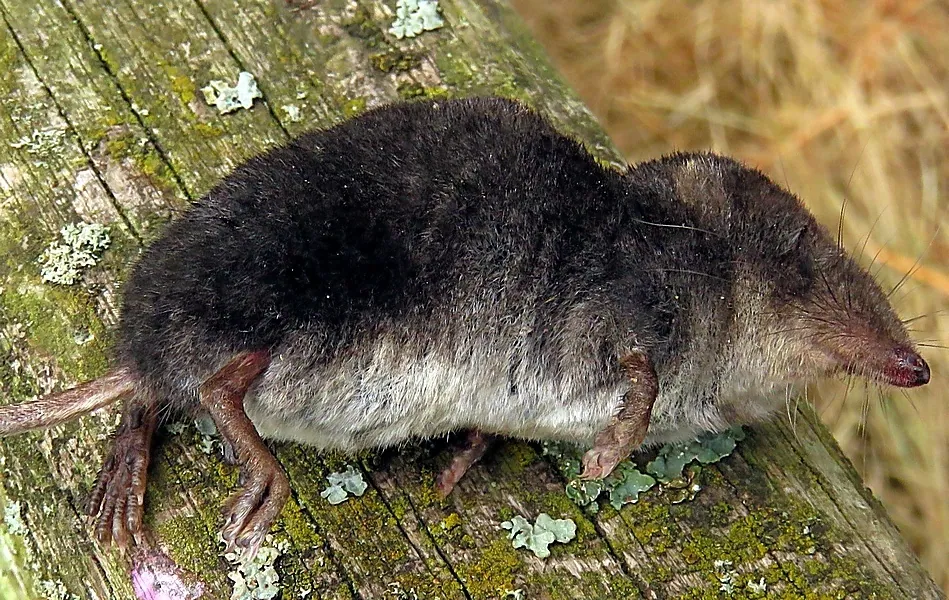
The Eurasian water shrew is a small, dark mammal that lives close to fresh water across northern Europe and Asia. It is one of the few venomous mammals, and it uses its venom to paralyse the prey it catches in the water.1
 How to recognise it
- Short, dark greyish-black fur on the head, back and sides1
- Dirty white underparts, sharply separated from the darker back1
- A white spot just behind the eye, and often another near the small ear1
- Black nose and a long, tapering snout1
- Sharp teeth tipped with red, and a slender tail with a keel of short white hairs underneath1
Venom power
Venom comes out through its fangs or teeth when it bites.
What does its venom do?
Its saliva contains a neurotoxic venom, which attacks the nerves. It delivers this venom at the base of the skull of its prey, and the venom paralyses prey even when the prey is larger than the shrew. Tests on field voles showed the venom is lethal at a minimum dose of 15 mg per kg of body weight.1
How dangerous is it to people?
Danger to people: MildLike a bee sting or less. Basically harmless to people, unless the person is allergic.Hantaviruses have been detected in shrews in Hungary and Poland, which raises public health concerns, although how the virus spreads is largely unknown.1
What does it do when it is scared?
Its venom is thought to immobilise organisms that may threaten it.1
 If it bites
Call your emergency number at once if the person has trouble breathing, swelling of the face or throat, or feels faint.
- Wash the wound well and get medical help.
This is general first aid guidance, not medical advice. Based on the first aid guidelines of the World Health Organization and the Australian Resuscitation Council. Facts come from public sources and may contain mistakes. When in doubt, always get medical help. First aid basics
 Stay safe
- Never touch, catch or tease a wild animal, even a small one, and even if it looks asleep or dead.
- Give it space. If you meet one, stay calm, step back slowly and let it go its own way.
- If it hurts you: wash the spot, stay calm and get medical help if the pain is strong or spreads, or the person feels unwell.
It is not out to get you. It uses its venom to catch food or to protect itself, and it would much rather hide. More about staying safe
Where in the world?
How big is it?
How long is it?
How heavy is it?

 about as long as a bank card
 so light you would not feel it on your hand
 could cover 100 metres in 90 seconds (the fastest human needs 9.6)
How big is Eurasian water shrew compared to you?
Just maths in your browser. Nothing is saved or sent anywhere.
How fast is it?


Facts
It is one of the few venomous mammals. Its venom comes from glands at the base of its lower front teeth, and grooves along the teeth channel the venom into the bite.1
Its teeth are tipped with red because of deposits of iron, which harden the enamel of the tips.1
It can dive up to two metres underwater and stay under for about twenty seconds before it must surface to breathe.1
Its short fur holds air, so its skin stays dry while it swims.1
It has a home range of about 500 square metres, but when foraging on land it can travel up to 3 km.1
For venom experts
- Scientific name
- Neomys fodiens
- Group
- Venomous mammals
- Also called
- Water shrew, Northern Water Shrew1
- Family
- Soricidae2
- Order
- Eulipotyphla
- Continents
- Europe, Asia
- Babies
- Litters of four to eight or more young are born after a 24-day gestation period, and females can have one or two litters a year.1
- Lifespan
- about 3 years1
- How it is doing in the wild
- Least Concern (IUCN Red List)1
- Danger to people
- 1 / 5: Mild3
Where the facts come from
- Eurasian water shrew (Wikipedia (CC BY-SA 4.0))
- Neomys fodiens (iNaturalist): names and classification.
- Venom Wiki: the danger level, the typical size and the speed guess are our own. See how we work them out: How we rate danger.
Every fact on this page has a number that points to its source. If we got something wrong, sorry, we are animal fans, not a science journal. Tell us at [email protected] and we will fix it.
Get the Venom Wiki app
Every creature, every picture and the games in your pocket, even without internet.


 Support Venom Wiki Venom Wiki is a one-man project: free, with no ads and no cookies. A small tip helps keep it online.Feed the scorpion
 Bengal slow loris
 Javan slow loris
 Pygmy slow loris
 Sunda slow loris
 Kayan River slow loris
 Philippine slow loris
 Common European adder
 Spanish fly
 Common wasp
 European hornet
 Fire salamander
 Western honey bee