
 Bitten or stung?
 All animals
 Pick a continent
 Africa
 Asia
 Europe
 South America
 Australia & Oceania
 Antarctica
 Pacific Ocean
 Atlantic Ocean
 Indian Ocean
 Arctic Ocean
 Mediterranean Sea
 Red Sea
 Caribbean Sea
 Coral Sea
 South China Sea
 Philippine Sea
 Andaman Sea
 North Sea
 Timor & Arafura Sea
 Bay of Bengal
 Gulf of California
 Games
 Venom battle
 Animal race
 Field notebook
 Venom TOP lists
 Stay safe
 Surprise me

Javan slow loris
 Bites
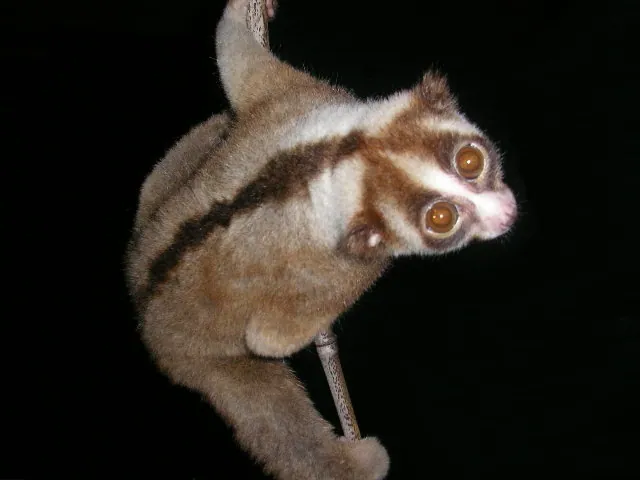
The Javan slow loris is a small, slow-moving primate that lives only on the western and central parts of the island of Java in Indonesia. It moves through the trees at night, creeping along vines and branches rather than leaping. It is critically endangered, mainly because it is captured for the pet trade.1
 How to recognise it
- A distinct white diamond pattern on the forehead, made by a stripe that runs over the head and forks towards the eyes and ears1
- Yellowish-grey body with cream-coloured head, neck and shoulders1
- Weighs between 565 and 687 g, with a head-body length of about 29 cm1
- Moves slowly through vines and lianas rather than jumping between trees, and is active at night1
Often confused with: It closely resembles the Bengal slow loris, which is similar in appearance, and the Sunda slow loris, which it was long considered a subspecies of. Rescue centres have sometimes misidentified it. It is larger than both the Sunda and Bornean slow lorises.1
Venom power
Venom comes out through its fangs or teeth when it bites.
What does its venom do?
Slow lorises have a venomous bite, which is very rare in mammals. They lick a gland on the inside of the elbow and mix the liquid with saliva. A bite causes painful swelling, and in rare cases a severe allergic reaction.1
How dangerous is it to people?
Danger to people: PainfulIt can really hurt, but it is almost never serious. If it bites
Call your emergency number at once if the person has trouble breathing, swelling of the face or throat, or feels faint.
- Wash the wound well and get medical help. If the person swells up, feels faint or has trouble breathing, it is an allergic emergency: call your emergency number.
This is general first aid guidance, not medical advice. Based on the first aid guidelines of the World Health Organization and the Australian Resuscitation Council. Facts come from public sources and may contain mistakes. When in doubt, always get medical help. First aid basics
 Stay safe
- Never touch, catch or tease a wild animal, even a small one, and even if it looks asleep or dead.
- Give it space. If you meet one, stay calm, step back slowly and let it go its own way.
- If it hurts you: wash the spot, stay calm and get medical help if the pain is strong or spreads, or the person feels unwell.
It is not out to get you. It uses its venom to catch food or to protect itself, and it would much rather hide. More about staying safe
Where in the world?
How big is it?
How long is it?
How heavy is it?

 as long as 3 bank cards end to end
 could cover 100 metres in 180 seconds (the fastest human needs 9.6)
How big is Javan slow loris compared to you?
Just maths in your browser. Nothing is saved or sent anywhere.
How fast is it?


Facts
Local farmers have helped maintain mid-air walkways that conservationists built so the lorises can cross between treetops in cleared farmland. These walkways also serve as irrigation pipes.1
Unlike most primates, it sleeps curled up on exposed branches rather than in nest holes.1
It is the largest of the slow lorises found in Indonesia.1
It can move on the ground to cross open spaces in disturbed habitat.1
Myth buster
Myth: It has magical and curative properties.
Truth: This is a myth. Even so, it is still sometimes used in traditional medicine in Indonesia, which adds to the pressure on the species.1
Where the facts come from
- Javan slow loris (Wikipedia (CC BY-SA 4.0))
- Nycticebus javanicus (iNaturalist): names and classification.
- Venom Wiki: the danger level, the typical size and the speed guess are our own. See how we work them out: How we rate danger.
Every fact on this page has a number that points to its source. If we got something wrong, sorry, we are animal fans, not a science journal. Tell us at [email protected] and we will fix it.
Get the Venom Wiki app
Every creature, every picture and the games in your pocket, even without internet.


 Support Venom Wiki Venom Wiki is a one-man project: free, with no ads and no cookies. A small tip helps keep it online.Feed the scorpion
 Bengal slow loris
 Pygmy slow loris
 Sunda slow loris
 Kayan River slow loris
 Philippine slow loris
 Eurasian water shrew
 Indian cobra
 Indian saw-scaled viper
 King cobra
 Puff adder
 Russell's viper
 Asian giant hornet