
 Bitten or stung?
 All animals
 Pick a continent
 Africa
 Asia
 Europe
 South America
 Australia & Oceania
 Antarctica
 Pacific Ocean
 Atlantic Ocean
 Indian Ocean
 Arctic Ocean
 Mediterranean Sea
 Red Sea
 Caribbean Sea
 Coral Sea
 South China Sea
 Philippine Sea
 Andaman Sea
 North Sea
 Timor & Arafura Sea
 Bay of Bengal
 Gulf of California
 Games
 Venom battle
 Animal race
 Field notebook
 Venom TOP lists
 Stay safe
 Surprise me

Green cat snake
 Bites
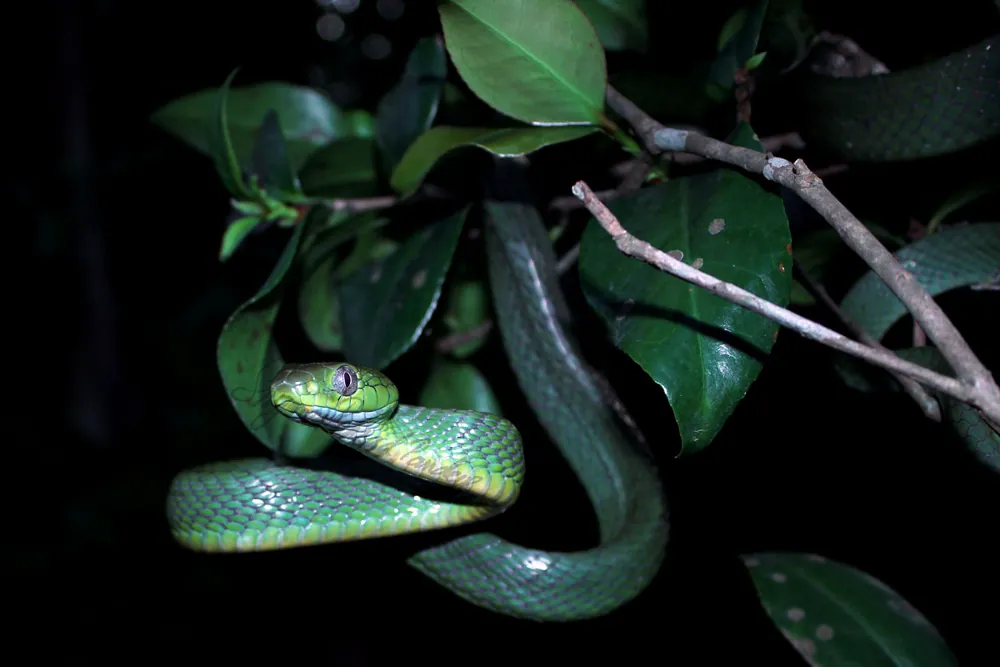
The green cat snake is a slim, bright green snake that lives mostly in trees. It is found in South Asia, China and South-east Asia, mainly in forests. It is a rear-fanged snake that is only mildly venomous to people.1
 How to recognise it
- Uniform green back, or green mixed with grey or blue1
- Greenish or yellowish white belly1
- Large eyes with vertical, cat-like pupils, and golden brown irises1
- Yellowish upper lip, with most head scales edged in black1
- Hatchlings are reddish brown with a green head, and begin to turn green at about 8 to 9 months old1
Venom power
Venom comes out through its fangs or teeth when it bites.
What does its venom do?
This is a rear-fanged snake, meaning its fangs are at the back of the mouth, and it is described as mildly venomous. Its venom can paralyse small prey. Bites are expected to cause only mild to moderate local swelling and pain, with occasional bruising, numbness, redness or bleeding, but no tissue death (necrosis) and no whole-body (systemic) effects.1
How dangerous is it to people?
Danger to people: PainfulIt can really hurt, but it is almost never serious.Bites are not expected to cause medically significant effects. Most cases are minor, but some are more severe and need hospital admission and treatment.1
What does it do when it is scared?
Usually sluggish and hard to provoke into striking, it may become hostile when threatened and display with its mouth wide open.1
 If it bites
Call your emergency number at once if the person has trouble breathing, swelling of the face or throat, or feels faint.
- Keep calm, wash the bite with soap and water and keep the bitten limb still. See a doctor if the swelling spreads, if there is bruising or bleeding, or if the bite becomes red and sore. Make sure tetanus protection is up to date.1
- Wash the bite, keep the person calm and get medical help. Some species (like the boomslang) can be deadly hours later.
This is general first aid guidance, not medical advice. Based on the first aid guidelines of the World Health Organization and the Australian Resuscitation Council. Facts come from public sources and may contain mistakes. When in doubt, always get medical help. First aid basics
 Stay safe
- Never touch, catch or tease a wild animal, even a small one, and even if it looks asleep or dead.
- Give it space. If you meet one, stay calm, step back slowly and let it go its own way.
- If it hurts you: wash the spot, stay calm and get medical help if the pain is strong or spreads, or the person feels unwell.
It is not out to get you. It uses its venom to catch food or to protect itself, and it would much rather hide. More about staying safe
Where in the world?
How big is it?
How long is it?
 as long as 4 house cats nose to tail
 as long as 11 bananas end to end
 could cover 100 metres in 60 seconds (the fastest human needs 9.6)
How big is Green cat snake compared to you?
Just maths in your browser. Nothing is saved or sent anywhere.
How fast is it?


Facts
It is one of the rear-fanged snakes, and its venom is used to paralyse small prey.1
Its long, grasping tail helps it live almost entirely in trees.1
Despite its size, it is sluggish and makes no attempt to escape when handled.1
Hatchlings look very different from adults, being reddish brown with a green head.1
It hunts at night and rests during the day, coiled among the branches.1
A female lays between 7 and 14 eggs, which take about 85 days to hatch.1
Where the facts come from
- Boiga cyanea (Wikipedia (CC BY-SA 4.0))
- Boiga cyanea (iNaturalist): names and classification.
- Venom Wiki: the danger level, the typical size and the speed guess are our own. See how we work them out: How we rate danger.
Every fact on this page has a number that points to its source. If we got something wrong, sorry, we are animal fans, not a science journal. Tell us at [email protected] and we will fix it.
Get the Venom Wiki app
Every creature, every picture and the games in your pocket, even without internet.


 Support Venom Wiki Venom Wiki is a one-man project: free, with no ads and no cookies. A small tip helps keep it online.Feed the scorpion
 Brown tree snake
 Tiger keelback
 Red-necked keelback
 Mangrove snake
 Asian vine snake
 Golden tree snake
 Indian cobra
 Indian saw-scaled viper
 King cobra
 Puff adder
 Russell's viper
 Asian giant hornet
