
 Bitten or stung?
 All animals
 Pick a continent
 Africa
 Asia
 Europe
 South America
 Australia & Oceania
 Antarctica
 Pacific Ocean
 Atlantic Ocean
 Indian Ocean
 Arctic Ocean
 Mediterranean Sea
 Red Sea
 Caribbean Sea
 Coral Sea
 South China Sea
 Philippine Sea
 Andaman Sea
 North Sea
 Timor & Arafura Sea
 Bay of Bengal
 Gulf of California
 Games
 Venom battle
 Animal race
 Field notebook
 Venom TOP lists
 Stay safe
 Surprise me

Green weaver ant
 Bites
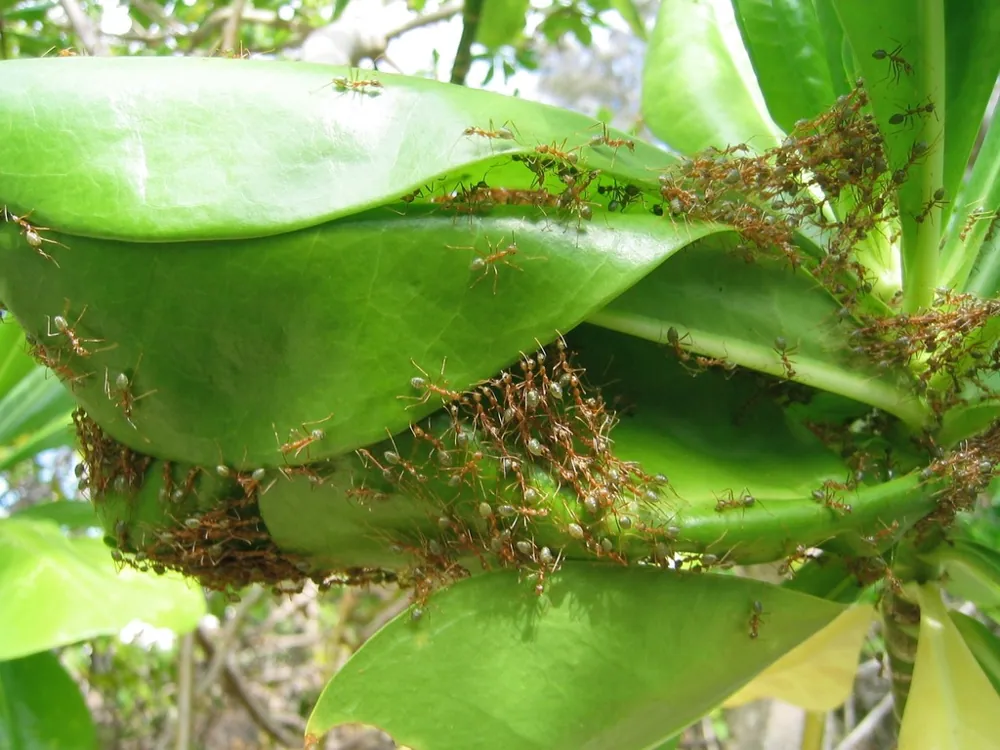
The green weaver ant is a tree-dwelling ant that builds its nests by stitching leaves together with silk. It lives in the warm, wet forests of tropical Asia and northern Australia. It has a painful bite and can spray irritant chemicals, so it is best watched from a distance.1
 How to recognise it
Venom power
Venom comes out through its fangs or teeth when it bites.
What does its venom do?
The ant does not sting. Its bite is painful, and it can also secrete irritant chemicals from its abdomen.1
How dangerous is it to people?
Danger to people: MildLike a bee sting or less. Basically harmless to people, unless the person is allergic.The ants are aggressive towards people. In Sri Lanka, protecting coffee crops with these ants was abandoned because picking the crop proved too painful.1
What does it do when it is scared?
When threatened, workers gather in local clusters against intruders, and if the threat continues, the colony mobilises in larger numbers.1
 If it bites
Call your emergency number at once if the person has trouble breathing, swelling of the face or throat, or feels faint.
- Wash and cool the stings.
- If the person has trouble breathing, swelling of the face or throat, or feels faint, it is an allergic emergency: call your emergency number.
This is general first aid guidance, not medical advice. Based on the first aid guidelines of the World Health Organization and the Australian Resuscitation Council. Facts come from public sources and may contain mistakes. When in doubt, always get medical help. First aid basics
 Stay safe
- Never touch, catch or tease a wild animal, even a small one, and even if it looks asleep or dead.
- Give it space. If you meet one, stay calm, step back slowly and let it go its own way.
- If it hurts you: wash the spot, stay calm and get medical help if the pain is strong or spreads, or the person feels unwell.
It is not out to get you. It uses its venom to catch food or to protect itself, and it would much rather hide. More about staying safe
Where in the world?
How big is it?
How long is it?
 about as long as a paper clip
How big is Green weaver ant compared to you?
Just maths in your browser. Nothing is saved or sent anywhere.
How fast is it?


Facts
Weaver ants build leaf nests by teamwork. Workers pull leaf edges together, and others use larvae like living shuttles to make silk that binds the leaves.1
A single colony can reach up to half a million individuals, and one colony was recorded occupying 151 nests across 12 trees.1
Some jumping spiders mimic these ants with chemical scents to enter their nests and eat the larvae.1
In Thailand and the Philippines, the larvae and pupae are eaten, and are said to taste creamy, sour and lemony.1
The oldest written record of using these ants for pest control is from China in 304 CE, where they protected citrus.1
In Java, Indonesia, the larvae and pupae, called kroto, are harvested as food for songbirds and as fishing bait.1
Myth buster
Myth: Green weaver ants sting like bees or wasps.
Truth: They do not sting. Their bite can be painful, and they can spray irritant chemicals from the abdomen.1
Where the facts come from
- Oecophylla smaragdina (Wikipedia (CC BY-SA 4.0))
- Oecophylla smaragdina (iNaturalist): names and classification.
- Venom Wiki: the danger level, the typical size and the speed guess are our own. See how we work them out: How we rate danger.
Every fact on this page has a number that points to its source. If we got something wrong, sorry, we are animal fans, not a science journal. Tell us at [email protected] and we will fix it.
Get the Venom Wiki app
Every creature, every picture and the games in your pocket, even without internet.


 Support Venom Wiki Venom Wiki is a one-man project: free, with no ads and no cookies. A small tip helps keep it online.Feed the scorpion
 Jack jumper ant
 Bulldog ant
 Red wood ant
 Arboreal bicoloured ant
 Asian needle ant
 Black-banded jumper ant
 Indian cobra
 Indian saw-scaled viper
 King cobra
 Puff adder
 Russell's viper
 Asian giant hornet