
 Bitten or stung?
 All animals
 Pick a continent
 Africa
 Asia
 Europe
 South America
 Australia & Oceania
 Antarctica
 Pacific Ocean
 Atlantic Ocean
 Indian Ocean
 Arctic Ocean
 Mediterranean Sea
 Red Sea
 Caribbean Sea
 Coral Sea
 South China Sea
 Philippine Sea
 Andaman Sea
 North Sea
 Timor & Arafura Sea
 Bay of Bengal
 Gulf of California
 Games
 Venom battle
 Animal race
 Field notebook
 Venom TOP lists
 Stay safe
 Surprise me

House centipede
 Bites
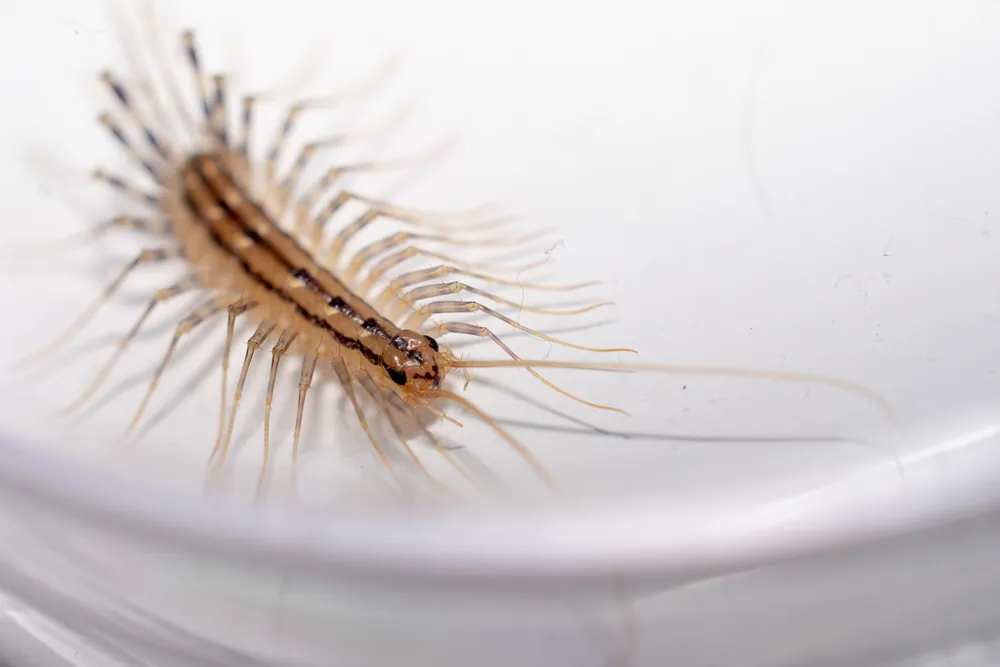
The house centipede is a long-legged, yellowish-grey centipede that often shares homes with people. It comes from the Mediterranean region and has spread across much of the world. It is fast, has very long legs, and eats household pests, so it is useful to have around.1
 How to recognise it
- Typically yellowish-grey, with three dark stripes running down the length of its body.1
- Up to 15 pairs of long legs, which also have dark stripes.1
- Body is typically 25 to 35 mm long. With its legs and antennae, it looks about 75 to 100 mm long.1
- Runs very quickly across floors, up walls and along ceilings, and can stop suddenly and stay still.1
- Has well-developed eyes, unlike most other centipedes.1
Venom power
Venom goes in through two fang-like front legs under the head, not through teeth.
What does its venom do?
It has a mild venom, which it injects through small claw-like structures called forcipules. Its venom is used mainly to subdue prey. In a bite on a person, the effect is limited to mild pain and swelling in the local area, similar to a bee sting.1
How dangerous is it to people?
Danger to people: MildLike a bee sting or less. Basically harmless to people, unless the person is allergic.House centipedes pose essentially no threat to people. They are not aggressive and usually flee when disturbed. Bites are rare and usually happen only when the centipede is cornered or handled roughly. Their forcipules have difficulty penetrating human skin. Allergic reactions have been reported but are rare, and nearly all successful bites heal quickly without complications.1
What does it do when it is scared?
When disturbed, it usually runs away quickly, and it can detach any legs that have become trapped.1
 If it bites
Call your emergency number at once if the person has trouble breathing, swelling of the face or throat, or feels faint.
- Wash the bite, cool it or soak it in warm water for the pain, and get medical help if it gets worse.
This is general first aid guidance, not medical advice. Based on the first aid guidelines of the World Health Organization and the Australian Resuscitation Council. Facts come from public sources and may contain mistakes. When in doubt, always get medical help. First aid basics
 Stay safe
- Never touch, catch or tease a wild animal, even a small one, and even if it looks asleep or dead.
- Give it space. If you meet one, stay calm, step back slowly and let it go its own way.
- If it hurts you: wash the spot, stay calm and get medical help if the pain is strong or spreads, or the person feels unwell.
It is not out to get you. It uses its venom to catch food or to protect itself, and it would much rather hide. More about staying safe
Where in the world?
How big is it?
How long is it?
 about as long as a paper clip
 could cover 100 metres in 260 seconds (the fastest human needs 9.6)
How big is House centipede compared to you?
Just maths in your browser. Nothing is saved or sent anywhere.
How fast is it?


Facts
It can detach its own legs if they become trapped, which helps it escape danger.1
It can tell harmful prey from safe prey, and it changes how it feeds depending on the danger. With wasps, it retreats after biting to let the venom take effect.1
Its tail-like hind legs look like antennae, so when it is at rest it is hard to tell its head end from its tail end.1
Unlike most centipedes, it has well-developed faceted eyes, although it hunts mostly by smell and touch through its antennae.1
Its blood contains proteins that carry oxygen, which is unusual among centipedes.1
It can live its whole life inside a building, usually on the ground floor of homes.1
Myth buster
Myth: House centipedes are dangerous and likely to attack people.
Truth: They are not aggressive and usually run away. Their bites are rare and cause only mild, local pain and swelling.1
For venom experts
- Scientific name
- Scutigera coleoptrata
- Group
- Centipedes
- Family
- Scutigeridae2
- Order
- Scutigeromorpha
- Continents
- Europe, Asia, Africa
- Babies
- They lay eggs in spring. In a laboratory study of 24 females, the average was 63 eggs and the maximum was 151. The young hatch with four pairs of legs and gain more with each moult until they reach 15 pairs.1
- Lifespan
- about 7 years1
- Danger to people
- 1 / 5: Mild3
Where the facts come from
- Scutigera coleoptrata (Wikipedia (CC BY-SA 4.0))
- Scutigera coleoptrata (iNaturalist): names and classification.
- Venom Wiki: the danger level, the typical size and the speed guess are our own. See how we work them out: How we rate danger.
Every fact on this page has a number that points to its source. If we got something wrong, sorry, we are animal fans, not a science journal. Tell us at [email protected] and we will fix it.
Get the Venom Wiki app
Every creature, every picture and the games in your pocket, even without internet.


 Support Venom Wiki Venom Wiki is a one-man project: free, with no ads and no cookies. A small tip helps keep it online.Feed the scorpion
 Chinese red-headed centipede
 Giant Australian centipede
 Mediterranean banded centipede
 Vietnamese giant centipede
 African blue-ring centipede
 Indian tiger centipede
 Common European adder
 Spanish fly
 Common wasp
 European hornet
 Fire salamander
 Western honey bee