
 Bitten or stung?
 All animals
 Pick a continent
 Africa
 Asia
 Europe
 South America
 Australia & Oceania
 Antarctica
 Pacific Ocean
 Atlantic Ocean
 Indian Ocean
 Arctic Ocean
 Mediterranean Sea
 Red Sea
 Caribbean Sea
 Coral Sea
 South China Sea
 Philippine Sea
 Andaman Sea
 North Sea
 Timor & Arafura Sea
 Bay of Bengal
 Gulf of California
 Games
 Venom battle
 Animal race
 Field notebook
 Venom TOP lists
 Stay safe
 Surprise me

Mediterranean recluse
 Bites
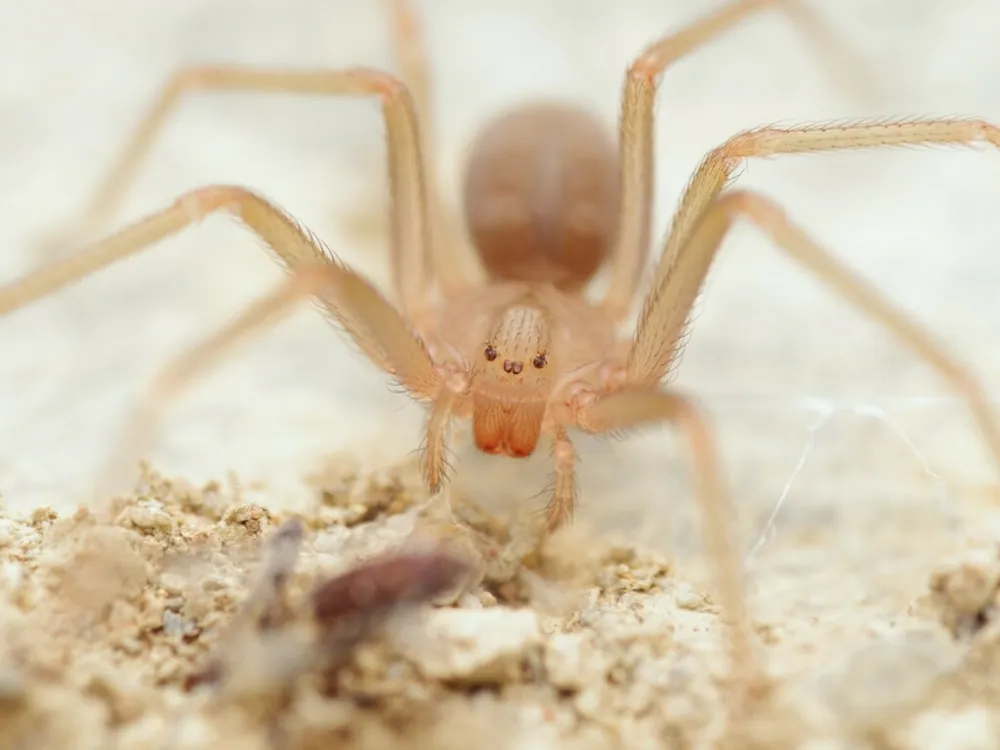
The Mediterranean recluse spider is a small spider that comes from the Mediterranean region. It has spread to many parts of the world through human travel and trade, and it is listed as one of the most invasive spiders in the world. Its bite can cause skin damage, so it is worth knowing what it looks like.1
 How to recognise it
- A medium-sized spider with three pairs of two eyes arranged in a triangle, instead of the usual eight eyes1
- A violin-shaped pattern on the front part of the body (cephalothorax)1
- Adults of both sexes grow to about 7 to 7.5 mm long1
- Its web is very thin and fragile, made of silk strands laid in a disorganised way1
Often confused with: It is nearly indistinguishable in appearance from the brown recluse spider (Loxosceles reclusa). Pest control for one can often be adapted for the other.1
Venom power
Venom comes out through its fangs or teeth when it bites.
What does its venom do?
Its venom contains an enzyme called sphingomyelinase D, which causes necrosis, meaning the death of skin and other tissue around the bite. Most cases are medically insignificant. In some cases, penetrating pain starts 2 to 8 hours after the bite, followed by burning, and the area becomes red and painful. A blister may form that turns dark blue with a sunken centre over several days. In rare cases, the blood and kidneys can be damaged, which can lead to kidney failure.1
How dangerous is it to people?
Danger to people: SeriousA bite needs a doctor. Deaths are very rare.Most bites are medically insignificant, but some people are affected much more seriously. In 2024, the species was blamed for the deaths of two people in Italy.1
 If it bites
Always call your emergency number first (for example 112 in Europe, 911 in North America, 000 in Australia).
- Wash the bite with soap and water and put a cold pack on it. Keep the bitten part still and raised. See a doctor if pain grows, a blister or dark patch forms, or the person gets a fever or dark urine.1
- Wash the bite and put an ice pack on it for the pain. Get medical help if the pain is strong, spreads or the person feels unwell.
This is general first aid guidance, not medical advice. Based on the first aid guidelines of the World Health Organization and the Australian Resuscitation Council. Facts come from public sources and may contain mistakes. When in doubt, always get medical help. First aid basics
 Stay safe
- Never touch, catch or tease a wild animal, even a small one, and even if it looks asleep or dead.
- Give it space. If you meet one, stay calm, step back slowly and let it go its own way.
- If one bites you: stay calm, keep still, call your emergency number (for example 112 in Europe, 911 in North America, 000 in Australia) or get to a hospital fast. Remember what it looked like, a photo helps.
It is not out to get you. It uses its venom to catch food or to protect itself, and it would much rather hide. More about staying safe
Where in the world?
How big is it?
How long is it?
 smaller than a fingernail
How big is Mediterranean recluse compared to you?
Just maths in your browser. Nothing is saved or sent anywhere.
How fast is it?


Facts
It is listed as one of the most invasive spiders in the world.1
It can survive for long periods without food and water, which makes it hard to control in homes.1
Young spiders shed their skins several times as they grow, and these skins often look pale and ghostly.1
Males hunt more actively than females, partly because they are also searching for a mate.1
For venom experts
- Scientific name
- Loxosceles rufescens
- Group
- Spiders
- Also called
- Mediterranean recluse spider1
- Family
- Sicariidae2
- Order
- Araneae
- Continents
- Europe, Asia, Africa
- Babies
- Egg sacs contain about 40 eggs, which take a few weeks to hatch, depending on the temperature.1
- How it is doing in the wild
- Least Concern (South African National Biodiversity Institute)1
- Danger to people
- 3 / 5: Serious3
Where the facts come from
- Mediterranean recluse spider (Wikipedia (CC BY-SA 4.0))
- Loxosceles rufescens (iNaturalist): names and classification.
- Venom Wiki: the danger level, the typical size and the speed guess are our own. See how we work them out: How we rate danger.
Every fact on this page has a number that points to its source. If we got something wrong, sorry, we are animal fans, not a science journal. Tell us at [email protected] and we will fix it.
Get the Venom Wiki app
Every creature, every picture and the games in your pocket, even without internet.


 Support Venom Wiki Venom Wiki is a one-man project: free, with no ads and no cookies. A small tip helps keep it online.Feed the scorpion
 Redback spider
 Mediterranean black widow
 Six-eyed sand spider
 Brown widow
 Diving bell spider
 European yellow sac spider
 Common European adder
 Spanish fly
 Common wasp
 European hornet
 Fire salamander
 Western honey bee