
 Bitten or stung?
 All animals
 Pick a continent
 Africa
 Asia
 Europe
 South America
 Australia & Oceania
 Antarctica
 Pacific Ocean
 Atlantic Ocean
 Indian Ocean
 Arctic Ocean
 Mediterranean Sea
 Red Sea
 Caribbean Sea
 Coral Sea
 South China Sea
 Philippine Sea
 Andaman Sea
 North Sea
 Timor & Arafura Sea
 Bay of Bengal
 Gulf of California
 Games
 Venom battle
 Animal race
 Field notebook
 Venom TOP lists
 Stay safe
 Surprise me

Panamanian golden frog
 Poison in its skin
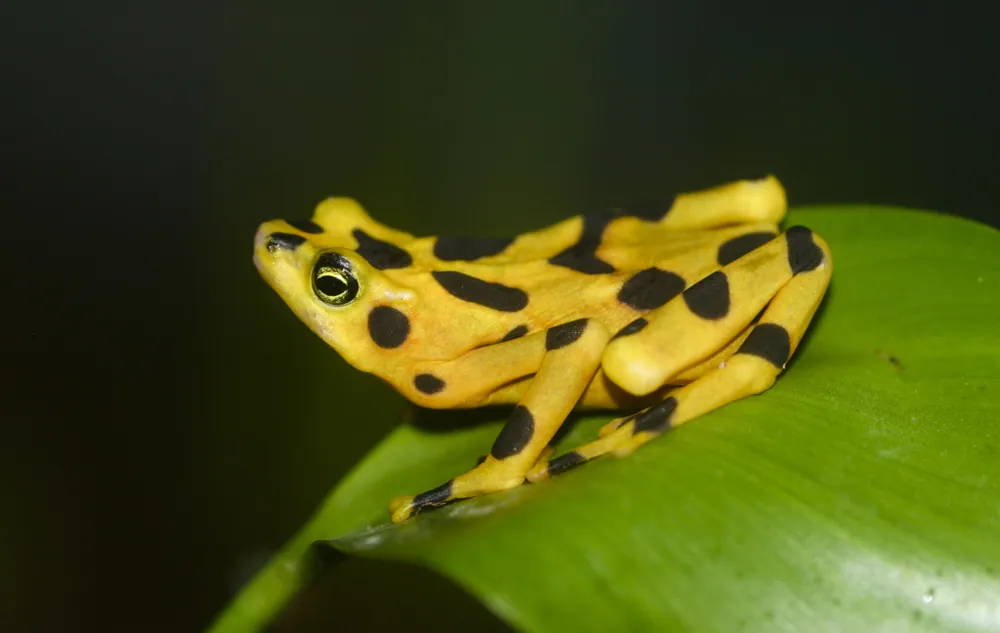
The Panamanian golden frog is a bright yellow-gold toad that lives only in Panama. It lives along mountain streams in the cloud forests of the west-central part of the country. It is a national symbol, and it is also one of the most endangered amphibians in the world.1
 How to recognise it
Poison power
Its skin is poisonous. It is dangerous to touch, lick or eat.
What does its poison do?
It is poisonous rather than venomous, because its toxins work on contact with the skin and are not injected. The toxin is water-soluble and affects the nerve cells of anyone who touches it. In tests on mice, large doses killed within 20 to 30 minutes, after convulsions that stopped breathing and blood circulation.1
How dangerous is it to people?
Danger to people: SeriousIf someone touches or eats it, see a doctor. Deaths are very rare.Its toxin affects the nerve cells of anyone who comes into contact with it, and large doses can be fatal. Because it is critically endangered, the frog should be left alone in the wild.1
What does it do when it is scared?
When a predator approaches, it waves and lifts its foot to show its bright colours, which warn of its toxicity. If the predator keeps coming, the waving and calls increase in speed and volume.1
 If someone touched or ate it
Always call your emergency number first (for example 112 in Europe, 911 in North America, 000 in Australia).
- Wash your hands well after any contact and do not touch your eyes or mouth. If the skin poison gets into the mouth, eyes or a cut, rinse with lots of clean water and call the emergency number or poison centre.1
- If someone touched one: wash the hands well and do not touch the eyes or mouth. If a child or pet licked or ate one: call your poison centre or emergency number.
This is general first aid guidance, not medical advice. Based on the first aid guidelines of the World Health Organization and the Australian Resuscitation Council. Facts come from public sources and may contain mistakes. When in doubt, always get medical help. First aid basics
 Stay safe
- Never touch, catch or tease a wild animal, even a small one, and even if it looks asleep or dead.
- Give it space. If you meet one, stay calm, step back slowly and let it go its own way.
- If you touched or ate it: do not rub your eyes or mouth, wash your hands and get medical help.
It is not out to get you. Its poison is only there so that nothing eats it. More about staying safe
Where in the world?
How big is it?
How long is it?
How heavy is it?

 about as long as a bank card
 so light you would not feel it on your hand
 could cover 100 metres in 90 seconds (the fastest human needs 9.6)
How big is Panamanian golden frog compared to you?
Just maths in your browser. Nothing is saved or sent anywhere.
How fast is it?


Facts
It is able to communicate by waving its feet, a bit like semaphore, as well as by sound.1
It is an 'earless' frog with no eardrums, yet it can still hear sounds and work out where they come from.1
Its toxins are powerful enough that some predators avoid it, though a few snakes can cope with its poison.1
Tadpoles have black and gold colouring, which helps protect them from the sun.1
It was filmed in the wild for the last time in 2006 for the BBC series Life in Cold Blood.1
Myth buster
Myth: It is a poison dart frog.
Truth: Despite names like 'golden arrow poison frog', it is not a poison dart frog. It is a true toad, a member of the family Bufonidae.1
For venom experts
- Scientific name
- Atelopus zeteki
- Group
- Poison frogs, toads & newts
- Also called
- Panamanian golden toad, Zetek's golden frog, Cerro Campana stubfoot toad1
- Family
- Bufonidae2
- Order
- Anura
- Continents
- North America
- Babies
- Eggs are laid in shallow streams and hatch after 2 to 10 days. The tadpoles then take 6 to 7 months to grow.1
- Lifespan
- about 12 years1
- How it is doing in the wild
- Critically Endangered (IUCN). It may have been extinct in the wild since 2007.1
- Danger to people
- 3 / 5: Serious3
Where the facts come from
- Panamanian golden frog (Wikipedia (CC BY-SA 4.0))
- Atelopus zeteki (iNaturalist): names and classification.
- Venom Wiki: the danger level, the typical size and the speed guess are our own. See how we work them out: How we rate danger.
Every fact on this page has a number that points to its source. If we got something wrong, sorry, we are animal fans, not a science journal. Tell us at [email protected] and we will fix it.
Get the Venom Wiki app
Every creature, every picture and the games in your pocket, even without internet.


 Support Venom Wiki Venom Wiki is a one-man project: free, with no ads and no cookies. A small tip helps keep it online.Feed the scorpion
More from the same group: Poison frogs, toads & newts
 Cane toadPoison frogs, toads & newtsNeeds a doctorDo not touch
 Strawberry poison-dart frogPoison frogs, toads & newtsPainfulDo not touch
 California newtPoison frogs, toads & newtsCan killDo not touch
 Rough-skinned newtPoison frogs, toads & newtsCan killDo not touch
 Colorado River toadPoison frogs, toads & newtsNeeds a doctorDo not touch
 Green and black poison dart frogPoison frogs, toads & newtsPainfulDo not touch
 Terciopelo
 Eastern coral snake
 Eastern diamondback rattlesnake
 Timber rattlesnake
 Western diamondback rattlesnake
 Arizona bark scorpion