
 Bitten or stung?
 All animals
 Pick a continent
 Africa
 Asia
 Europe
 South America
 Australia & Oceania
 Antarctica
 Pacific Ocean
 Atlantic Ocean
 Indian Ocean
 Arctic Ocean
 Mediterranean Sea
 Red Sea
 Caribbean Sea
 Coral Sea
 South China Sea
 Philippine Sea
 Andaman Sea
 North Sea
 Timor & Arafura Sea
 Bay of Bengal
 Gulf of California
 Games
 Venom battle
 Animal race
 Field notebook
 Venom TOP lists
 Stay safe
 Surprise me

Wasp spider
 Bites
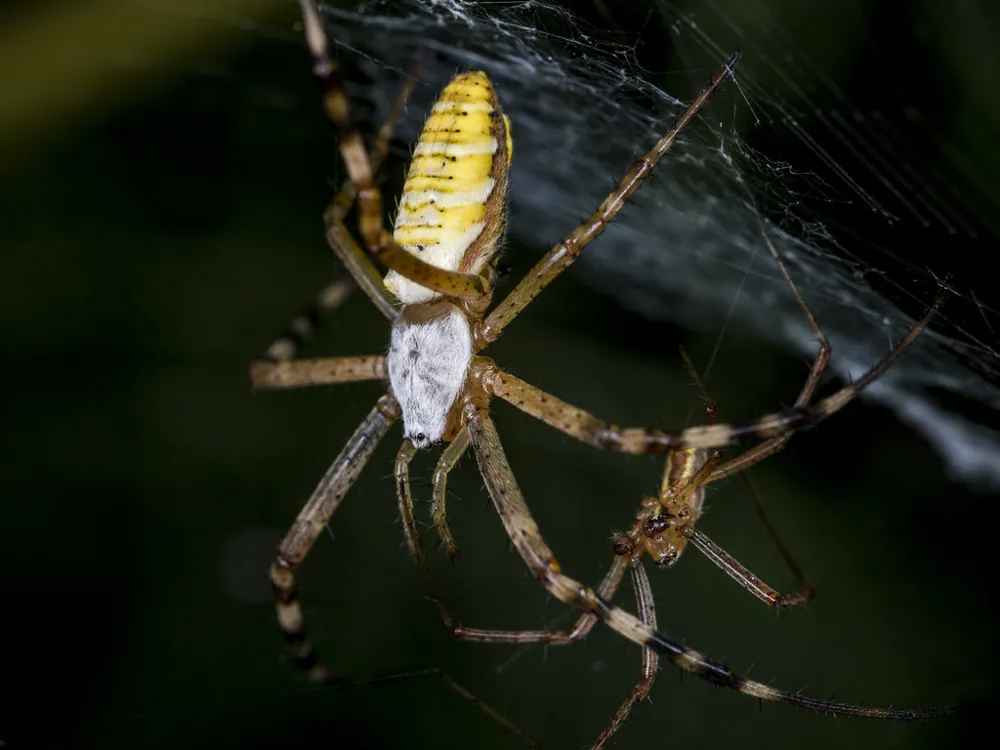
The wasp spider is an orb-weaver spider with bold yellow, white and black stripes on its abdomen, which look a bit like a wasp. It lives across Central and Northern Europe, parts of Asia and Africa, and the Azores. Its unusual mating habits make it one of the most studied spiders of its kind.1
 How to recognise it
Venom power
Venom comes out through its fangs or teeth when it bites.
What does its venom do?
The spider injects its prey with a paralysing venom, which stops the prey from moving, and a protein-dissolving enzyme, which breaks down the prey's body tissues.1
How dangerous is it to people?
Danger to people: MildLike a bee sting or less. Basically harmless to people, unless the person is allergic. If it bites
Call your emergency number at once if the person has trouble breathing, swelling of the face or throat, or feels faint.
- Wash the bite and put an ice pack on it for the pain. Get medical help if the pain is strong, spreads or the person feels unwell.
This is general first aid guidance, not medical advice. Based on the first aid guidelines of the World Health Organization and the Australian Resuscitation Council. Facts come from public sources and may contain mistakes. When in doubt, always get medical help. First aid basics
 Stay safe
- Never touch, catch or tease a wild animal, even a small one, and even if it looks asleep or dead.
- Give it space. If you meet one, stay calm, step back slowly and let it go its own way.
- If it hurts you: wash the spot, stay calm and get medical help if the pain is strong or spreads, or the person feels unwell.
It is not out to get you. It uses its venom to catch food or to protect itself, and it would much rather hide. More about staying safe
Where in the world?
How big is it?
How long is it?
 about as long as a paper clip
How big is Wasp spider compared to you?
Just maths in your browser. Nothing is saved or sent anywhere.
How fast is it?


Facts
Females often eat the males after mating, a behaviour called sexual cannibalism. Males improve their chances by waiting near an immature female's web until she moults into adulthood, when her jaws are still soft. In one study, this raised male survival from 20% to 97%.1
Some males block other males from mating with the same female by breaking off part of a pedipalp inside her. Because a male has only two pedipalps, he can mate at most twice.1
Males are small enough to enter a female's web without being detected, which helps them mate.1
Webs with a stabilimentum are damaged less often by birds flying through them, although its exact purpose is not known.1
In summer 2006, researchers found an influx of wasp spiders in the UK. The yellow stripes on this population are more cream-coloured.1
Where the facts come from
- Argiope bruennichi (Wikipedia (CC BY-SA 4.0))
- Argiope bruennichi (iNaturalist): names and classification.
- Venom Wiki: the danger level, the typical size and the speed guess are our own. See how we work them out: How we rate danger.
Every fact on this page has a number that points to its source. If we got something wrong, sorry, we are animal fans, not a science journal. Tell us at [email protected] and we will fix it.
Get the Venom Wiki app
Every creature, every picture and the games in your pocket, even without internet.


 Support Venom Wiki Venom Wiki is a one-man project: free, with no ads and no cookies. A small tip helps keep it online.Feed the scorpion
 Redback spider
 Mediterranean black widow
 Six-eyed sand spider
 Brown widow
 Diving bell spider
 European yellow sac spider
 Common European adder
 Spanish fly
 Common wasp
 European hornet
 Fire salamander
 Western honey bee