
 Bitten or stung?
 All animals
 Pick a continent
 Africa
 Asia
 Europe
 South America
 Australia & Oceania
 Antarctica
 Pacific Ocean
 Atlantic Ocean
 Indian Ocean
 Arctic Ocean
 Mediterranean Sea
 Red Sea
 Caribbean Sea
 Coral Sea
 South China Sea
 Philippine Sea
 Andaman Sea
 North Sea
 Timor & Arafura Sea
 Bay of Bengal
 Gulf of California
 Games
 Venom battle
 Animal race
 Field notebook
 Venom TOP lists
 Stay safe
 Surprise me

Western hognose snake
 Bites
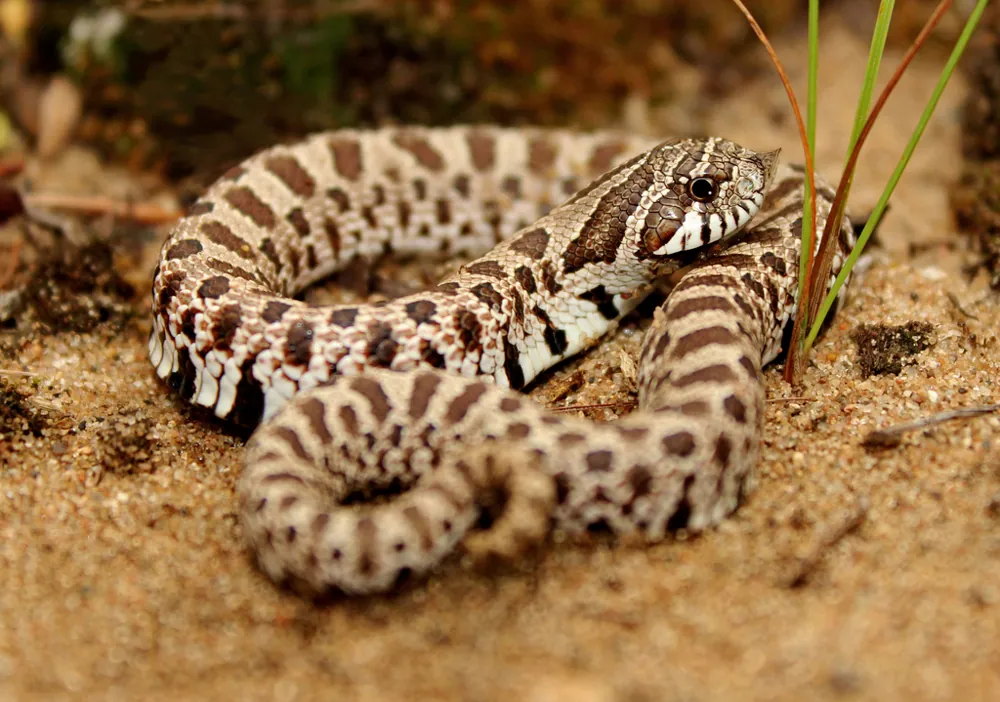
The western hognose snake is a small, stout-bodied snake with an upturned nose that looks a bit like a pig's snout. It lives across much of North America, from southern Canada to northern Mexico, in sandy and gravelly places such as prairies and grasslands. It is often mistaken for a rattlesnake, but its bite is not regarded as dangerous to people.1
 How to recognise it
- Relatively small and stout-bodied, with adults rarely exceeding 40 to 50 cm in total length, tail included.1
- A modified, upturned nose scale gives it a distinctive hog-like snout.1
- Colour and pattern vary a great deal between subspecies and individuals.1
- When threatened, it flattens its neck, hisses and may puff up its throat with air.1
Often confused with: To an untrained eye, most individuals look much like rattlesnakes, which is thought to be a form of mimicry that makes predators wary. Its upturned snout and small, stout body are features to note.1
Venom power
Venom comes out through its fangs or teeth when it bites.
What does its venom do?
The snake releases modified saliva from its Duvernoy's glands, which runs down a groove in its rear fang and helps break down the toxins of toads it eats. No deaths or whole-body (systemic) effects in people have been recorded from its bite. Bites may occasionally be medically significant.1
How dangerous is it to people?
Danger to people: MildLike a bee sting or less. Basically harmless to people, unless the person is allergic.The species is not dangerous to people and is not regarded as venomous. Its bites are extremely rare, and no deaths or systemic effects have been recorded. Bites may uncommonly be medically significant.1
What does it do when it is scared?
It flattens its neck, hisses and may make mock strikes with its mouth closed. If harassed further, it usually plays dead rather than biting.1
 If it bites
Call your emergency number at once if the person has trouble breathing, swelling of the face or throat, or feels faint.
- Wash the bite, keep the person calm and get medical help. Some species (like the boomslang) can be deadly hours later.
This is general first aid guidance, not medical advice. Based on the first aid guidelines of the World Health Organization and the Australian Resuscitation Council. Facts come from public sources and may contain mistakes. When in doubt, always get medical help. First aid basics
 Stay safe
- Never touch, catch or tease a wild animal, even a small one, and even if it looks asleep or dead.
- Give it space. If you meet one, stay calm, step back slowly and let it go its own way.
- If it hurts you: wash the spot, stay calm and get medical help if the pain is strong or spreads, or the person feels unwell.
It is not out to get you. It uses its venom to catch food or to protect itself, and it would much rather hide. More about staying safe
Where in the world?
How big is it?
How long is it?
 as long as 3 bananas end to end
 as long as 6 bank cards end to end
 could cover 100 metres in 77 seconds (the fastest human needs 9.6)
How big is Western hognose snake compared to you?
Just maths in your browser. Nothing is saved or sent anywhere.
How fast is it?


Facts
Captive breeders have produced more than 50 'designer' colour morphs of this snake.1
In captivity, many hognose snakes refuse food for about two to three and a half months, from January to mid March, because they instinctively brumate, or sleep, underground in winter.1
Males are considerably smaller than females.1
Hatchlings reach sexual maturity after about two years, based mostly on size rather than age.1
Myth buster
Myth: Because it looks like a rattlesnake, it must be dangerous or deadly.
Truth: The western hognose snake is not dangerous to people. Its rare bites have not caused recorded deaths or whole-body effects, and it usually plays dead instead of biting.1
For venom experts
- Scientific name
- Heterodon nasicus
- Group
- Rear-fanged snakes
- Also called
- Plains hognose snake, Prairie hognose snake, Spoonbill snake1
- Family
- Colubridae2
- Order
- Squamata
- Continents
- North America
- Babies
- It lays eggs. Females lay 4 to 23 elongate, thin-shelled eggs between June and August, which hatch after about 60 days.1
- How it is doing in the wild
- Least Concern (IUCN)1
- Danger to people
- 1 / 5: Mild3
Where the facts come from
- Western hognose snake (Wikipedia (CC BY-SA 4.0))
- Heterodon nasicus (iNaturalist): names and classification.
- Venom Wiki: the danger level, the typical size and the speed guess are our own. See how we work them out: How we rate danger.
Every fact on this page has a number that points to its source. If we got something wrong, sorry, we are animal fans, not a science journal. Tell us at [email protected] and we will fix it.
Get the Venom Wiki app
Every creature, every picture and the games in your pocket, even without internet.


 Support Venom Wiki Venom Wiki is a one-man project: free, with no ads and no cookies. A small tip helps keep it online.Feed the scorpion
 Brown vine snake
 Eastern hognose snake
 Green vine snake
 Desert night snake
 Night snake
 Sonoran lyre snake
 Terciopelo
 Eastern coral snake
 Eastern diamondback rattlesnake
 Timber rattlesnake
 Western diamondback rattlesnake
 Arizona bark scorpion